Unlock precision risk management

On 30 September 2025, the International Energy Agency held its "High-Level Roundtable on Energy Infrastructure Resilience" in Paris. Risk Management Partners, a unit of Munich Re, was invited to participate in the discussion. In this article, we share our learnings and contributions from the conference.
One of the key findings was that spatial intelligence is becoming the foundation of a climate-resilient energy infrastructure. Delegates called for "no-regrets" measures, starting with better planning, more accurate monitoring and greater investment in resiliency measures such as thicker glass panels for solar PV in hail-exposed areas, pointing out that every facility and location have their unique risk signature.
The electricity grid appears to be particularly vulnerable, as disruptions in an electrified, digital economy can have immediate and costly effects.
Key concept: spatial intelligence
The disciplined use of high-resolution, location-specific data and models to understand, measure and manage physical climate risks at the asset, corridor and portfolio levels – linking hazards, exposure, vulnerability and risk mitigation to operational and financial decisions.
The risk picture that planning must address
Climate change is reshaping loss patterns. According to Munich Re’s NatCatSERVICE year‑end assessment, 2024 natural disasters caused $320 bn in total economic losses, and $140 bn in insured losses. That’s the third‑costliest year on record for insured losses and well above historical averages.
So-called non-peak perils dominated the loss picture. Medium-sized, high-frequency perils (also called non-peak or secondary perils), in particular hailstorms, floods and wildfires, now cause a large proportion of insured and uninsured damages. These risks often require higher quality and more granular spatial modelling than primary perils such as tropical cyclones.
Managers are concerned, but prevention and insurance policies often only follow after a loss event. While there is no shortage of insurance capacity, attaining full coverage for individual risks in highly exposed areas (e.g. coverage for hail damages for solar PV in highly exposed areas) can be costly or impossible.
Precision is therefore fast becoming key to insurance coverage remaining accessible and affordable, as well as to making the right decisions around capital-intensive and effective resilience measures.
Key term: non‑peak (“secondary”) perils
High‑frequency, often localised perils such as hailstorms, flash/river flood and wildfire that have become major contributors to losses in many countries.
Evidence that location details are key to risk
| Scenario | Share of substations in highest river-flood zone |
|---|---|
| River Flood (Defended) | ~3% |
| River Flood (Undefended) | ~25% |
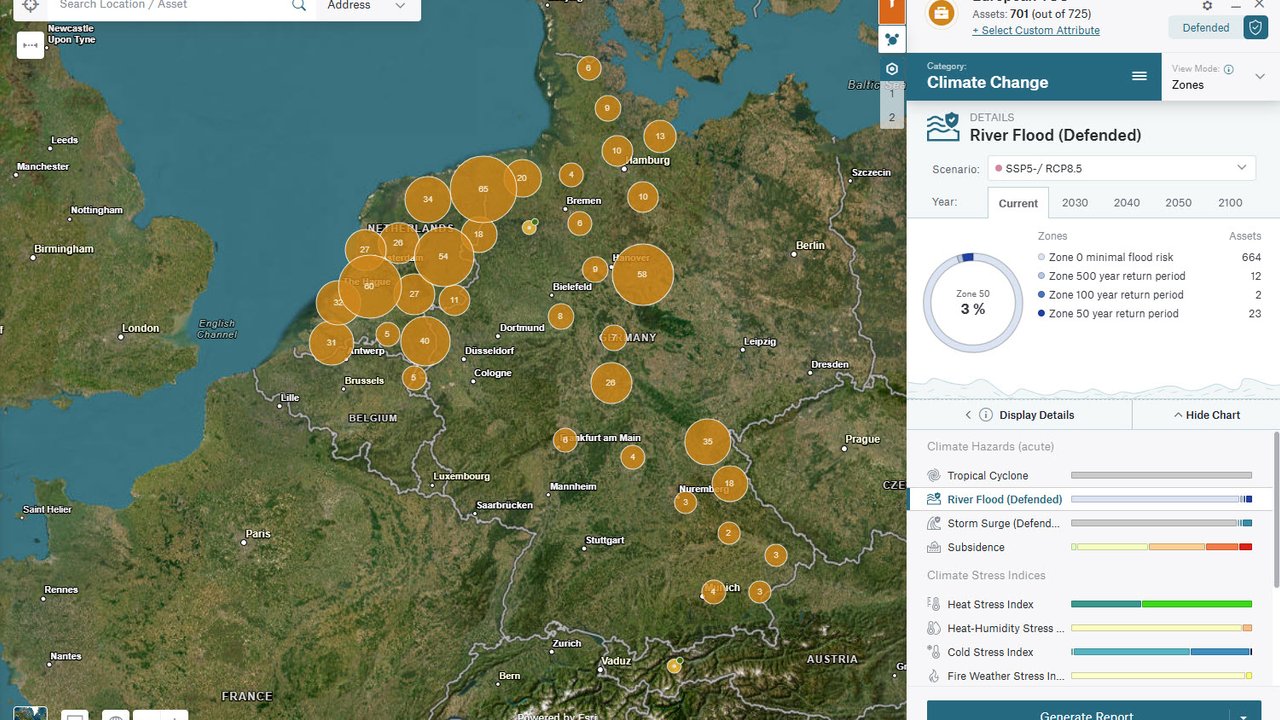
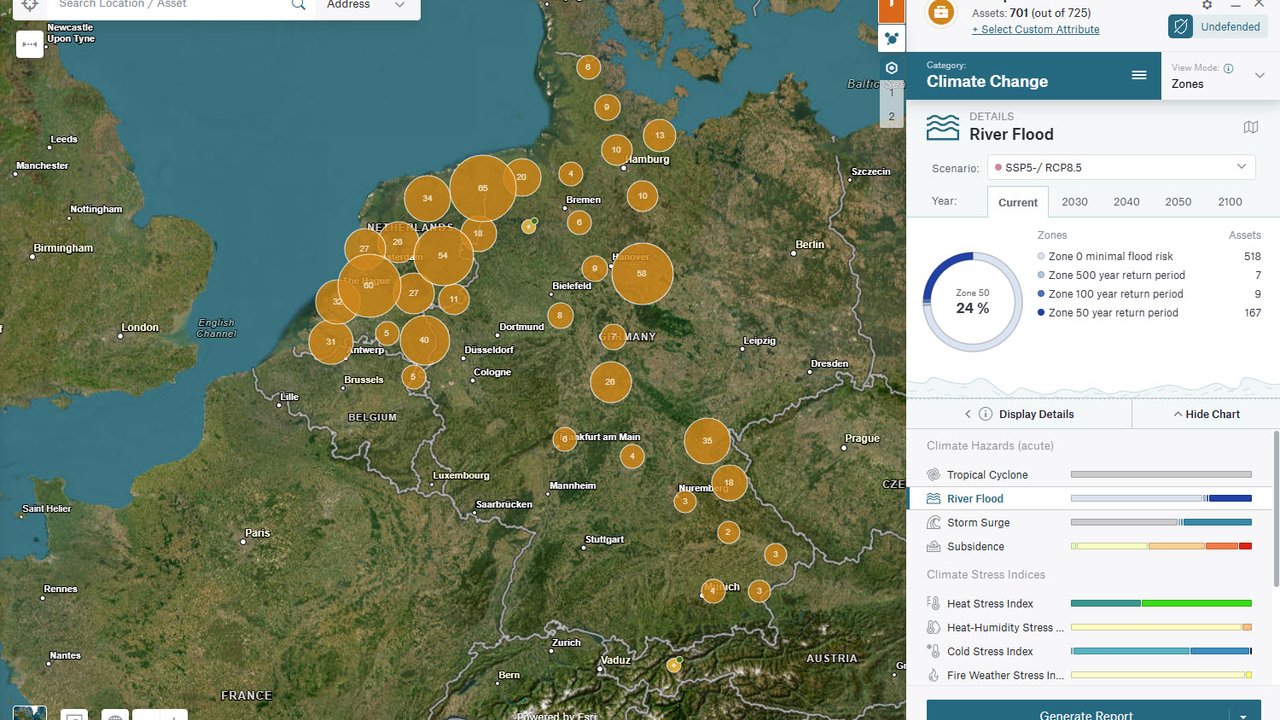
The conclusion is practical: when analysing at the site level, a distinction should be made between public and private protection standards, maintenance realities and residual depths at critical components, not just at the site boundary.
Forward-looking, granular risk assessments, targeted resilience measures and innovative insurance solutions can become a virtuous cycle that maintains both the insurability and investability of energy assets. Or in other words: build where the water can be kept out, harden where it cannot, and mitigate the rest with intelligent risk transfer.
Assessing companies, not just single assets
The International Energy Agency's round table linked resilience to finance. Capital is likely to flow into projects, portfolios, and companies that can demonstrate less expected losses, faster recovery, and ultimately more resilient financial returns. The logical next step therefore is to translate site-level hazards into the language that banks and asset managers actually use: expected losses and cash flow.
Risk Management Partners is currently developing an approach that assesses not only locations but also companies by translating asset-level risks into expected losses for the company and impacts on cash flow, enabling lenders and investors to assess risks, identify counterparties requiring adaptation finance, align portfolios and meet new regulatory requirements.
A practical guide for decision-makers
- Understand
Start with a unified geospatial baseline of existing and planned assets. Use Location Risk Intelligence to upload portfolios and identify assets most exposed to hazards today and under different climate scenarios. Apply the Areas & Lines feature to assess infrastructure and large production assets. - Measure
Use Location Risk Intelligence to estimate the financial impact from climate risks and identify those assets that could have a financially material impact on your bottom line. Use Regional Scoring to benchmark your portfolio’s exposure across regions and postcodes. - Manage
Translate risk into resilience: harden assets, ensure substitutability, improve siting of assets, engage with insurance companies to benefit from their risk engineering and risk transfer capabilities, and secure support from lenders and investors for resiliency investments.
Risk Management Partners, a unit of Munich Re