Accelerated underwriting has demonstrated how data and analytics can improve risk assessment and streamline the path to coverage. Insurers are now extending those same capabilities further upstream, using predictive insights to inform lead generation, customer segmentation, and distribution strategies.
A key insight from Munich Re’s 2026 Future of Underwriting Conference is that many factors influencing placement rates and straight-through processing are established before an application reaches underwriting. The prospects who enter the funnel, and the pathways they follow, can have a significant impact on downstream outcomes.
As a result, insurers are rethinking where underwriting strategy begins. By applying underwriting insights to acquisition and distribution decisions, they can improve placement rates, reduce friction, and create a better customer experience.
Why applicant mix matters
Consider two underwriting programs with nearly identical rules, pricing, and risk appetite that produce dramatically different outcomes. The reason often has less to do with how applicants are evaluated and more to do with the composition of the applicant pool each program attracts.
Applicant mix can directly impact downstream outcomes. Acquisition strategies that attract large numbers of applicants who are unlikely to qualify can increase costs and create unnecessary friction. By contrast, targeting prospects who are a better fit for a carrier's products and underwriting pathways can improve efficiency without compromising underwriting standards.
For insurers, this means that underwriting performance is shaped not only by how applicants are evaluated, but also by who enters the sales funnel in the first place. As a result, insurers increasingly view marketing, distribution, and underwriting as interconnected functions.
Moving to precision targeting
Using predictive insights, insurers can better understand both underwriting fit and purchase intent. This allows them to focus marketing efforts on individuals who are more likely to qualify for coverage, complete the application process, and ultimately place business.
Precision targeting enables insurers to prioritize opportunities that are more likely to result in successful placements and efficient use of acquisition resources. Making these decisions effectively requires a more sophisticated understanding of both risk and purchasing behavior.
Leveraging underwriting insights earlier in the customer journey
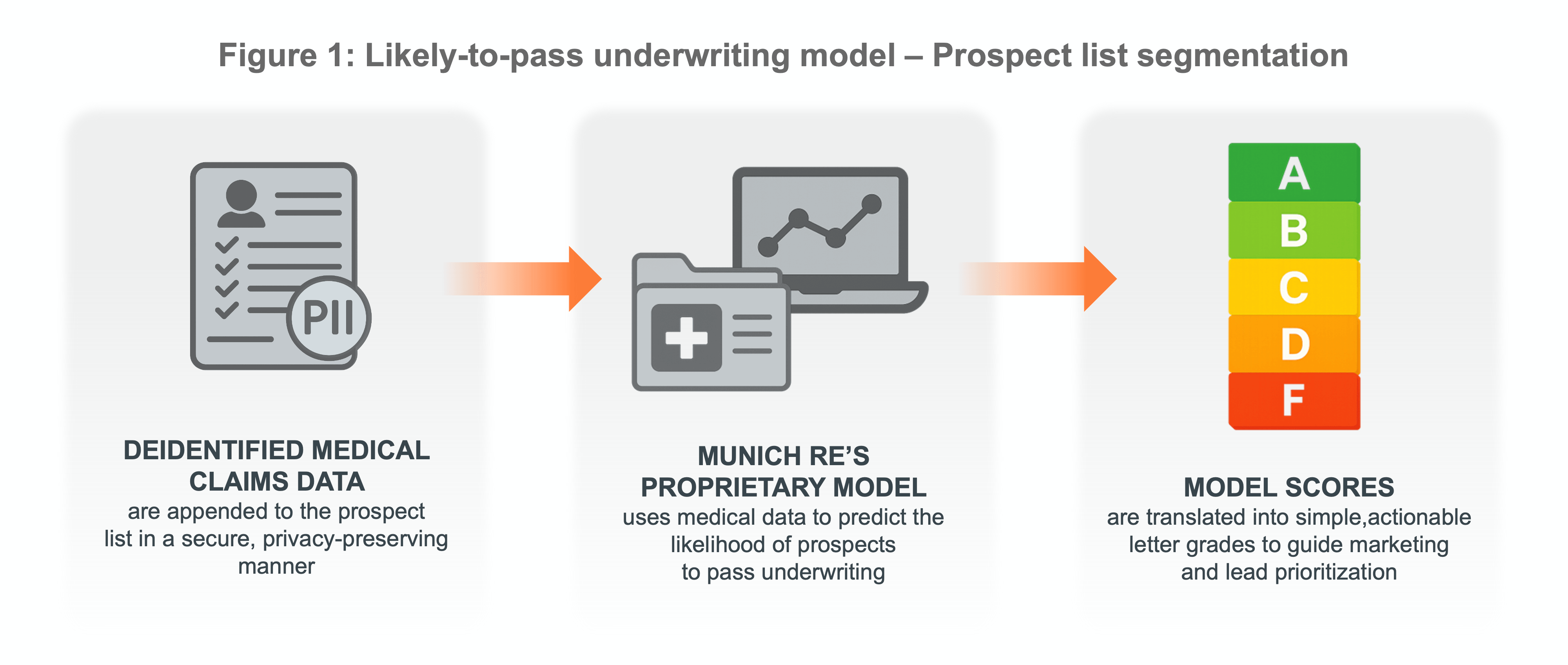
The most significant enabler of this shift is the ability to apply underwriting insights earlier in the customer journey. Predictive models can estimate the likelihood that a prospect will successfully pass underwriting, helping insurers identify individuals who are a better fit for specific products and underwriting pathways (Figure 1).
Leveraging de-identified medical and demographic data in a privacy-preserving manner, insurers can score prospects on a target list to tailor outreach. These models are designed to support marketing and distribution strategies; they do not replace or determine underwriting decisions, which continue to be made through the insurer's established underwriting process.
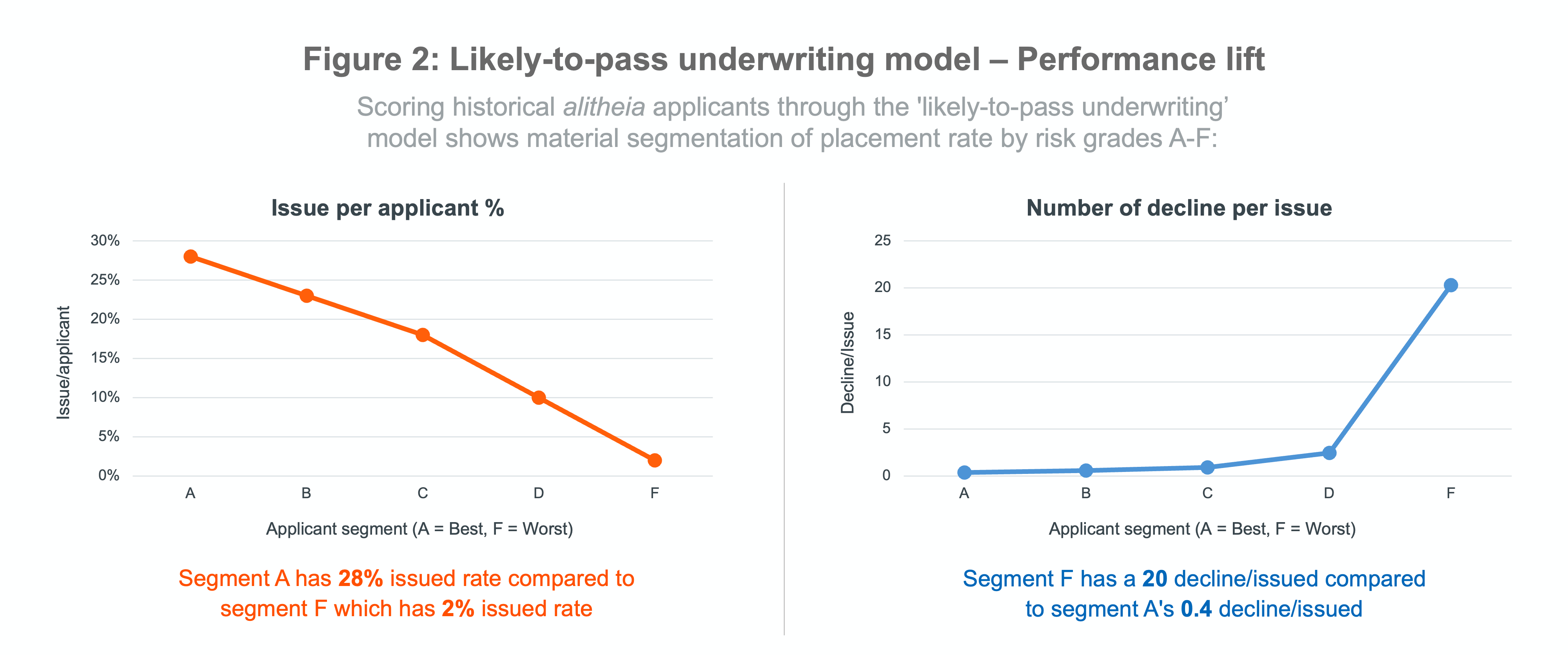
These probability scores are simplified into actionable segments to guide marketing and lead prioritization. In our experience, higher-scoring segments consistently achieve stronger placement rates, while lower-scoring segments are more likely to generate declines (Figure 2).
However, focusing solely on underwriting likelihood introduces a limitation. Individuals who are highly likely to qualify are not always the most likely to purchase. Some of the healthiest prospects may be the most inclined to comparison shop, resulting in lower placement rates or an increase in policies not taken.
To address this limitation, we developed a complementary model to predict purchase behavior. Combined, these two modeling approaches enable insurers to identify prospects who are likely to qualify for coverage and ultimately become policyholders.
Designing a multi-path customer journey
As insurers adopt more advanced segmentation models, traditional lead-generation is being replaced by a more flexible, multi-path strategy. Rather than directing all prospects toward a single product and underwriting process, insurers can use evidence-based insights to guide customers toward products and purchasing experiences better suited to their needs and likely risk. This may involve routing lower-risk applicants to accelerated pathways, while directing more complex cases toward simplified or alternative products.
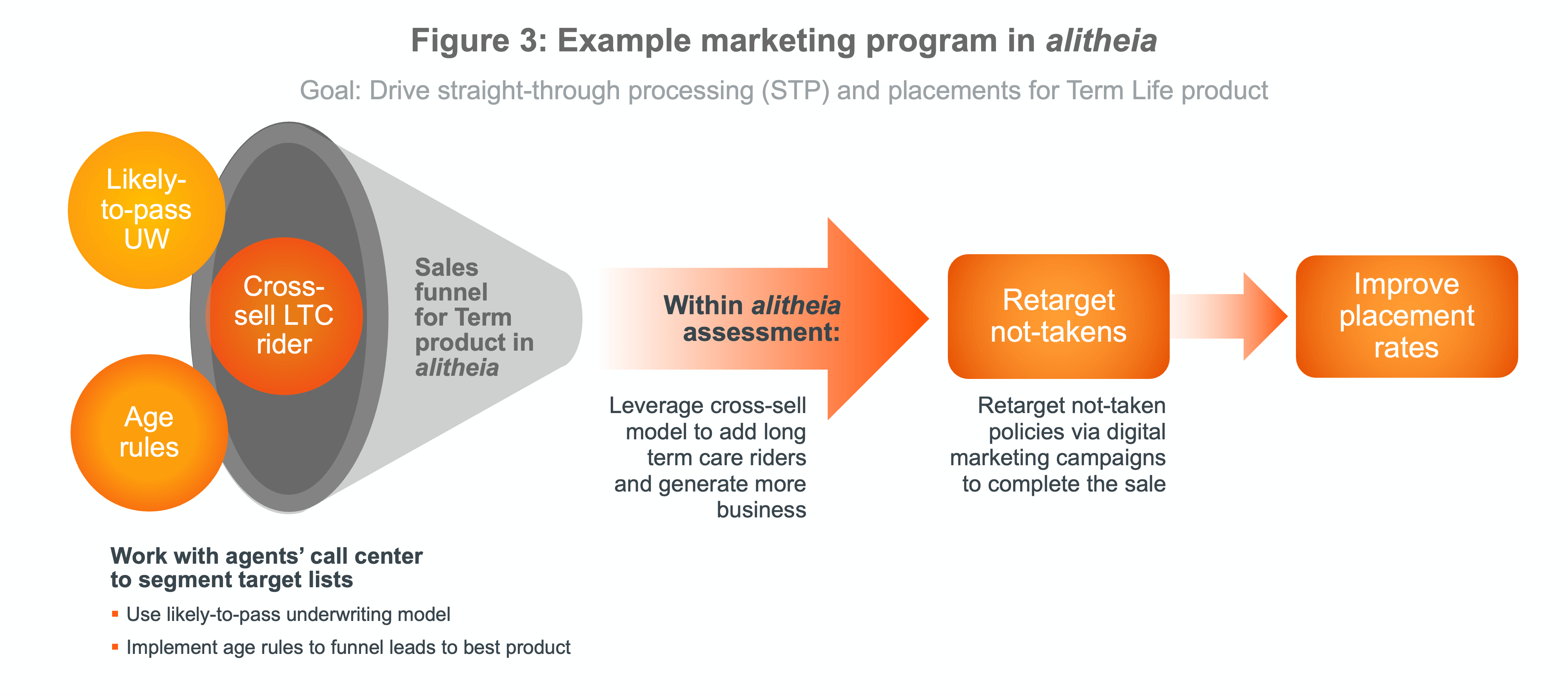
More sophisticated segmentation makes it possible to design different experiences for different customer needs. Connecting individuals with appropriate products earlier in the journey can minimize avoidable declines and create a more intuitive customer experience. It can also expand access to insurance by helping applicants who may not qualify for one product find alternatives where they have a greater likelihood of success (Figure 3). While these strategies can improve how products, channels, and customer journeys are tailored, individual underwriting decisions remain subject to the insurer's established evaluation process.
Extending value across the funnel
A more integrated approach to lead generation also opens new opportunities beyond initial acquisition. For example, insurers can use product look-alike models to identify customers who may be a good fit for additional coverage, such as long-term care or disability riders. These recommendations can be incorporated into the underwriting process, allowing carriers to present relevant coverage options when a customer is already engaged. Customers can benefit from a more streamlined purchasing experience, while insurers can increase value per policyholder by addressing multiple coverage needs in a single interaction. Similarly, re-engagement strategies allow insurers to reconnect with prospects who did not complete the process on their first attempt. Individuals who received a quote but did not apply, or who chose not to accept an offer, represent a meaningful opportunity when approached with targeted follow-up. Leveraging digital outreach, agent engagement, and direct marketing channels, insurers can reintroduce relevant offers at the right time and increase overall placement rates.
Taken together, these capabilities reinforce the idea that lead generation is not a discrete step—it is an ongoing process that extends across the entire customer lifecycle.
A new blueprint for placement performance
The examples discussed throughout this article highlight a broader shift in how insurers think about placement performance. Underwriting performance cannot be optimized in isolation. It is one part of a broader, connected system that spans acquisition, distribution, product design, and decisioning.
- Upstream decisions can drive downstream outcomes
- Data-driven segmentation can improve both efficiency and customer experience
- Flexible routing can help connect applicants with the products and underwriting paths that best fit their needs.
For insurers, this requires closer alignment across marketing, distribution, and underwriting. Marketing and underwriting teams must collaborate more closely, sharing data, insights, and objectives rather than operating independently. Predictive models can be applied throughout the customer journey, helping carriers better align prospects with products, distribution channels, and underwriting pathways.
As the industry continues to innovate, many of the factors that influence placement outcomes are being shaped before an application is ever submitted. The insurers that gain the greatest advantage will be those that apply underwriting insights earlier in the customer journey, treating acquisition and underwriting as connected parts of the same process rather than separate functions.
Contact the authors