For life insurers, the conversation around artificial intelligence has shifted from broad potential to real, measurable application. Yet a fundamental challenge remains: how to translate underwriting expertise into scalable, production-ready decisioning.
Underwriting rules illustrate that challenge particularly well. They are the mechanism through which decades of clinical knowledge, risk philosophy, and operational constraints become actionable in automated environments. However, building and maintaining underwriting rules has historically been slow, manual, and difficult to operationalize.
The growing complexity of underwriting rule development
The need for faster, more flexible rule development is driven by a convergence of pressures across the underwriting ecosystem. Insurers are incorporating new and increasingly complex data sources, such as electronic health records (EHRs), each requiring new logic to interpret and assess effectively. Without robust rules, the value of these data sources is difficult to fully realize and incorporate into underwriting workflows.
At the same time, underwriting manuals are typically written in narrative form based on medical literature and must be translated into structured logic that automated systems can execute. The translation process is highly manual and resource-intensive, often resulting in bottlenecks in rule creation. Furthermore, as new medical research emerges, underwriting guidelines evolve, and manuals must be updated. As medical guidance changes, rules must also be revisited and refined, contributing to rule development workloads.
Each new data source or use case drives the creation of additional rule sets, often managed by small teams or individual experts. As a result, insurers need more rules, across more inputs, at greater speed – but the traditional development process remains difficult to scale.
A new model for rule generation
Rule AI reframes the creation of underwriting rules by combining large language models with established underwriting frameworks and medical knowledge. At its core, the approach uses generative AI to interpret underwriting manuals, translate them into structured decision logic, and generate rule trees tailored to specific use cases.
By automating rule generation, insurers can move beyond manual rule creation while maintaining adherence to risk philosophy. Automation also enables insurers to extend rule frameworks to emerging data sources like EHRs, where underwriting methodologies are still maturing, and to build on existing accelerated underwriting programs to expand into other product lines such as disability.
At Munich Re, EHR-based rule generation has emerged as a natural starting point, given both the scale of effort required and the opportunity to rapidly expand the number of assessable impairments.
One of the defining features of Rule AI is a collaborative operating model. The technology depends on close coordination between underwriting and data science expertise. Data scientists generate structured outputs and evaluate performance while underwriters validate, refine, and ensure alignment with risk philosophy. The resulting rules are then tested against historical data, closing the loop between design and performance.
From manual text to decision tree: How the approach works
Translating underwriting guidance into usable decision logic requires a structured and repeatable process. First, underwriting manual guidance for a given impairment is provided to the model, generating rules within defined constraints, such as the limits of available application questions or the intended data source. The model is designed to produce consistently structured, machine-readable outputs that can be integrated directly into rules engines. Next, these outputs are reviewed and refined to ensure consistency with the source material before testing against historical or synthetic data to assess performance and identify gaps.
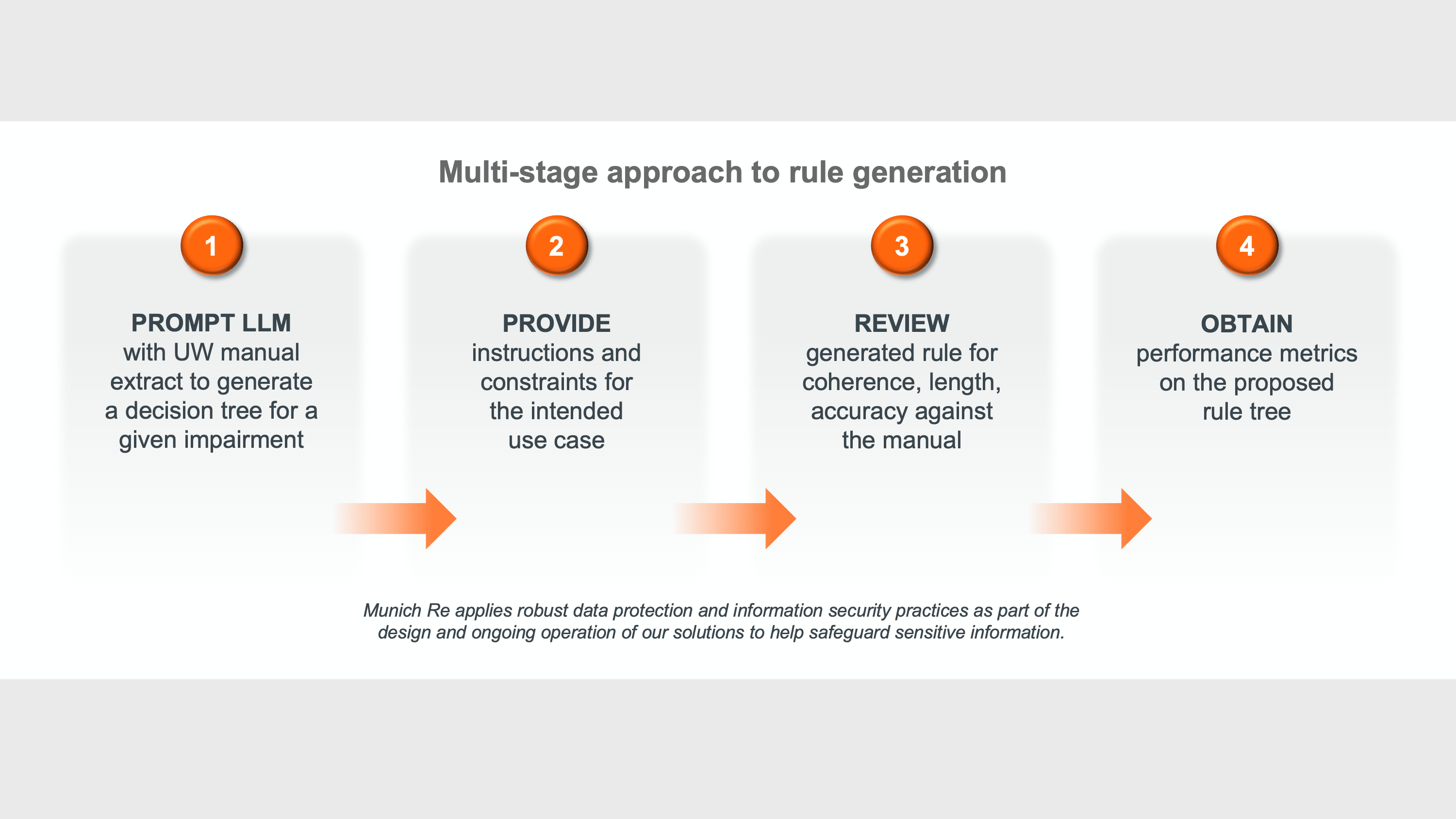
The process is inherently iterative. Rules can be regenerated and adjusted multiple times, with human oversight at each stage to ensure both accuracy and coherence. A key component of the process is structured prompting – carefully designed inputs that provide context, instructions, and expected outputs – allowing the model to produce consistent, machine-readable rules.
Rule quality is evaluated across three dimensions: completeness (coverage of relevant guidelines), avoidance of hallucinations (unsupported logic), and alignment with available evidence. Underwriter review remains crucial for assessing the rules from a technical and practical standpoint. Underwriters assess whether branches are relevant, whether key attributes are missing, and whether outputs reflect the intended data source. For example, rules generated for EHR use must rely only on information that exists within EHR data.
Early results: Speed and alignment at scale
Initial testing of Rule AI has produced encouraging results, particularly in proof-of-concept scenarios involving EHR-based assessments. In one example focused on atrial fibrillation, AI-generated rule sets were evaluated against existing rules using synthetic case data.
The results demonstrate meaningful directional alignment, with outcomes aligning in approximately 87% of cases when accounting for referred declines, as shown in Table 1. In parallel, rule development time was reduced by an estimated one to two hours per impairment.
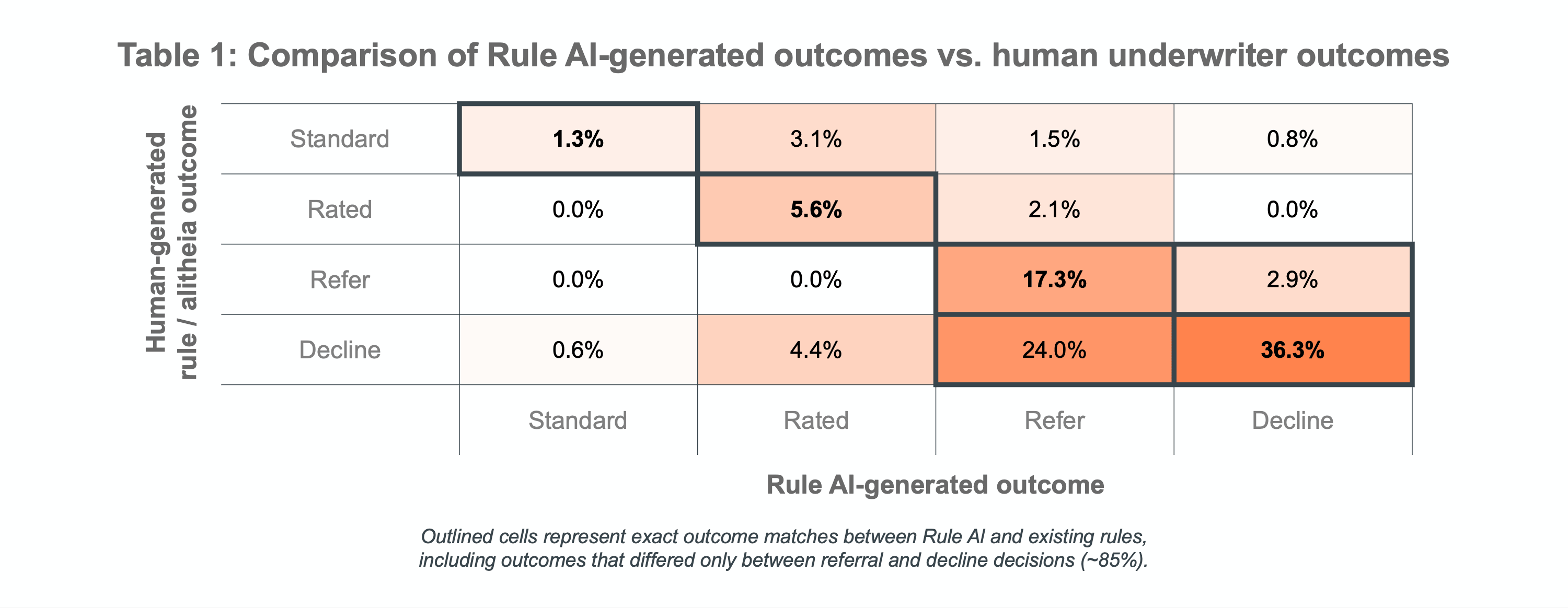
Equally important, analysis of discrepancies provided insight into where challenges remain. Missed declines were often linked to formatting issues in the source material, underscoring a broader constraint: content designed for human interpretation can lose critical detail when translated into machine-readable inputs.
Lessons learned – and what comes next
As with any emerging capability, Rule AI continues to evolve. Early experimentation highlights several important lessons. The technology is most effective as an assistive tool, with human oversight remaining essential to ensure adherence with underwriting intent. Its performance also depends heavily on the quality and structure of input data, and ambiguity in underwriting guidance can limit effectiveness, particularly when translating narrative content into structured outputs.
In addition, evaluation design has proven to be as important as prompt design. Establishing clear criteria for measuring rule performance and rigorously testing outputs plays a critical role in maintaining reliability. These findings reinforce the idea that successful adoption depends not only on model capability but on the surrounding process, including governance, validation, and input quality.
Early results also highlight a broader constraint: underwriting manuals are often written for expert interpretation rather than machine execution. In some cases, additional structuring or refinement may be required before rule generation can be fully effective.
Implications for underwriting transformation and execution
Rule AI has broader implications for how insurers could approach underwriting transformation. By automating the translation of underwriting knowledge into structured rules, rule creation is more efficient and repeatable, reducing the time required to operationalize new guidance while making emerging data sources more actionable.
Rule AI also reshapes the role of the underwriter. Rather than building rules manually, underwriters increasingly focus on validating, refining, and governing outputs, which is a shift toward higher-value decision-making. Greater consistency is another potential benefit, helping reduce variability in how guidelines are interpreted and applied across portfolios.
Perhaps most importantly, Rule AI can allow insurers to expand coverage more quickly, supporting a growing number of impairments and use cases without a proportional increase in resources.
The industry has spent years exploring what AI could do for underwriting. The next phase will focus on execution and embedding those capabilities into day-to-day workflows in a way that delivers tangible value.
Contact the authors