In accelerated underwriting (AUW), the core challenge has evolved. Historically, the focus was on expanding access to data—adding new sources, improving connectivity, and accelerating retrieval. Today, that barrier has largely been removed due to the ready availability of evidence from medical claims, labs, prescription data, and increasingly, electronic health records (EHRs).
The differentiator is no longer access, but application. More data does not inherently improve decisions; instead, it introduces greater complexity. The task now is to identify the most relevant signals, resolve inconsistencies, and translate fragmented inputs into clear, defensible outcomes. The question is no longer “Can we get the data?” but “Are we using the right data, in the right way, to make the right decision?”
This trend was highlighted at the Munich Re Future of Underwriting Conference and reflects work we have been actively exploring in two interconnected disciplines: data prioritization and requirements optimization. Data prioritization helps identify the signals that have the greatest impact, while requirements optimization determines how that information can be used to greater effect within the underwriting process. Together, they provide a framework for turning growing volumes of data into underwriting decisions that are consistent, efficient, and explainable.
Making sense of conflicting data signals
Modern underwriting decisions rarely rely on a single data source. Instead, they draw on multiple pieces of evidence to create a more complete picture of risk. As data sources expand, particularly with the increased use of EHRs, underwriters are often faced with overlapping or conflicting information. Sources differ in their coverage, timeliness, and alignment to actual outcomes, making it increasingly difficult to determine which signal should drive a decision.
Consider the simple example of an applicant’s BMI. A value may appear in multiple places. One data source may report a value of 30, while another shows 27. Both could be both plausible and reasonably recent, yet they can lead to different underwriting decisions. As digital data continues to expand, these types of inconsistencies are occurring with greater frequency.
Without a structured approach, this data-rich environment could introduce inconsistency in decision-making. Similar cases may receive different outcomes depending on which data source is prioritized, and automation becomes harder to scale confidently when signals conflict.
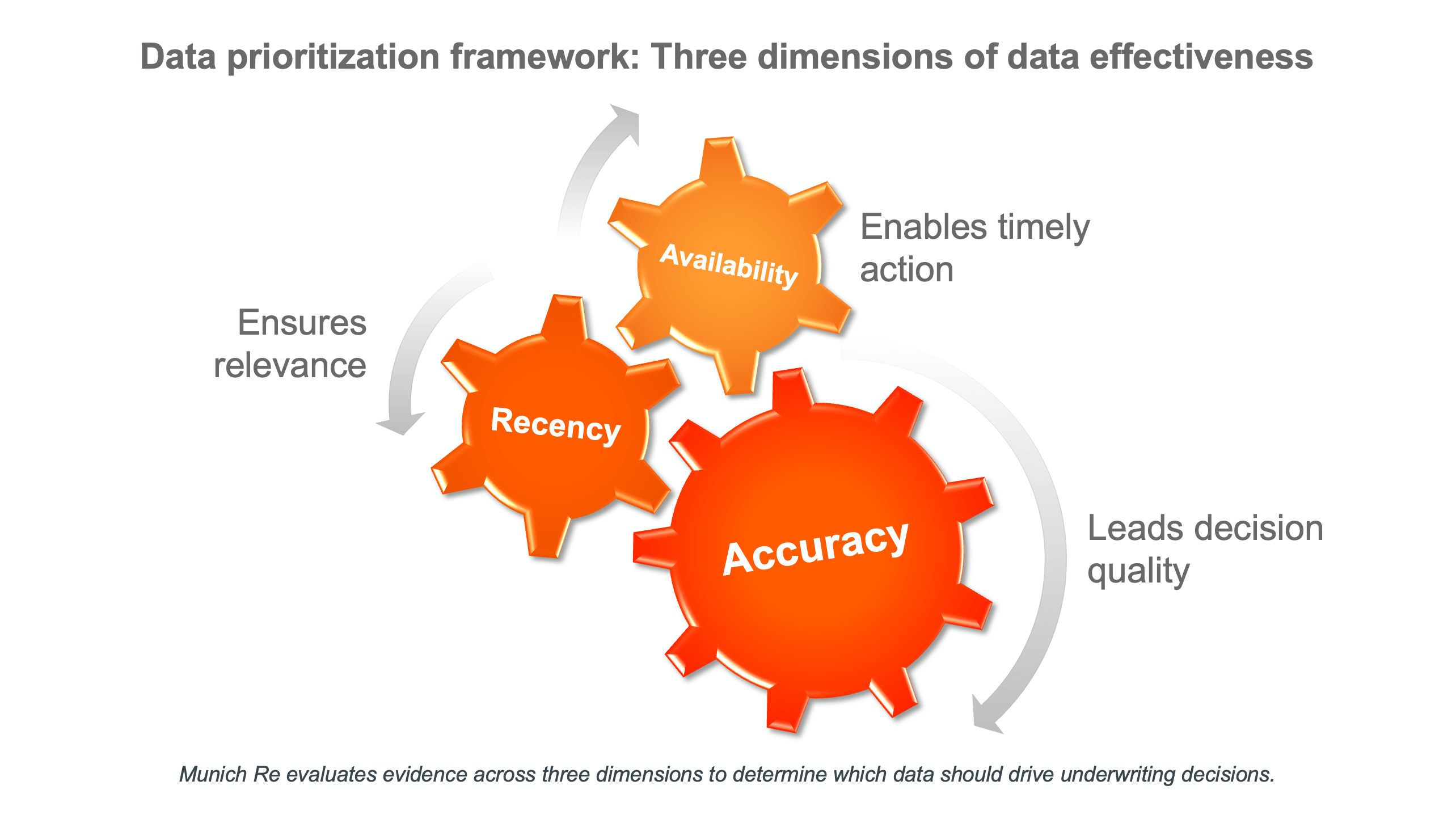
Addressing this requires a structured process for evaluating data, determining how each source should be used, when one source should take priority over another, and how trade-offs should be managed. A three-dimensional framework helps guide these decisions by evaluating each source based on its accuracy, availability, and recency.
- Accuracy reflects how well the data represents the applicant’s actual risk profile.
- Availability determines how often the data is present in real-world cases.
- Recency ensures that the information is relevant to the underwriting decision.
Instead of assuming one source is always superior, this framework allows underwriters to assess which source is best suited to the situation. In practice, this often leads to targeted rules that reduce ambiguity and improve consistency.
Putting the framework into practice
Munich Re applied this approach to historical underwriting data to assess how different sources perform in practice—showing how analytical rigor can directly support more consistent and explainable underwriting decisions. Two pieces of data we’ll highlight here are BMI and diagnosis codes from medical claims data.
When analyzing BMI across sources, we found that while disclosure data was almost always available, recently measured third-party data – specifically medical codes extracted from EHRs - aligned more closely with underwriting outcomes based on a measured, paramedical BMI. This insight led to a straightforward but impactful rule: when BMI-related medical codes are available within a defined timeframe, they should override disclosed values. This rule has helped bring about clearer decisions and stem data overload.
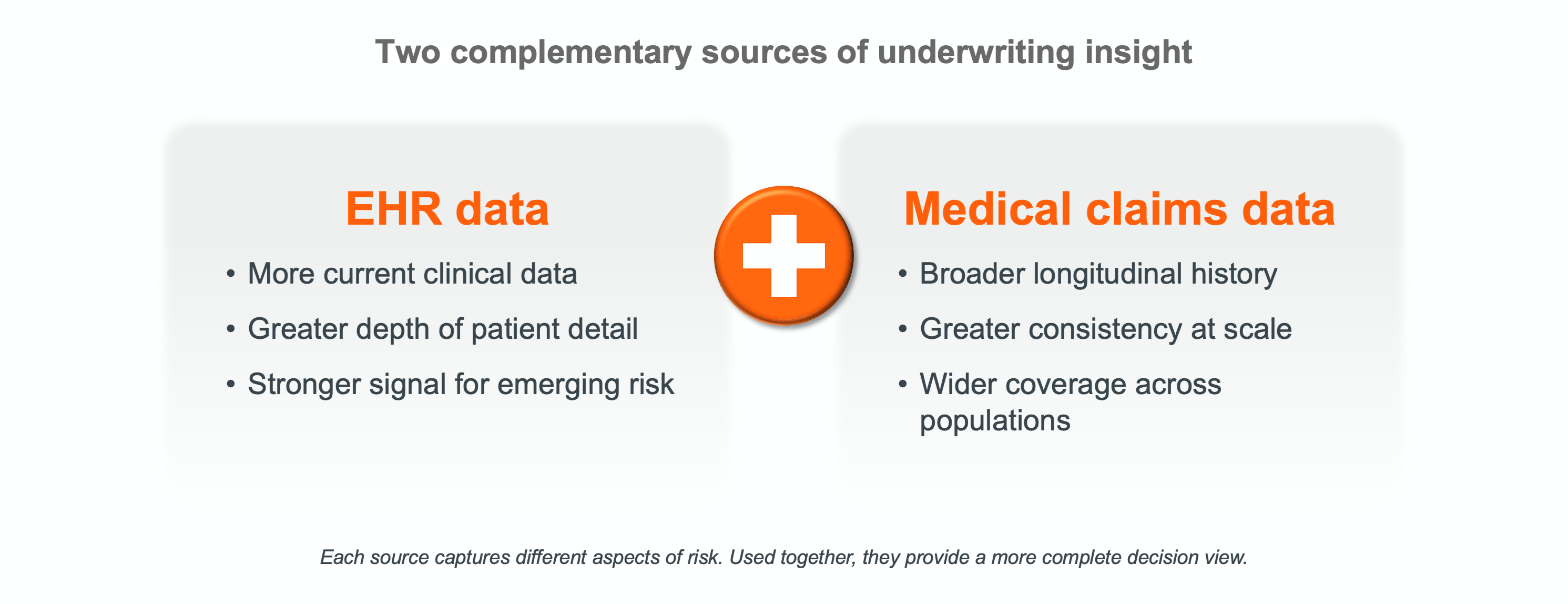
The three-dimensional framework was also applied to ICD-10 diagnosis codes, which now appear across both medical claims data and EHRs. Unlike BMI, there is no single “ground truth” source for diagnosis codes. To address this challenge, Munich Re’s proprietary modeling capabilities enabled us to compare the risk signals from the two sources using relative mortality risk scores.
When medical claims and EHR data were analyzed together, the overlap between the two sources was limited. This suggests that each source contributes distinct information to the underwriting process, instead of simply duplicating the same signal.
Targeting the right evidence for each decision
If data prioritization determines which signals to trust, requirements optimization determines which signals to gather in the first place and for whom they are the most relevant.
Historically, underwriting has erred on the side of inclusion. More evidence was seen as a way to reduce uncertainty and provide much-needed protective value. However, continuously layering data introduces diminishing returns. At a certain point, additional evidence adds cost and complexity without meaningfully improving decisions and may even reduce straight-through processing (STP) by introducing unnecessary friction.
This realization is driving a move away from “one-size-fits-all” evidence models. Evidence strategies are becoming increasingly tailored to the individual applicant, replacing the traditional practice of applying the same comprehensive requirements to everyone based on age and face amount.
A common underwriting scenario illustrates this evolution. When baseline evidence indicates a potential condition such as diabetes, traditional methodologies often trigger an immediate routing to full underwriting. This process materially delays risk assessment and increases overall underwriting costs.
A more optimized approach focuses on resolving the uncertainty directly. For example, if the key variable is glycemic control, then A1C values become the critical input. By automating the ordering of targeted clinical labs, risks can be resolved programmatically by rules or quickly by underwriters without requiring a full suite of requirements, lowering cost and time to decision.
This type of targeted ordering is not only theoretical. Munich Re has developed and patented requirements optimization capabilities that enable automated, reflexive evidence ordering based on real-time signals – ensuring that underwriting engines request only the information necessary to resolve specific risks.
These capabilities reflect a broader shift toward dynamic evidence strategies that adapt to each applicant, rather than relying on static, one-size-fits-all requirement sets.
Balancing speed, risk, and continuous improvement
Every underwriting decision involves trade-offs, most notably between speed and confidence. These are often measured through STP and mortality slippage. Improving STP can increase underwriting efficiency and enhance the customer experience, but it must be balanced against the risk of misclassification. The key is not eliminating trade-offs, but understanding and managing them.
By modeling how changes in evidence affect both STP and slippage, carriers can better understand where adjustments create real value. Our work has shown that, in some cases, removing a data source results in negligible increases in risk while significantly improving speed or reducing cost.
Typically, removing an entire data source for all applicants results in an increase in mortality slippage outweighing the benefit of increased STP. However, by using optimization techniques and real-time monitoring, we can identify specific applicant characteristics for which forgoing a piece of evidence can increase STP with negligible slippage.
It is important to note that these insights are rarely universal. What works for one segment may not work for another, reinforcing the need for segmentation and ongoing refinement.
Optimization is not a one-time exercise. Data environments change, applicant populations change, and new sources emerge. As a result, both data prioritization and requirements optimization must operate as continuous processes. Strategies should be tested using historical data, validated on new cases, and then monitored closely in production. Over time, they need to be recalibrated as underlying patterns evolve.
This framework reflects a broader evolution in underwriting, with decision-making becoming increasingly dynamic and adaptive over time.
Moving toward decision-ready underwriting
Success in this environment will come from underwriting organizations that treat data as a means to an end, but not the end itself. The focus is shifting toward enabling high-quality decisions: selecting evidence that truly matters, aligning requirements to the specific context of each applicant, and continuously improving through feedback from real-world outcomes.
Through its work in data prioritization and requirements optimization, including proprietary modeling, patented innovations, and ongoing collaboration with carriers, Munich Re is helping organizations move toward more targeted, adaptive, and decision-ready underwriting.
As underwriting continues to evolve, the ability to apply the right data at the right moment will play a central role in improving both efficiency and risk selection outcomes.
Contact the authors