Watch the webinar
Summary
Organisations that truly understand their flood exposure are better equipped when water rises. Using Location Risk Intelligence and ICEYE satellite technology, clients can identify assets at risk up to four days prior to an event, track water extent and depth during a flood, and understand the impact on any location in near real time.
Rising waters, rising costs
Whether caused by overflowing rivers, storm surge, or intense rainfall, floods are among the most disruptive weather-related hazards facing businesses in many regions today. Munich Re data shows that floods account for almost a quarter (24%) of all natural disaster-related losses worldwide.
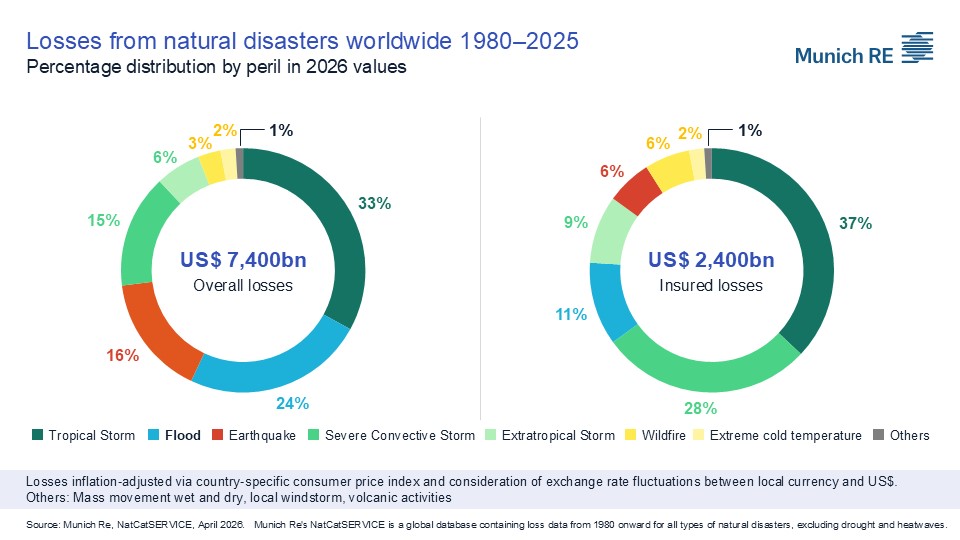
Such losses are often larger than what organisations would have expected based on historical experience alone. Three key aspects contribute to this trend:
- Exposure: More assets, higher property values, and more critical infrastructure are located in flood-prone regions.
- Vulnerability: Urbanisation and sealed surfaces can turn extreme rainfall into major damage.
- Climate: A warmer atmosphere can hold more moisture, which can increase the potential for heavy precipitation under the right conditions.
At the same time, flood risk can now be mapped with high granularity, analysed, stress tested, and forecasted with increasing precision. With historical and modelled data, live event data, and early warnings, companies are much better equipped to prepare for floods, as well as to mitigate the related damage and consequences.
Observing flood extent, depth, and progress
The foundation of this new generation of flood intelligence is synthetic aperture radar (SAR) technology. Headquartered in Helsinki, Finland, ICEYE operates the world's largest constellation of SAR satellites, and applies this technology to natural catastrophe situations.
Flood observation: ICEYE data and insights
| 25cm | Resolution in urban areas |
| 50m | Resolution for large areas |
| 3-4m | Granularity |
| 6hr | Updated every 6 hours for extent |
| 24hr | Updated every 24 hours for depth |
| 4 days | Early warning up to 96 hours in advance of flood |
Unlike optical satellites, the radar-based technology can observe through clouds, darkness, smoke, and rain. The imagery generated reveals the scale of a flood event, its progression, and the peak water level at a resolution of 25 centimetres and covering large areas at 50-metre resolution, around the clock
To do this, the radar imagery is combined with optical imagery, social media photos, river gauge readings, and digital elevation models to produce flood extent and depth layers at three to four metres of granularity, updated every six hours for extent and every 24 hours for depth.

During an event of actionable size, with ICEYE data, you no longer need to rely on legacy flat models, but see a change on the ground as it is. That enables you to optimise the event response and quantify damage with real confidence.
Solving the last mile problem
During live flood events, advanced satellite imagery and spatial datasets can show where water is. However, what organisations really need to know is: which of their locations are immediately affected, and how severely?
This is what you might call the last mile problem in flood risk intelligence. Many companies still struggle to connect real-time flood observation to their own assets and portfolios, which helps them prioritise what actions to take.

Location Risk Intelligence builds on ICEYE flood data by adding context and operational relevance. It immediately tells organisations where their locations are affected, and which are hit hardest. This is the step from awareness to decision and from seeing a flood to actively managing its business impact.
Location Risk Intelligence connects exposure to incoming flood events and activates alerts when an impact on assets is identified. This reduces uncertainty and the time required for crisis response.
Clients can access flood early warnings, live and past flood events, and information on which assets have been hit, including water extent and depth, all within a single interface.
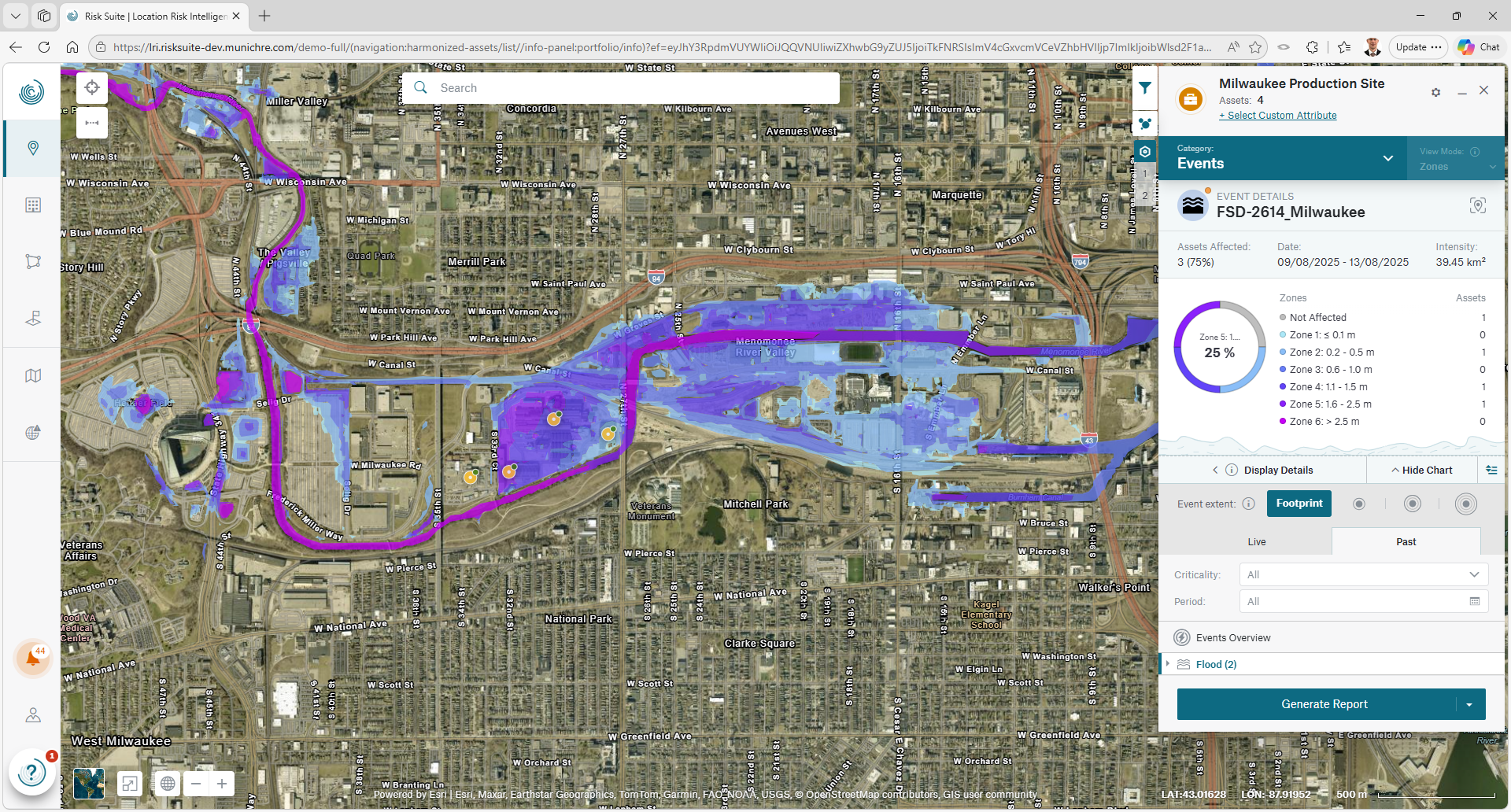
Real-life example: a production portfolio in Milwaukee, Wisconsin, USA, August 2025
In early August 2025, a severe storm system dropped approximately 14 inches (35.5 cm) of rainfall on the Milwaukee, Wisconsin area, triggering widespread flooding. Provisional data from the U.S. Geological Survey (USGS) showed that peak conditions at several monitoring sites exceeded previously recorded levels.
Performing an analysis using ICEYE satellite data integrated within Location Risk Intelligence revealed the impact on a manufacturing company in the area. The elevation profile showed that three of four facilities were within a flood zone, separated from a nearby river by only a small hill. In those buildings, the water was 3 to 6 ft deep (1 to 2 m).
For such highly susceptible properties, receiving a flood early warning up to four days in advance would allow sites to activate business continuity measures before the water rises.
Turning observation into action
With near real-time independent satellite observation and flood detection, ICEYE answers a critical first question: what actually happened?
This is where Location Risk Intelligence adds perspective. The platform connects observed flood data to an organisation's own locations and exposure. Before an event, early warning data supports contingency planning up to 96 hours ahead.
During an event, companies quickly understand what the event means for them and can decide which actions to take. The data and insights help clients to:
- Identify which assets have been affected.
- Rank locations by severity of impact.
- Prioritise crisis response.
- Reduce the time between event occurrence and action.
After an event, observed data adds to existing models and helps companies better understand their flood exposure and manage the risks. For insurance professionals, this information can also accelerate claims assessment with an evidence-based record of what occurred.
Integrating ICEYE satellite flood data into Location Risk Intelligence risk analytics brings hazard modelling and real-world event response together in one platform. Organisations can act with greater certainty before and during acute flooding and build more resilient strategies for the events that follow.
Frequently Asked Questions
1. What is the difference between flood hazard data and ICEYE flood event data?
2. How quickly is ICEYE flood data available when a flood event begins?
3. How is ICEYE data integrated into Location Risk Intelligence?
4. How is this technology useful for insurance underwriting and claims?
Be prepared. Contact us to activate ICEYE flood data in Location Risk Intelligence.
Expert