Get your free Belém climate risk report
a call to action on climate resilience
Summary
- Brazil is hosting this year’s COP30 climate conference in Belém. With the world's eyes on the Amazon, we have identified three areas where the host country's climate resilience could be strengthened.
- Munich Re's NatCatSERVICE data show that Brazil is prone to persistent droughts and destructive floods caused by rising temperatures, El Niño/La Niña dynamics, and land-use changes.
- Location Risk Intelligence helps to understand and measure risks at the location level, translate insights into operational and financial decisions, and embed transparent reporting and preparedness.
- Get your free climate risk report for Belém here.
Brazil’s climate reality
From 10 to 21 November 2025, Brazil is hosting the U.N. Climate Conference COP30 in Belém. For the host country itself, climate change is not a minor issue. It is a key driver already shaping economic performance, supply chains, and public finances.
Two hazards dominate this vast country: prolonged droughts and destructive floods. In 2024, Rio Grande do Sul suffered catastrophic floods that affected millions and caused billions in damage. At the same time, the north endured months of drought that destroyed crops and triggered price shocks.
This is not a temporary anomaly – it reflects a structural shift, exacerbated by rising temperatures and amplified by the El Niño–Southern Oscillation (ENSO), a climate pattern originating far out in the Pacific that influences weather patterns globally. El Niño phases, such as in 2024, tend to intensify rainfall in southern Brazil and exacerbate droughts in the north. La Niña phases reverse the pattern: the south faces greater drought risk, while the north receives more rainfall.
Get an in-depth understanding of what’s throwing Brazil’s climate off balance here.
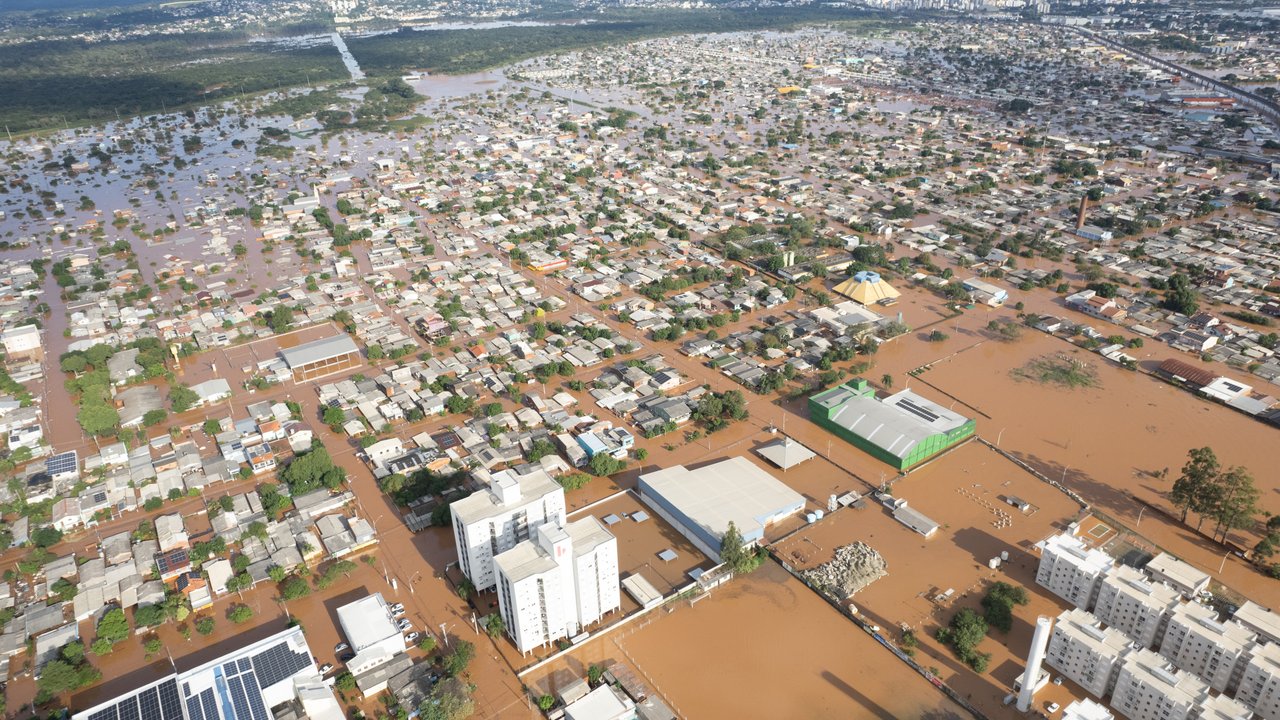
Aerial view of the flooding in Rio Grande do Sul 2024
Three use cases for evidence-based climate resilience
Resilience and adaptation begin with evidence and understanding. Leaders must go beyond general risk assessments and gain precise, location-specific insights that will stand up to scrutiny in the boardroom, trading room and public audits.
Location Risk Intelligence, Munich Re's modular SaaS platform, translates climate data into operational decisions. Based on decades of experience in natural hazards, it enables decision-makers to move from climate theory to actionable strategies. Here, we outline three use cases.
1. Precipitation stress assessment
In regions vulnerable to heavy rainfall and flooding, precipitation stress can disrupt infrastructure and logistics. Location Risk Intelligence offers a Precipitation Stress Index that combines historical rainfall patterns, climate projections, and local topography to assess hazard intensity across planning horizons.
Utilities, transport operators, and manufacturers can use these insights to reinforce drainage systems, adapt building standards, or adjust supply routes. By anticipating precipitation extremes, organisations reduce downtime, and safeguard continuity.
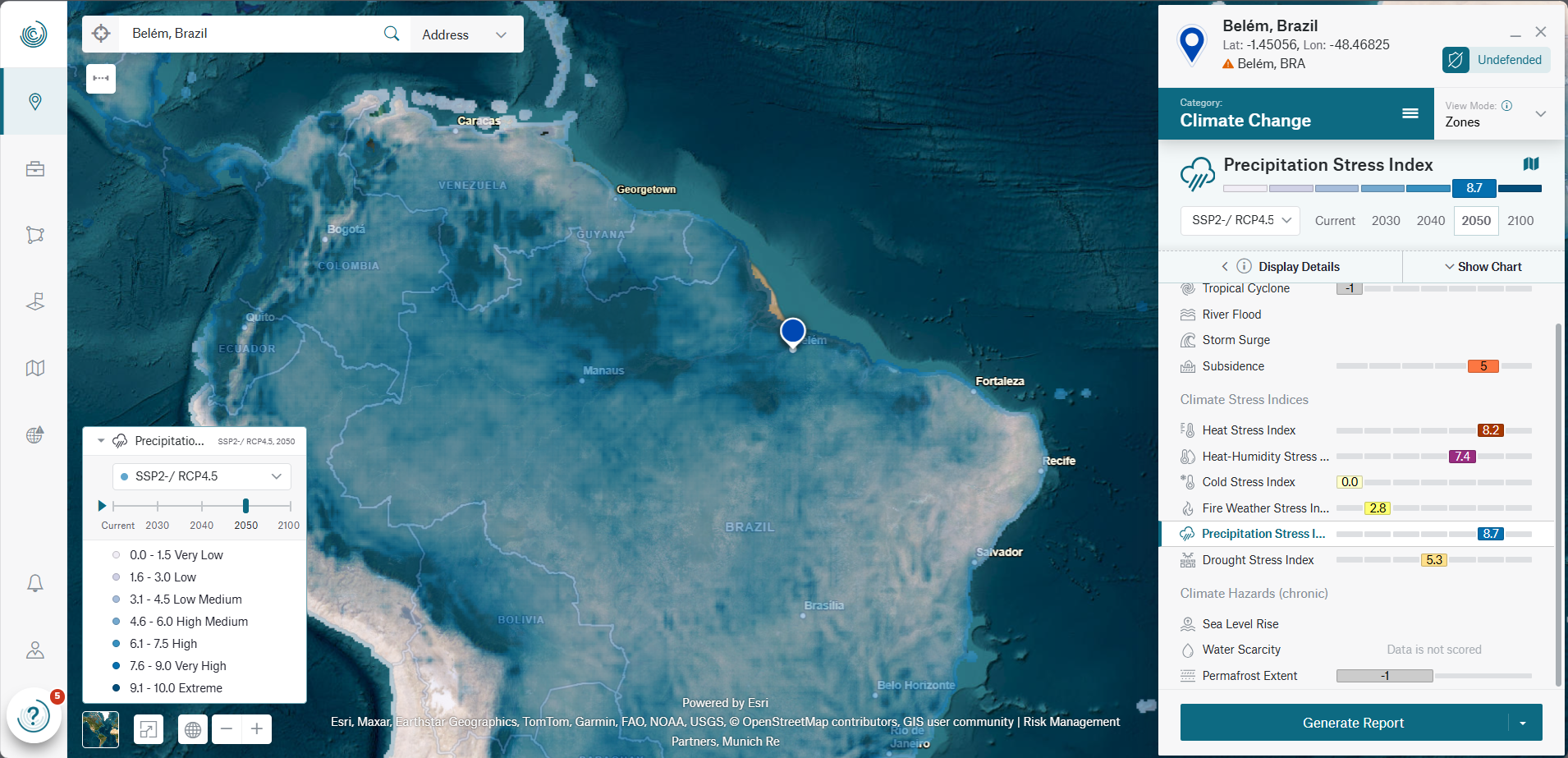
Source: Location Risk Intelligence Climate Change Edition, Precipitation Stress Index projection for 2050 under SSP2-/RCP4.5 scenario at Belém, Brazil
2. Heat stress assessment
Extreme heat poses risks to energy systems, workforce safety, and production efficiency. Location Risk Intelligence’s Temperature Stress Index provides forward-looking data on heat intensity and frequency, factoring in climate scenarios and historical trends.
Industries such as energy, construction, and agribusiness can leverage this information to implement cooling strategies, optimise shift planning, or diversify operations. Proactive measures help mitigate heat-related disruptions and protect assets and personnel.
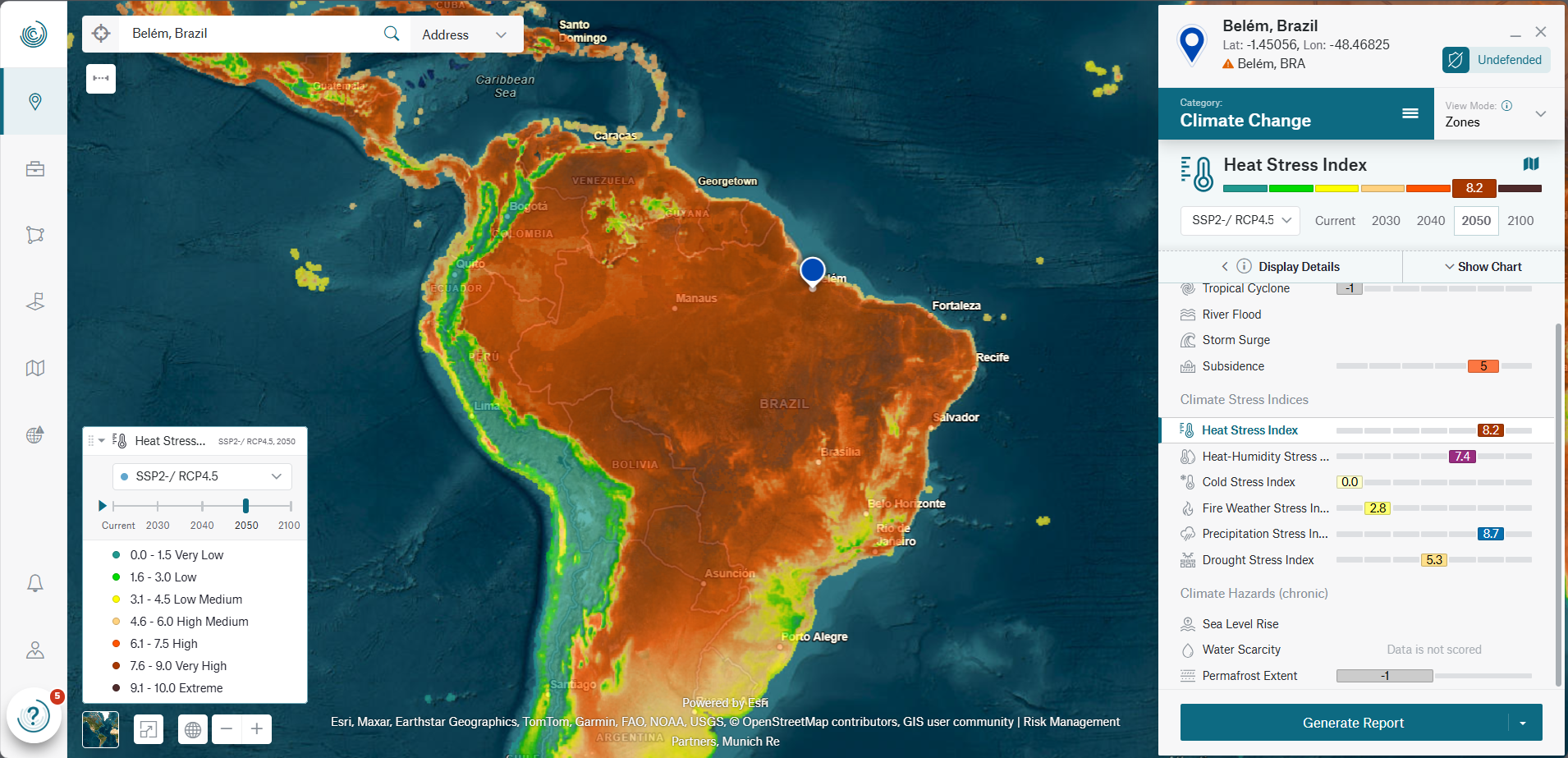
Source: Location Risk Intelligence Climate Change Edition, Heat Stress Index projection for 2050 under SSP2-/RCP4.5 scenario at Belém, Brazil
3. Drought stress assessment
In drought-prone regions, water scarcity can disrupt production and supply chains. The platform’s Drought Stress Index delivers a forward-looking view of hazard intensity across planning horizons, factoring in climate models and historical patterns.
Agribusinesses and manufacturers can use this data to adjust crop strategies, secure water resources, or diversify operations to reduce vulnerability and safeguard continuity.
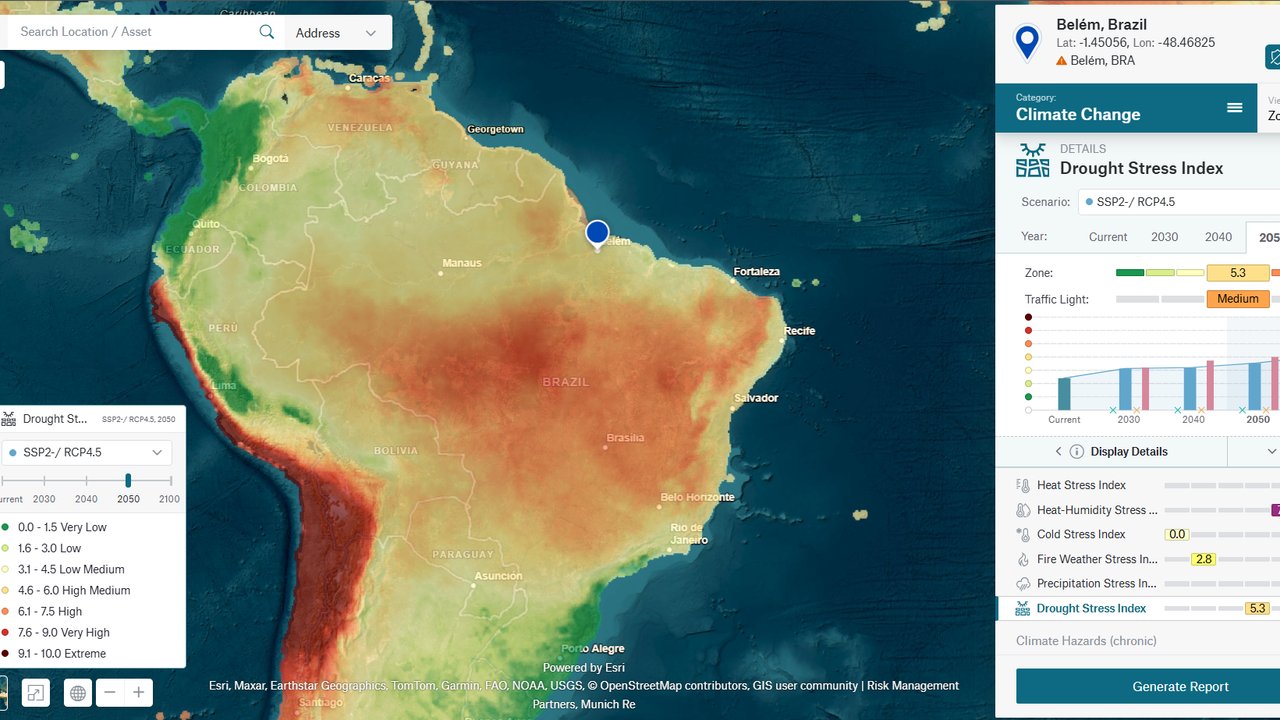
Source: Location Risk Intelligence Climate Change Edition, Drought Stress Index projection for 2050 under SSP2-/RCP4.5 scenario at Belém, Brazil