
When climate risks add up, insights pay off
Identify location-based exposures early to inform your credit, investment, and portfolio decisions.
In the financial services sector, climate risks could tip the balance sheet. Extreme weather and climate shifts can damage property and put pressure on credit quality and collateral. Munich Re’s Location Risk Intelligence provides natural hazard insights to help financial institutions to manage physical climate risk and strengthen portfolio resilience.
Natural disasters potentially hit assets and infrastructure, disrupt counterparties’ operations, push insurance premiums up, and collateral values down. Financial consequences include weaker returns, reduced profitability, and potential losses on investments.
One in six companies
faces a potentially meaningful or significant annual impact on their operating profit from natural hazard events.
Source: Munich Re’s Location Risk Intelligence Company Climate Risk Edition. Sample analysis across 8,173 globally significant firms

As a result, asset managers, banks, investment firms, financial data providers, insurers, fin techs, and payment services face growing expectations from regulators, supervisors, clients, and shareholders to understand, measure, and manage physical climate risks.
Munich Re’s Location Risk Intelligence enables financial institutions to assess climate risk exposure using granular analytics for individual properties or entire companies. Institutions gain a clearer view of where natural hazards could translate into financial impact. These insights support underwriting, investment analysis, credit assessment, and portfolio steering.
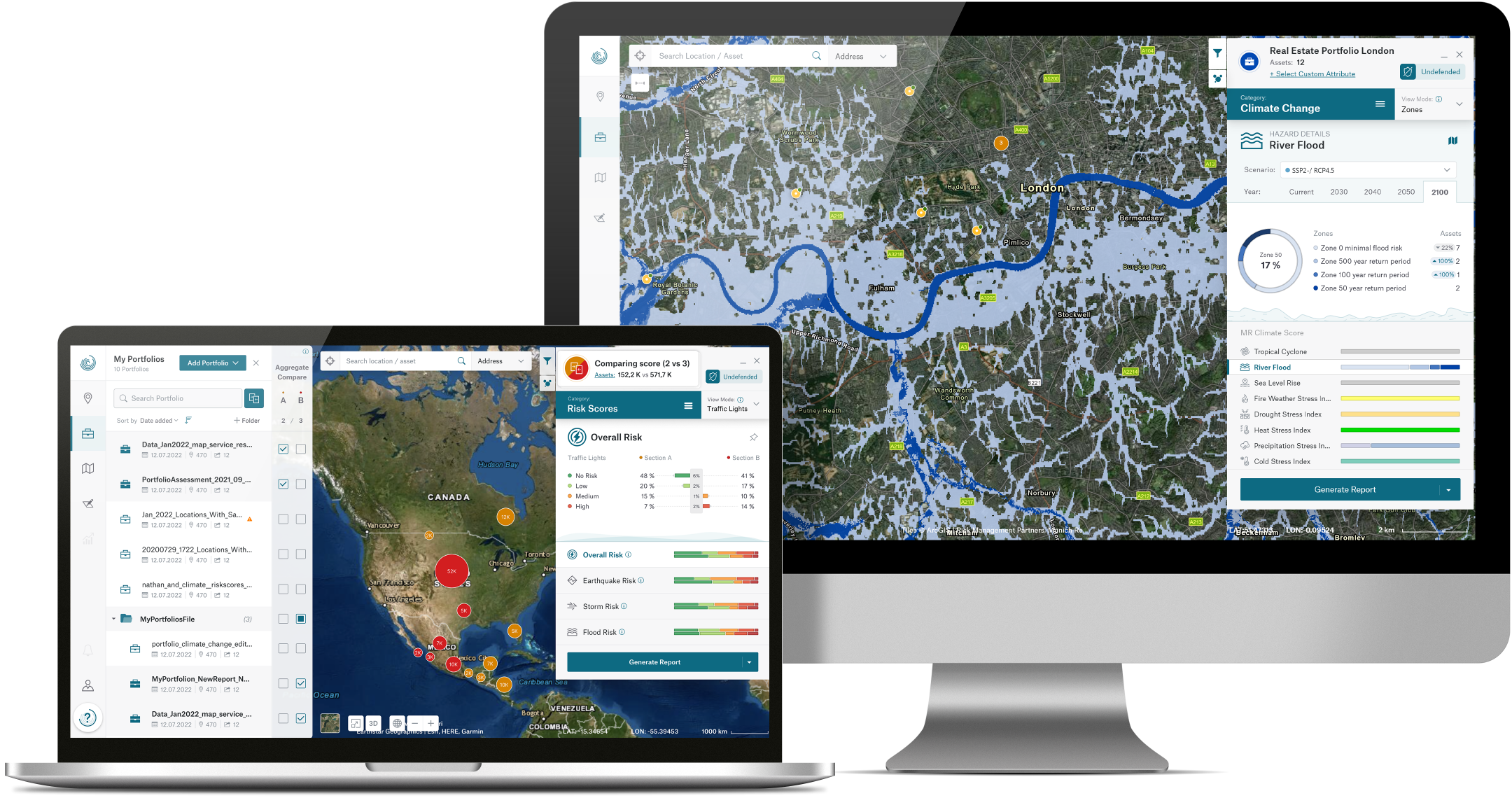
Bringing physical risk insights into key financial processes
Location Risk Intelligence allows financial institutions to embed present and future natural hazard risk insights into portfolio analysis, risk frameworks, and decision‑making across the organisation.
1. Improve portfolio risk management and diversification
Natural hazards can lead to geographically correlated risks such as storms and flooding across portfolios. Concentrated regional risk exposure can amplify losses and undermine diversification benefits.
With Location Risk Intelligence, financial institutions can identify geographic hazard concentrations and compare exposure across portfolios. Informed portfolio construction and steering leads to greater resilience.
2. Support investment and asset-allocation decisions
Long‑term investment performance may depend on asset resilience in changing conditions. Chronic climate risks can influence asset values, expected returns, and exit options across multiple asset classes.
Location Risk Intelligence supports forward‑looking assessment of climate risks and scenario‑based strategy discussions. Such insights inform asset allocation and investment decisions and help to secure returns.
3. Address regulatory and disclosure expectations
Regulatory and supervisory expectations around climate‑related financial risk management continue to evolve. Financial institutions are increasingly required to demonstrate robust identification and assessment of physical climate risks in their risk frameworks.
Location Risk Intelligence supports consistent, transparent, and location‑based analysis that can be integrated into internal risk management processes, stress testing, and climate‑risk disclosures.
4. Strengthen credit and counterparty risk assessment
Physical risks can influence the creditworthiness and operational resilience of borrowers and counterparties. Assets exposed to flooding, heat stress, storms, or water scarcity may present higher default potential or reduced cash flows, leading to greater recovery uncertainty.
Location Risk Intelligence provides location‑specific hazard insights that support credit analysis and counterparty due diligence through risk assessments of individual assets and at company level.
Learn how Location Risk Intelligence can support robust natural hazard and climate risk management in financial services.
Your benefits with Location Risk Intelligence for financial services
Enhance risk assessment
Integrate natural hazard insights into credit, investment, and counterparty analysis to improve due diligence.
Support decision-making
Incorporate climate risk insights into asset‑allocation and capital planning for forward-looking strategy.
Improve transparency
Enable consistent physical risk analysis to strengthen governance, auditability, and regulatory dialogue.
Strengthen portfolio resilience
Identify risks across geographies and sectors to reduce losses and strengthen resilience under stress.
Access decision-ready data
Integrate results into existing workflows via API and generate reports in various formats (PDF, CSV, Excel).
Meet disclosure needs
Collect climate risk data as required by regulators. IPCC-aligned formats simplify reporting and disclosure.
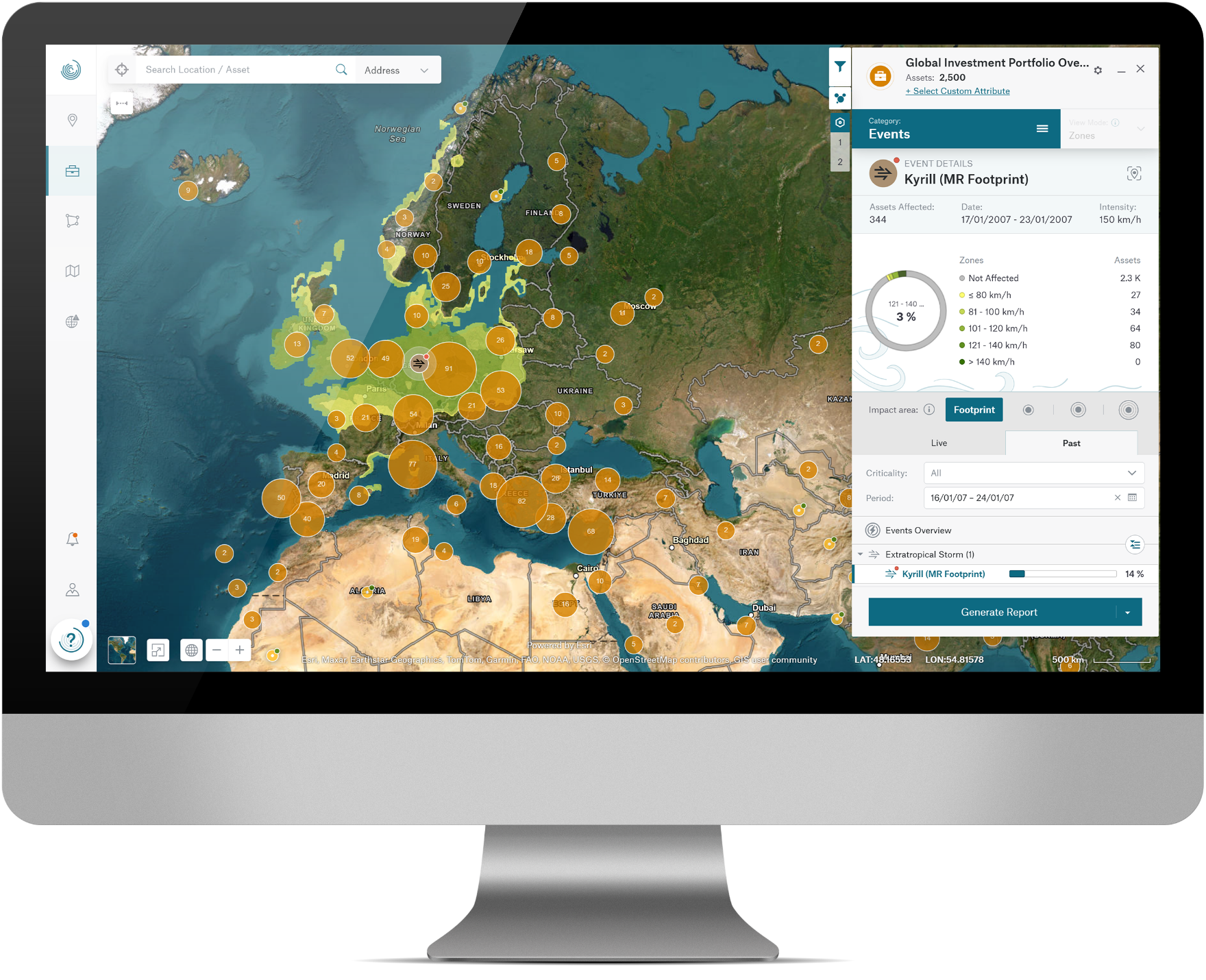
How Location Risk Intelligence and its editions support financial services
Munich Re’s Location Risk Intelligence is a modular SaaS solution that enables financial institutions to identify and quantify risks from natural hazards and climate change across assets, portfolios, and counterparties.
Climate Change Edition
Understand current and future natural hazard risks using IPCC‑aligned scenarios to support risk management and long‑term investment decisions.
Climate Financial Impact Edition
Quantify the potential financial impact of physical climate risks on portfolios and assets up to the year 2100 to reduce credit risk and strengthen resilience.
Company Climate Risk Edition
Assess direct financial losses from natural hazards and climate change for more than 340 million companies. Translate risk into financial metrics to support counterparty due diligence, onboarding, and monitoring.
Strengthen your risk decisions. With Location Risk Intelligence, financial services institutions gain clearer insight into exposure and potential losses related to natural hazards and climate change.
Frequently Asked Questions
How does Location Risk Intelligence enable granular assessments of natural hazard risks across portfolios?
The solution provides location‑level risk insights that can be aggregated across portfolios and asset classes. With Company Climate Risk Edition, you can quantify the financial impact of risk from natural hazards and climate change on corporate portfolios.
How can climate risk insights be integrated into credit, investment, and risk management processes?
Location Risk Intelligence enables institutions to identify concentrations of risk and adjust strategies accordingly. This supports credit analysis, investment decisions, portfolio steering, and risk assessments.
Which types of financial institutions can use Location Risk Intelligence?
Banks, asset managers, investment firms, insurers, financial data providers, fin techs, payment services, and other financial services providers can use the solution.
Can Location Risk Intelligence support climate stress testing and scenario analysis?
Yes. The solution enables forward‑looking analysis under IPCC‑aligned climate scenarios, supporting stress testing of assets and portfolios. This lets you assess the potential impact of natural hazards over various time horizons.
How does Location Risk Intelligence support collateral and asset valuation?
By providing location‑specific hazard and exposure insights, the solution helps financial institutions better understand potential climate‑related value erosion affecting collateral and real assets.
Can the solution help identify correlated climate risks across portfolios?
Yes. Location Risk Intelligence maps natural hazard risks across regions, sectors, and asset types, helping institutions identify geographically correlated exposures that may undermine portfolio diversification.
How does Location Risk Intelligence support supervisory dialogue and regulatory reviews?
The solution delivers transparent, location‑based climate-related data and financial metrics aligned with regulatory requirements including CSRD and TCFD/ISSB. Consistent, standardised outputs are designed to meet the expectations of supervisory bodies and help streamline disclosures.