Electric vehicles
How to address this growing market from an insurance perspective
properties.trackTitle
properties.trackSubtitle
Executive Summary
In recent years, e-mobility has achieved a breakthrough in many markets around the world. The question is no longer if electric vehicles (EVs) are coming and will replace traditional powertrains, but rather how they are coming and when they will take over the largest share of the global powertrain mix. For details on how to differentiate between non-plug-in electric vehicles and plug-in electric vehicles, see below
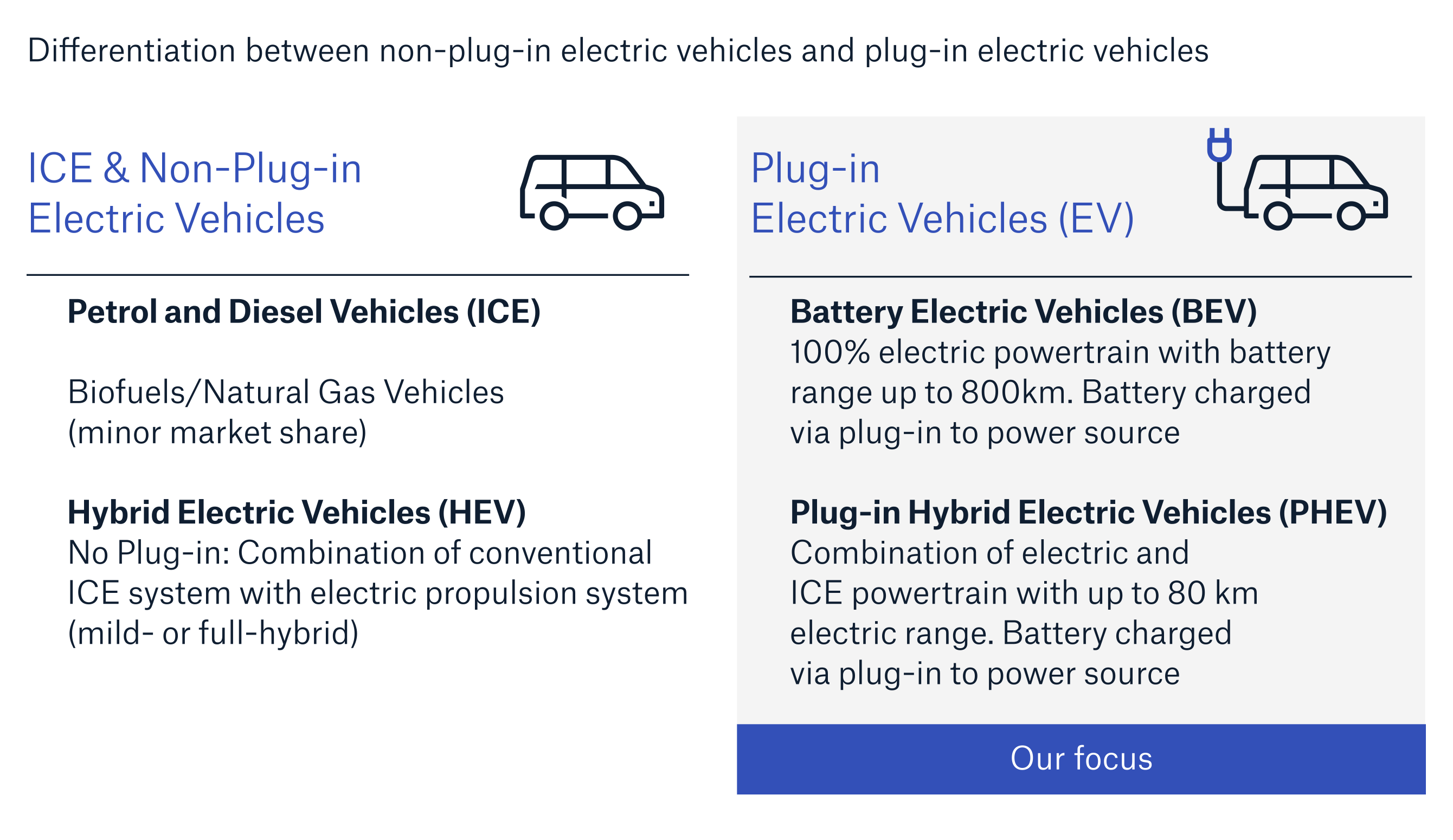
The new rise in EV sales also brings challenges and opportunities for many different market segments. OEMs need to decrease their production costs for EVs and increase their vehicles’ range at the same time. Governments need to decide how long they want and need to continue to incentivise the markets. And the whole charging network industry needs to find a way to provide a convenient charging experience and sufficient capacities. But (re)insurance also plays a vital role in this equation and needs to address new customer risks and deliver state-of-the-art solutions with a high level of quality.
The challenge for insurance is to identify new risks concerning the vehicle itself and potential new driving behaviours, despite not having sufficient EV data at hand. The battery especially plays an important role, as it represents the major cost block in case of a claim.
By conducting a thorough and statistically robust analysis on a dataset with high EV exposure, we came a substantial step closer to accurately quantifying EV risk. We can say with a good level of confidence that we believe MOD Accident frequency and MTPL frequency are moderately higher while MOD Glass severity is slightly reduced, though the magnitude of this effect, and whether it is temporary, will still need to be investigated further as the EV market share continues to grow.
Furthermore, we do not currently have evidence suggesting that EVs are subject to different risks than ICEs for MOD Assistance or MOD Other perils. For future analysis, questions concerning fire, theft or other perils will be interesting to address as the availability of data increases.
Disclaimer: The conclusions presented throughout this report are not necessarily applicable to other portfolios or countries. Therefore, they should be taken with a grain of salt when comparisons are made.
Get in touch with us