The frequency of severe hailstorms is increasing more rapidly in Europe than anywhere else in the world. Closely linked to climate change, such storms can cause considerable damage. This is a key takeaway from a recent study compiled by researchers from the European Severe Storms Laboratory (ESSL), the Adam Mickiewicz University, Poznań, and Munich Re, published in Nature Geoscience, a science journal1. The researchers analysed weather data from 1950 to 2023 and insurance losses from 1992 to 2023.
Referred to as very large hail (or VLH), hailstones larger than 5 centimetres can cause considerable damage to buildings, vehicles and infrastructure – and also pose a danger to people. When severe hailstorms strike densely populated areas, losses quickly run into the billions. The study in Nature Geoscience analysed the correlations between weather data, the frequency of VLH, and loss trends. Small hail (< 2 cm) can also cause significant damage, especially in agriculture.
X11_consent-in-forms.jpg/_jcr_content/renditions/original./Raedler_Anja_n340032_(c)X11_consent-in-forms.jpg "Anja Rädler")
This study is the first comprehensive analysis of global risks, trends and losses with regard to very large hail. Its insights have enabled us to enhance our hail risk model for Europe, which now reflects cutting-edge research. In short, it's a tremendous boon to our specialists in risk assessment and underwriting.
A summary of the key findings
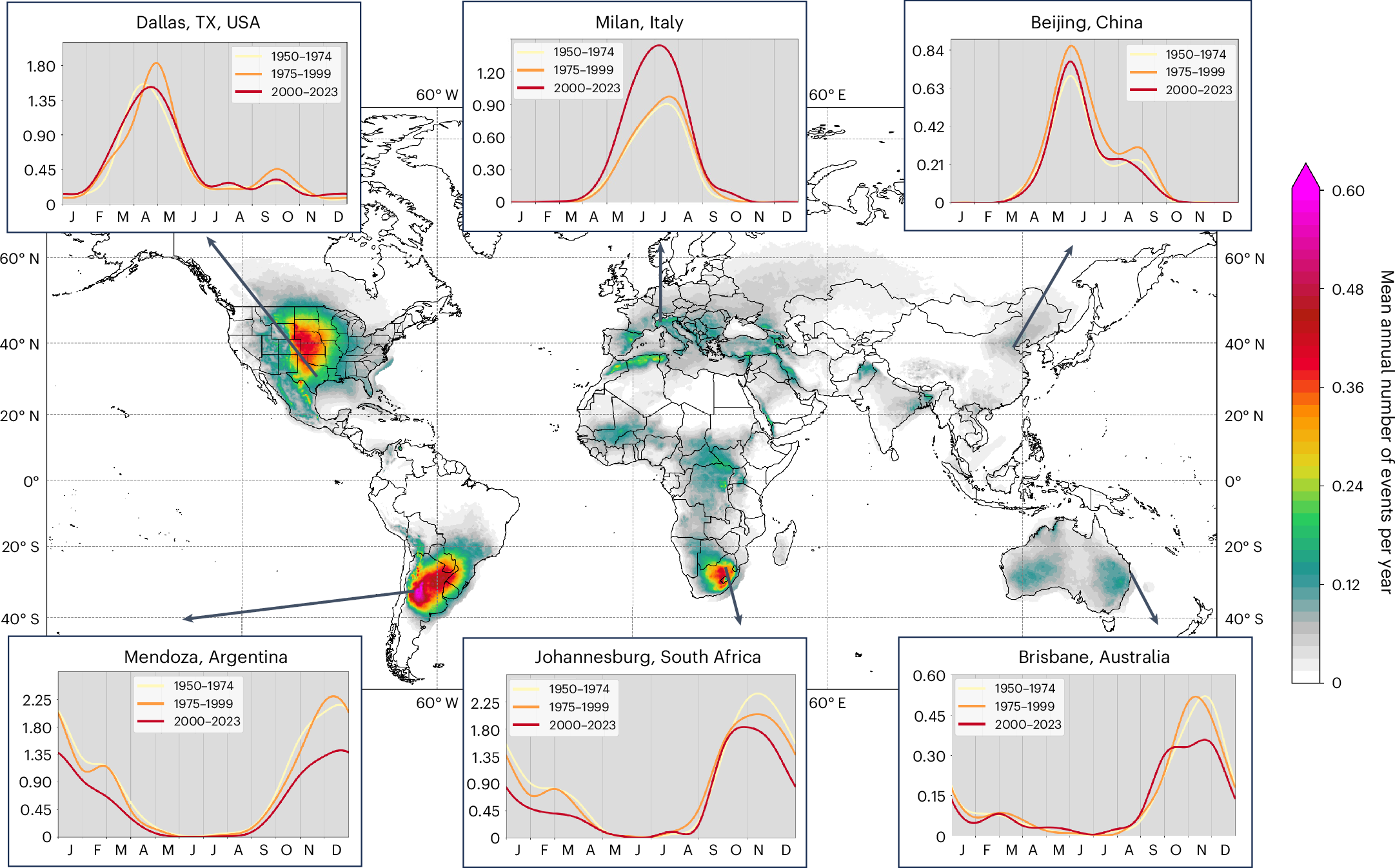
Mean annual number of VLH events between 1950 and 2023
Mean trend in annual number of VLH events per decade between 1950 and 2023
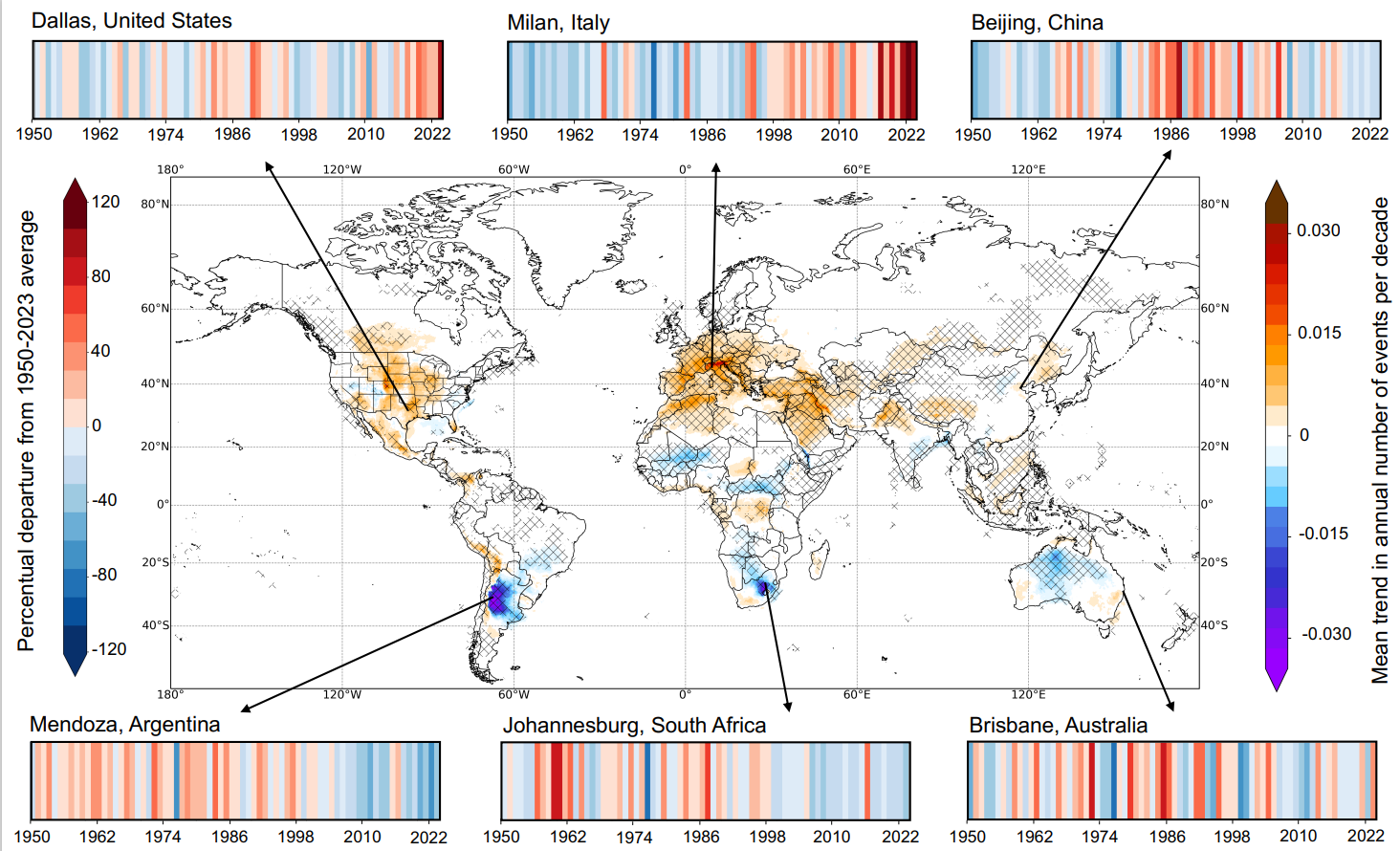
In the United States, the hail hazard varied. While no increase was observed in many regions, the risk of very large hailstones rose by around 50% in and near Dallas, Texas, for example.
By contrast, the frequency of VLH decreased significantly in some parts of the southern hemisphere, particularly in South America. The study’s researchers attribute this decline to factors such as lower humidity and greater stability in the middle layers of the atmosphere – which also tends to be influenced by climate change and changing precipitation patterns, including longer droughts.
According to the study, losses caused by severe hail rose in the USA, Australia and Europe. This was largely attributable in Europe to the greater frequency of severe hailstorms and, indirectly, climate change; other factors played pivotal roles in Australia and the United States, including higher exposed values and/or greater vulnerability.
- Battaglioli, F., Taszarek, M., Groenemeijer, P. et al. Contrasting trends in very large hail events and related economic losses across the globe.
Nat. Geosci. 19, 52–58 (2026). https://doi.org/10.1038/s41561-025-01868-0
(The original article is licensed under a Creative Commons Attribution 4.0 International License. To view a copy of this licence, visit http://creativecommons.org/licenses/by/4.0/)

Hail is a truly destructive natural hazard. Although hailstorms affect only small areas, large hailstones can cause tremendous damage. If very large hail falls on a conurbation, billions in losses can happen quickly. Studies such as this one are very important in helping us to better understand the risks.
Our expert