Improved risk assessment
Munich Re offers its clients medical underwriting guidelines that can be applied to various disability insurance products – in over 120 markets worldwide. In Germany, this includes disability insurances for own or any occupation. The expected claim incidences of these products depend on the definition of the benefit triggers. In the case of income protection insurance, in Germany, the claim occurs when the insured individual can perform less than 50% of their last occupation for a period of at least six months. With total and permanent disability insurance, the insured individual is permanently unable to carry out any kind of work. The probability of a claim occurring is also influenced by demographics, occupation and pre-existing medical conditions.
The medical literature rarely provides analyses that align with insurance-related issues of disability insurance products. It has therefore often been difficult to establish clear risk relationships between pre-existing medical conditions and the various product definitions. Medical underwriting guidelines for one disability product were accordingly largely derived from another disability product with a different definition through individual expert assessments. Ongoing digitalisation and the resulting availability of increasingly detailed underwriting, portfolio and external data allow ever more precise analysis, while data-based analyses and specialist expert assessments are increasingly complementing each other.
In collaboration with a data analysis institute, Munich Re investigated the relationship between diagnosed pre-existing conditions and subsequent duration of sick leave and periods of reduced earning capacity – as proxies for various product definitions. The retrospective longitudinal study with an observation period of eight years was based on a comprehensive dataset from the German statutory health insurance system and related to several million insured individuals. The dataset comprised over 1,000 medical diagnoses in ICD-10 format, as well as demographic and socioeconomic information.
The results of the study at a glance
- Additional claims cases for basic coverages with a simple but strict benefit definition (e.g. total and permanent disability) are claimed disproportionately by people with serious or chronic pre-existing conditions. These can include cancer, severe neurological disorders and mental disorders.
- These diagnoses with chronic and severe courses show an increasing relative claim risk from comprehensive coverages to basic coverages. Here, the use of appropriate medical loadings is essential for protecting the community of policyholders.
- Stable risk patterns were observed for diagnoses with a milder or controllable clinical course, such as iron deficiency anaemia or asthma. Here, medical risk loadings or exclusions for such conditions can be applied uniformly to all types of disability insurance.
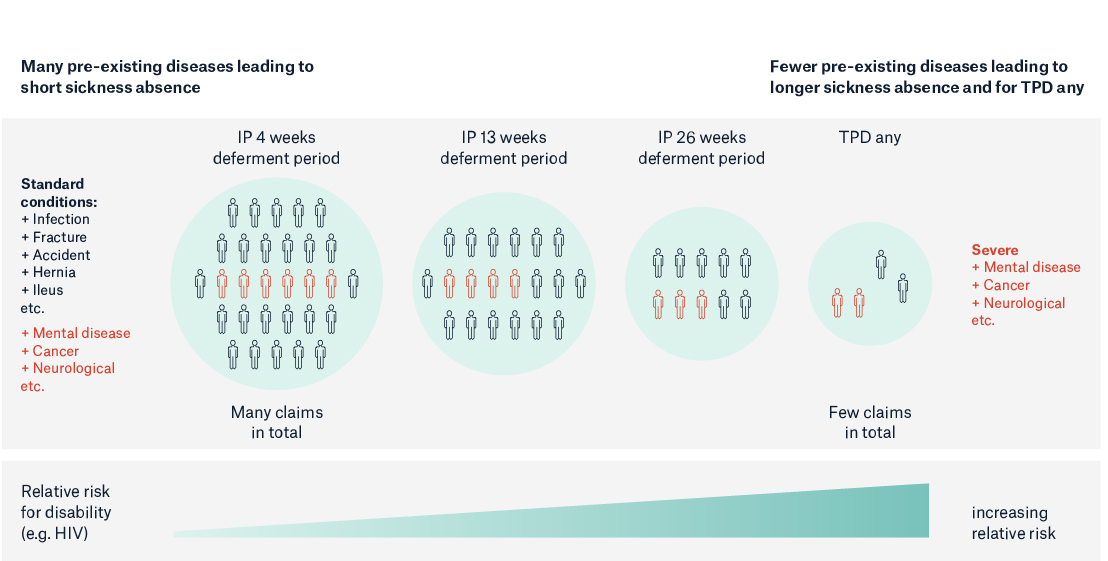
Many pre-existing conditions can lead to short-term absence from work, while a few pre-existing conditions can result in longer absences from work.
Click here to access to the PDF directly.
Implications for life insurance
Combining insurance-medicine and actuarial expertise with data-based findings creates the basis for more precise risk assessments and innovative product design. Insurers benefit from adequate assessments at the time of underwriting, while policyholders benefit from fairer products that serve their needs.
The study shows that risk loadings for disability covers must be calculated precisely and in line with the risks involved. Basic coverages with stricter benefit triggers (e.g. longer deferment periods or permanent disability for any occupation) do not necessarily lead to lower medical risk loadings. Munich Re has accordingly revised its underwriting guidelines for disability products on the basis of these new findings. For certain medical conditions, the guidelines now offer updated recommendations for occupational disability and total and permanent disability of any occupation which have already been incorporated into the MIRA underwriting manual and Munich Re's digital regulations. These in turn form the basis of the MIRA Digital Suite, including MIRA Pro.

Munich Re's expertise in medical underwriting is based on a combination of medical know-how and data analyses. We are keen to expand this expertise – not least for the benefit of insurers and policyholders. In a regulatory environment where medical underwriting is increasingly scrutinised by authorities and patient advocates, it is essential to continuously refine the evidence-based approach to underwriting and make it more transparent.
Experts