
Summary
- With more than 100 trillion US dollars in real estate value at stake in OECD countries, climate risk has to run through the entire asset life cycle because heatwaves, floods and other natural and climate hazards directly hit value, cash flow and exit options.
- Investors have access to a wealth of platforms full of maps ansd hazard scores, but it is challenging to obtain clear answers on which assets are truly at risk. Location Risk Intelligence by Risk Management Partners, a unit of Munich Re, can help to close this gap.
- Regulators see climate risk as an increasingly relevant risk, pushing real estate, banks, insurers and corporates to assess, act and report on physical climate risk and making it a boardroom topic.
The 12th OECD Forum in Paris
Did you know that in Paris four out of five buildings were constructed before 1974, long before climate resilience was part of any building code? Those zinc rooftops that look so iconic from a distance now act like radiators in a heatwave. Basements lie in the path of a swollen Seine. Cooling systems are retrofitted into structures that were never designed for forty degree summers.
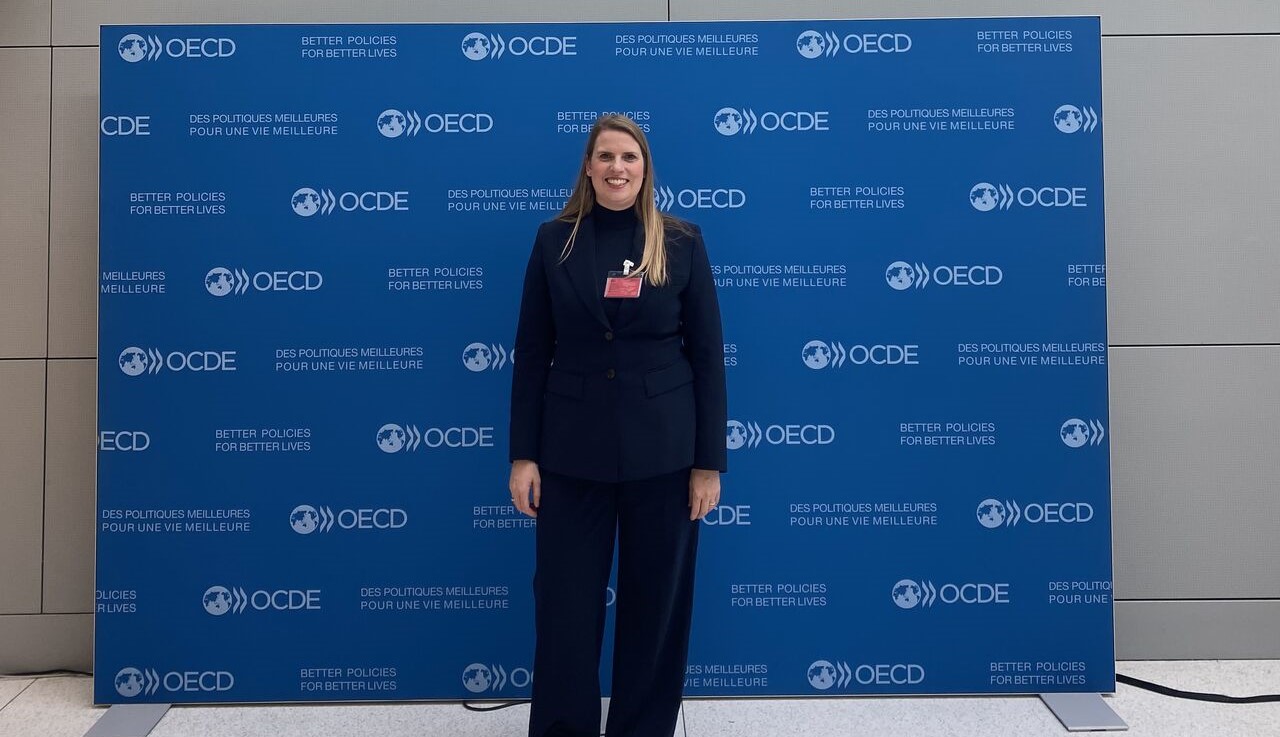
This is the physical backdrop against which the 2025 OECD Forum on Green Finance and Investment took place. Under the theme “High-Level Plenary: Investing in Sustainability, Investing in Economic Resilience”, policymakers, supervisors, investors and practitioners came together to discuss how capital can support a climate compatible economy.
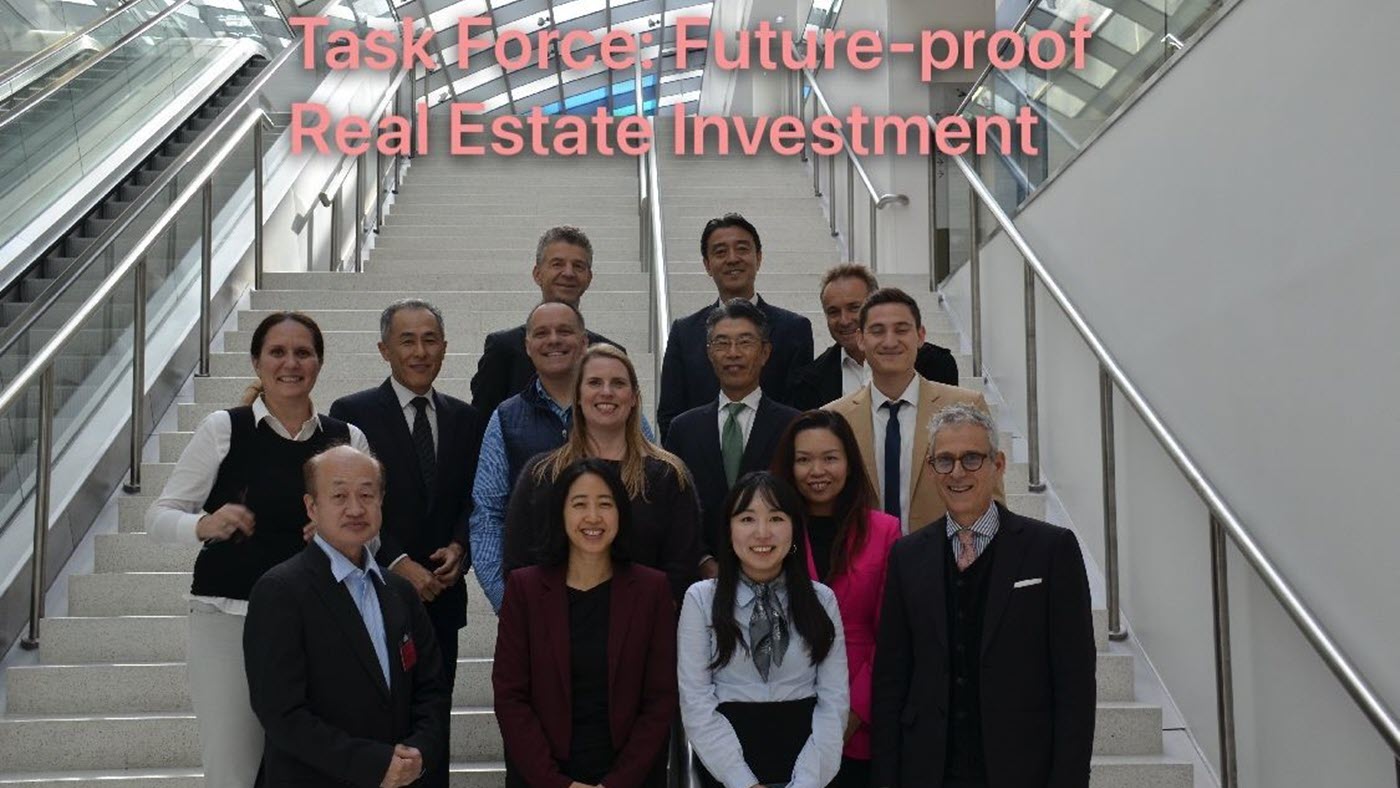
As Risk Management Partners, we participated in the Extended Panel Discussion “Future-Proof Real Estate Investment”. Here is what we took away from two intense days at the 12th OECD Forum in Paris.

1. Future proof real estate is now a macro topic
The extended session on “Future-proof Real Estate Investment” captured the tension. Real estate in OECD countries alone is worth more than one hundred trillion US dollars. It is both a driver of emissions and one of the asset classes most exposed to heatwaves, floods, storms and subsidence.
A clear message in Paris was that climate risk needs to run through the entire asset life cycle: site selection, due diligence, financing, capital expenditure planning, asset management and exit. It is no longer enough to ask whether a building looks “green” on paper. The real question is how that building behaves in the fifth heatwave of the year, or in the next 50 year return period flood event. The discussion moved quickly from theory to practice. Valuation standards, risk models and investment strategies need to reflect not only current hazard, but also how climate change impacts real estate in the future under different emission scenarios.
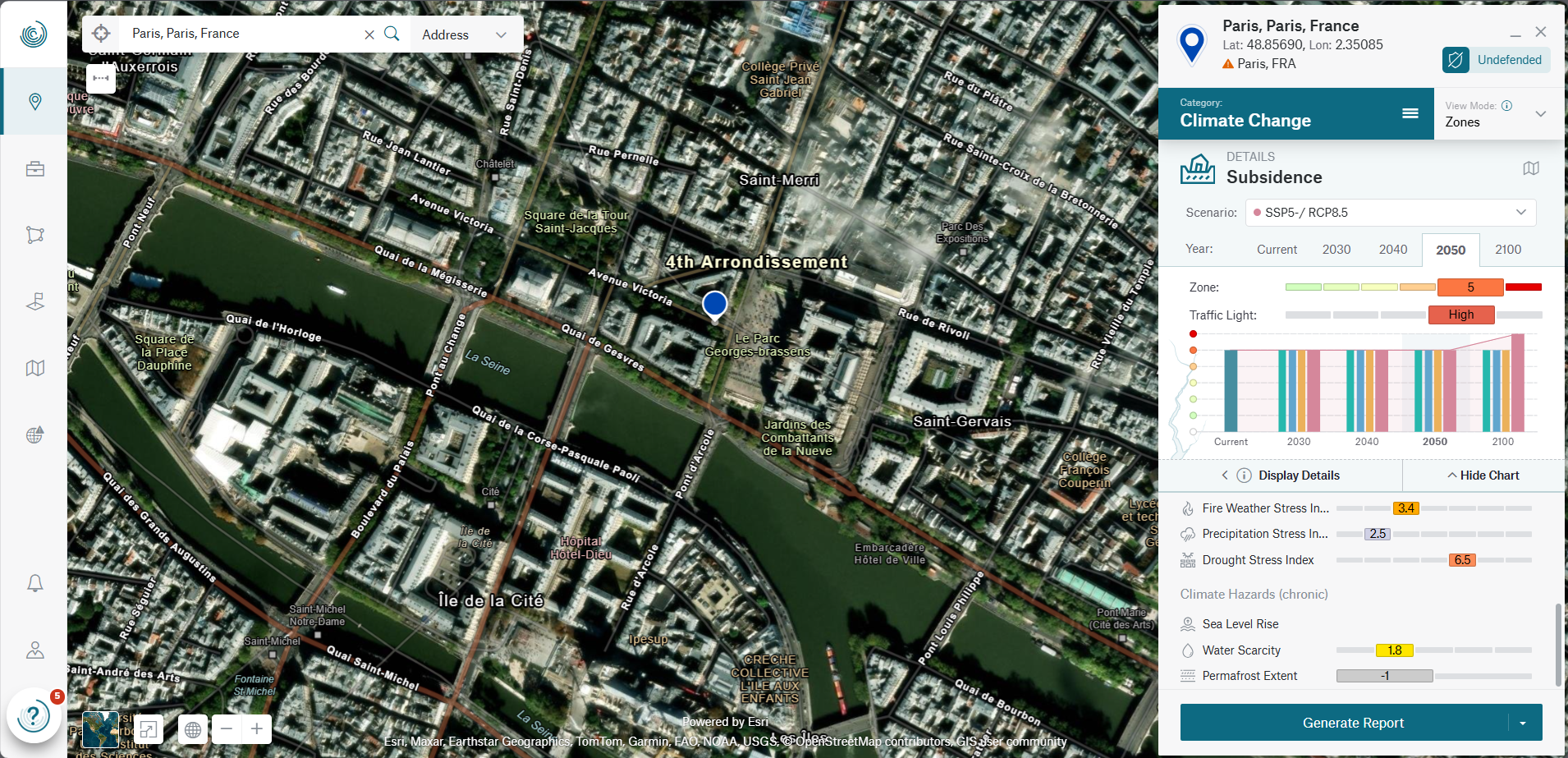
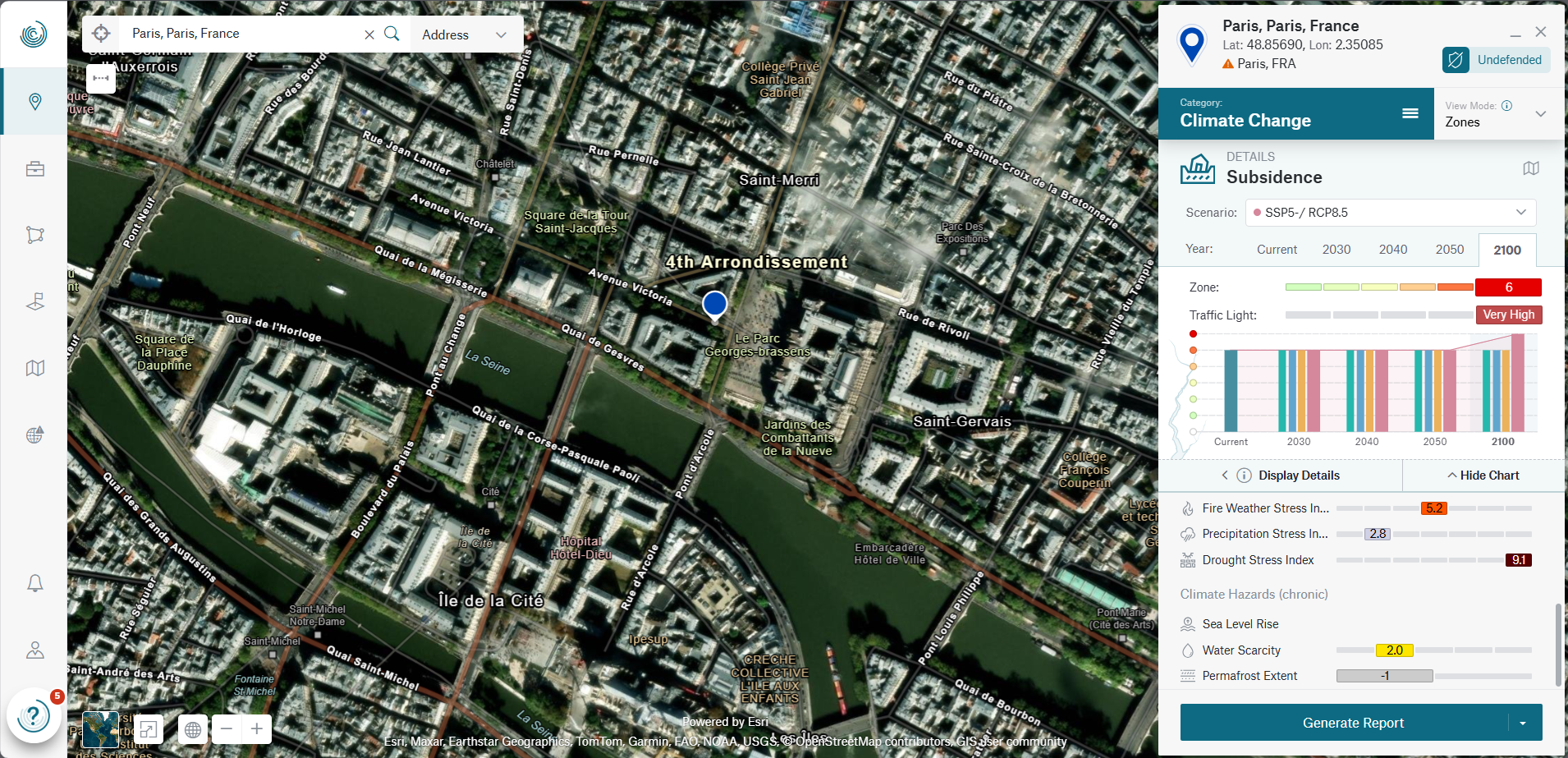
The following images display screenshots from the Climate Financial Impact Edition of Location Risk Intelligence, which helps organisations to integrate climate-related financial risk data into their business processes and decisions. It visualizes projections for subsidence, the hazard of gradual sinking or sudden collapse of the ground, for 2050 and 2100 under SSP5-/ RCP8.5 scenarios (undefended) in Paris. While the risk stays “high” until 2050, it even jumps to “very high” in 2100 projections.
2. Data does not necessarily mean action
One theme surfaced repeatedly: Institutions have more climate data than ever before, yet decision makers still struggle to turn it into concrete action.
Real estate investors and asset managers described platforms full of maps, hazard scores and scenarios. At the same time, investment committees still asked fundamental questions: Which assets are genuinely at risk? What is material at portfolio level? Which adaptation measures alter the risk profile, and by how much?
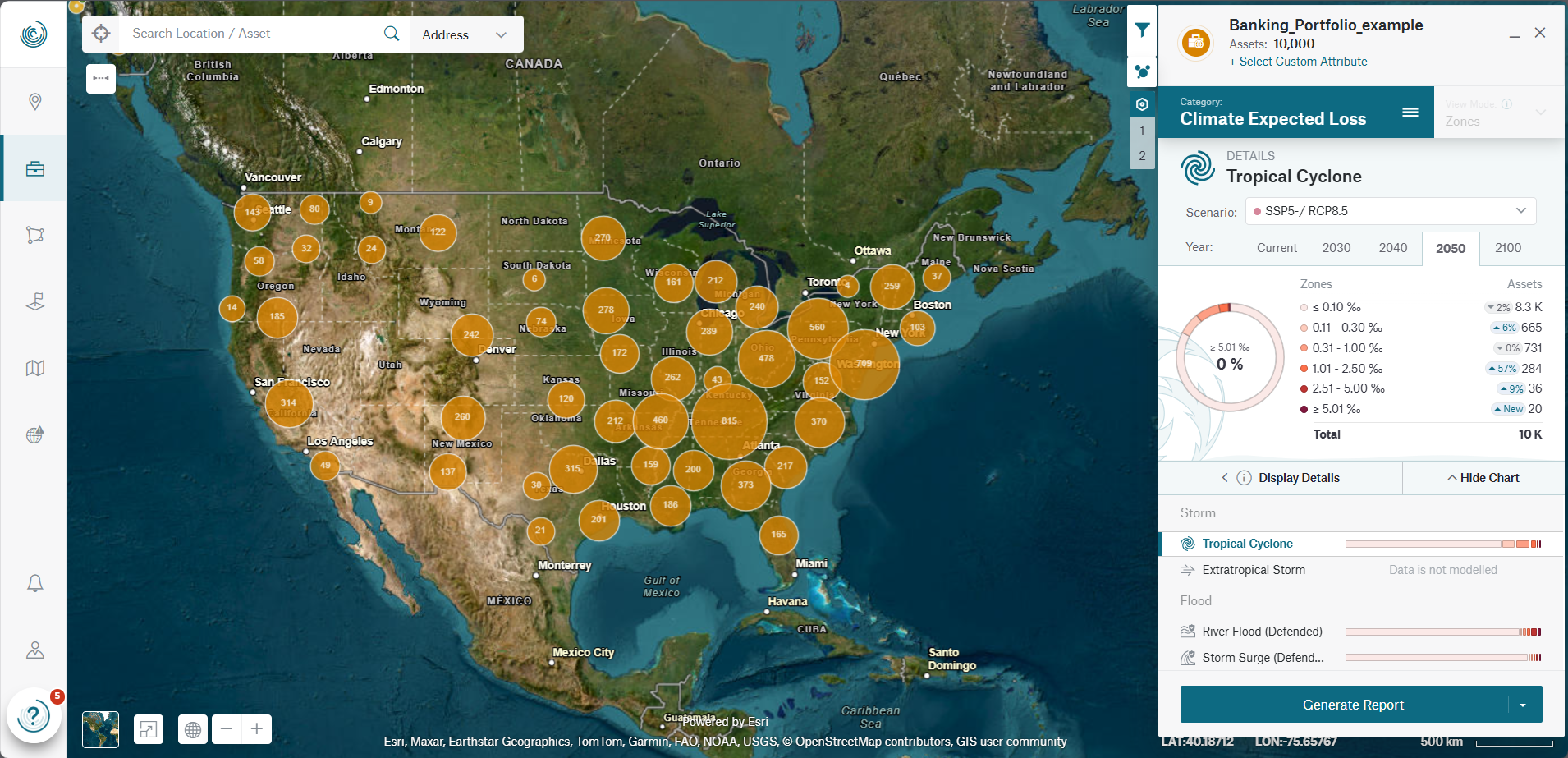
This is exactly the gap where we can contribute. Location Risk Intelligence connects hazard scores to expected losses, and it does this across entire portfolios and at asset level. Our example shows the Climate Expected Loss due to tropical cyclone events for a 10,000 asset banking portfolio in the US. Climate Expected Loss is the average annual loss, i.e. annualised expected loss, due to physical damage to buildings and their contents, measured in per mille [‰].
3. Regulation as catalyst, not comfort blanket
The broader forum agenda looked at how regulation can unlock capital for mitigation, adaptation and biodiversity. In the real estate panel, the message was sharper: regulation isn't about ticking boxes. It's a catalyst that forces institutions to get their risk, finance and sustainability teams working from the same data and speaking the same language.
Regulators are becoming increasingly clear that organisations must address physical risks. For insurers and reinsurers, this is familiar ground – catastrophe models have always been part of pricing and portfolio management. What's changed is the expectation that this expertise now needs to flow into real estate valuations, bank risk models and corporate planning.
Conclusion
Contact our expert
Want to keep an eye on how climate risks affect your industry?
properties.trackTitle
properties.trackSubtitle