Learn more in our webinar

Summary
The rules are final, but the starting point can be pragmatic
The EBA published its final Guidelines on environmental scenario analysis on 5 November 2025, complementing its broader ESG risk management framework. The approach rests on two pillars: integrating environmental risks into existing stress testing frameworks to assess near-term financial impacts, and conducting resilience analysis to evaluate how environmental risks and opportunities could affect business models and strategies over the medium to long term.
January 2027 is a deadline, not a starting signal. By that date, institutions are expected to have a defensible approach in place: one grounded in forward-looking analysis, a coherent narrative, documented assumptions, and cross-functional processes that connect scenario analysis to real decisions.

Environmental scenario analysis is not a pure modelling exercise. Its value lies in helping banks connect regulatory expectations with strategic choices. Understanding where risks are material, how resilience can be strengthened, and which assumptions need to be made explicit across the organisation.
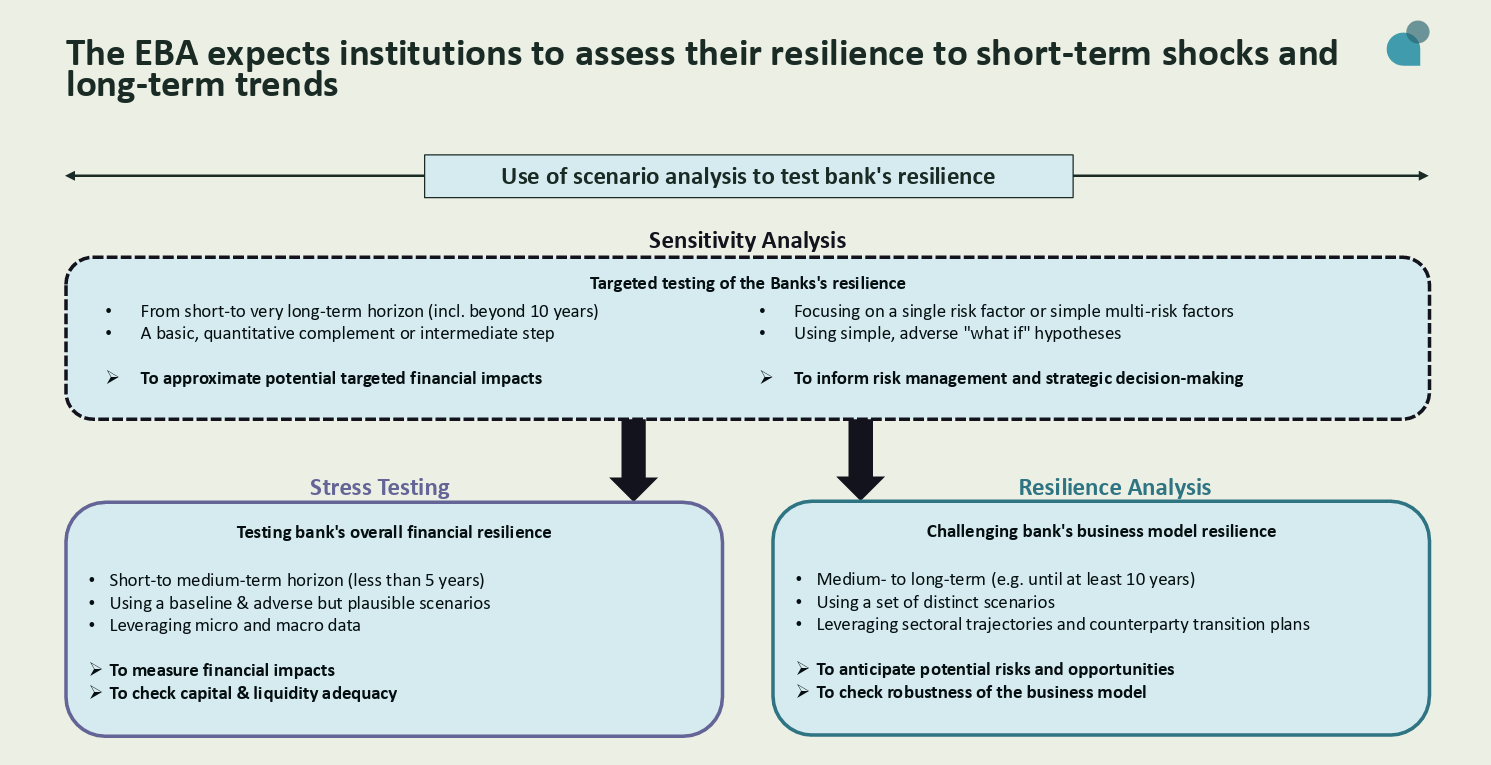
Visual 1: The EBA’s two track approach
A simple flowchart illustrating the conceptual structure reflected in the EBA Guidelines (Source: EBA)
Where banks should start in practice
The most common mistake is treating this as one large modelling project. The EBA embeds proportionality throughout: the Guidelines focus on material risks, allow for qualitative approaches and expert judgement, and accept simplified methods like sensitivity analysis as a starting point. Institutions don't need to solve everything at once, but they do need a structured, credible path forward.
In practice, the starting point is the narrative, not the model. Which environmental risk drivers are most relevant to the institution's business model, sectors, and geographies? Which physical and transition risk channels matter most? Which portfolios carry the most exposure?
Once those questions are answered, it becomes clearer where a near-term stress testing lens applies and where a longer-term resilience view is needed. The Guidelines support both, with resilience analysis covering a horizon of at least ten years.
This is also where granular, asset-level climate risk data can add real value: not by replacing existing processes, but by helping institutions translate scenarios into inputs that sit alongside portfolio analysis, credit workflows, and strategic planning.

For many banks, the immediate challenge is not ambition but execution: knowing where to begin. High-quality, asset-level climate risk data provides the bridge between regulatory scenarios and unlocking decision‑ready insights.
Six steps to get moving
- Start with materiality, not completeness.
Identify the environmental risks most relevant to the institution's business model, sectors, and geographies. The EBA is clear: scenario analysis should focus on what's material first. - Define a common narrative across functions.
Develop one coherent internal view of how the business environment could evolve. The Guidelines stress the importance of a narrative that is understood, endorsed, and used consistently – not just in risk, but across the organisation. - Separate short-term stress testing from long-term resilience analysis.
These are related but distinct exercises. One focuses on near-term financial adequacy; the other asks whether the business model remains viable over time. - Use recognised scenarios as a base, then adapt them.
The EBA points to established sources such as the NGFS while allowing institutions to tailor scenarios to their specific risk profiles and exposures. - Accept that early-stage work may be partly qualitative.
Where data gaps or long-time horizons limit precision, expert judgement is expected. Not a shortcut, but a legitimate part of the maturity journey. - Connect scenario analysis to decisions.
Scenario analysis should inform portfolio steering, credit processes, sector reviews, risk appetite discussions, and resilience priorities. If it ends as a report on a shelf, the exercise has missed its point.
Conclusion
Frequently Asked Questions (FAQ)
What do the EBA Guidelines on environmental scenario analysis require from banks?
What is the difference between stress testing and resilience analysis under the EBA framework?
Do banks need fully quantitative models from day one?
Where should banks start if data and methodology are still evolving?
Which scenarios should banks use as a starting point?
Which Location Risk Intelligence Edition is most relevant for environmental scenario analysis?
Company Climate Risk Edition allows banks and final institutions to quantify physical climate risk across entire corporate portfolios. It provides Climate Expected Loss values for four key natural hazards as well as an overall aggregated score.
Climate Change Edition helps banks assess how physical climate risk exposure evolves under future warming scenarios up to 2100, making it useful for forward-looking scenario design and exposure analysis.
Climate Financial Impact Edition goes one step further by translating climate-related risks into financial metrics, including expected loss-based views that can support portfolio, credit, and resilience discussions.
Reporting Edition is most relevant when institutions need to analyse, document, and structure climate risk information for reporting and audit-oriented workflows.