Get our whitepaper on wildfires in North America

Summary
Wildfire is increasingly a nationwide risk across the United States, not a West Coast exception. Statistics from the National Interagency Fire Center show that, between 2020 and 2025, the United States averaged 62,000 wildfires per year with roughly 7.3 million acres burned annually. At the same time, the White House accelerated the regulatory pace by issuing an Executive Order on Wildfire Prevention and Response. Expectations are shifting from limited actions in historically affected areas to a more systematic and pro-active approach to wildfire risk.
That shift was clear at a recent North American Electric Reliability Corporation (NERC)-led workshop in Salt Lake City, Utah. Regulators, utilities, and researchers discussed how wildfire hazard conditions and resulting risk are affecting the reliability of the power grid across the United States. Wildfire affects power systems in two directions at once: the grid is exposed to fire, smoke, and heat, while equipment faults are often also ignition sources for new fires.
One takeaway stood out: with wildfire hazard intensifying and the power grid expanding, spatial intelligence is a key instrument in the toolbox of wildfire risk mitigation. Without granular, risk-based prioritisation to identify where risk is building across assets and corridors, wildfire mitigation in the power sector will remain inefficient, costly, and insufficient.
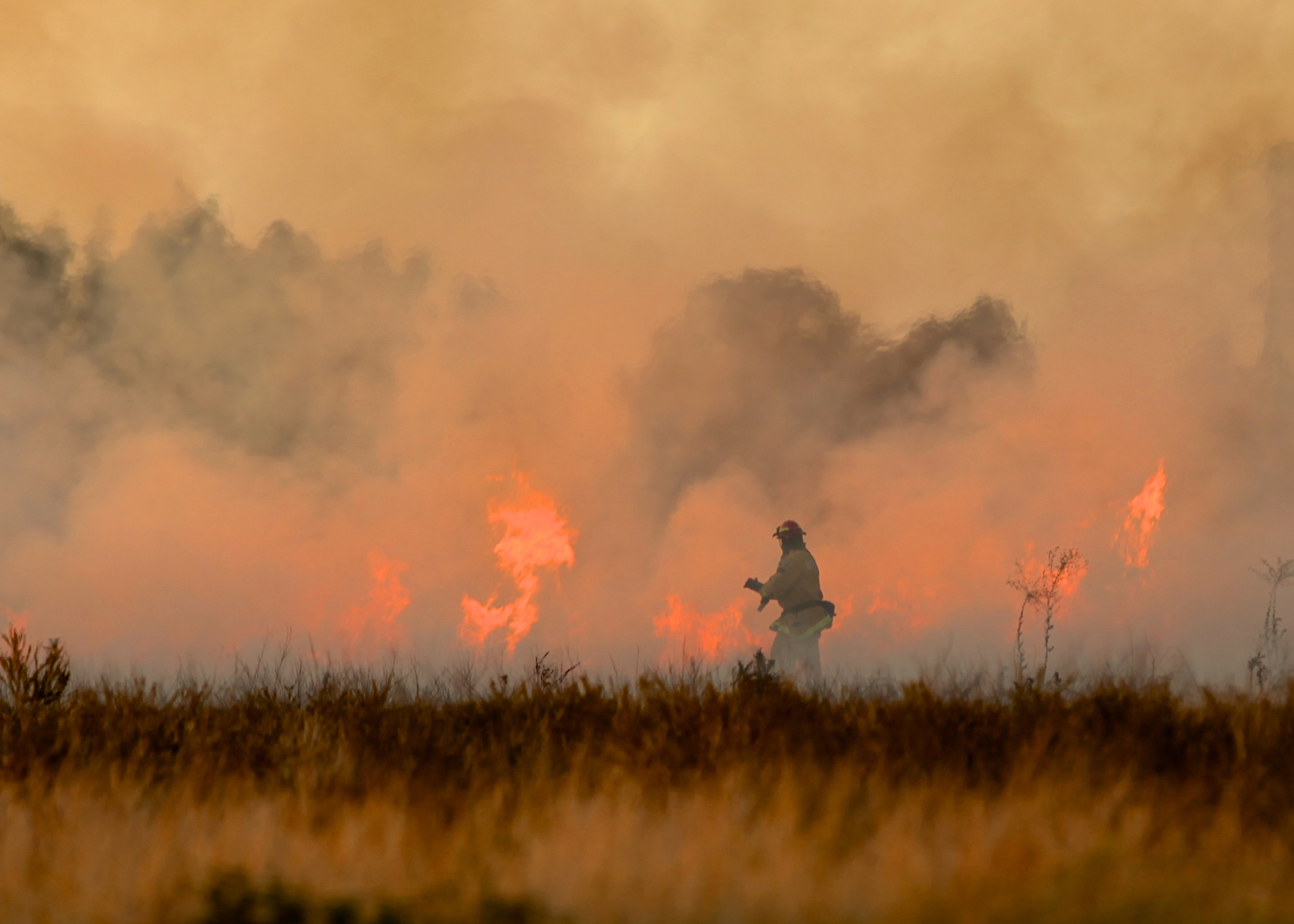
Firefighter fighting a brush fire
What are the lessons from the Los Angeles fires?
According to Munich Re estimates, the January 2025 Los Angeles wildfires caused around US$ 53bn in overall losses and roughly US$ 40bn in insured losses (inflation-adjusted). A hazardous combination of drought and strong winter winds created ideal wildfire conditions.
Thirty people lost their lives, thousands their homes. It became the most expensive wildfire disaster on record.
While California is well experienced with wildfire, there is an increasing risk that a major wildfire shock arrives in a region with far less experience managing wildfire at scale. In such regions, a lack of preparedness and knowledge around wildfires can have ever-larger consequences – in particular in critical infrastructure such as the power grid. As societies electrify transport, heating and industry, as well as add new capabilities such as AI, any disruption to the grid has serious socio-economic impacts.
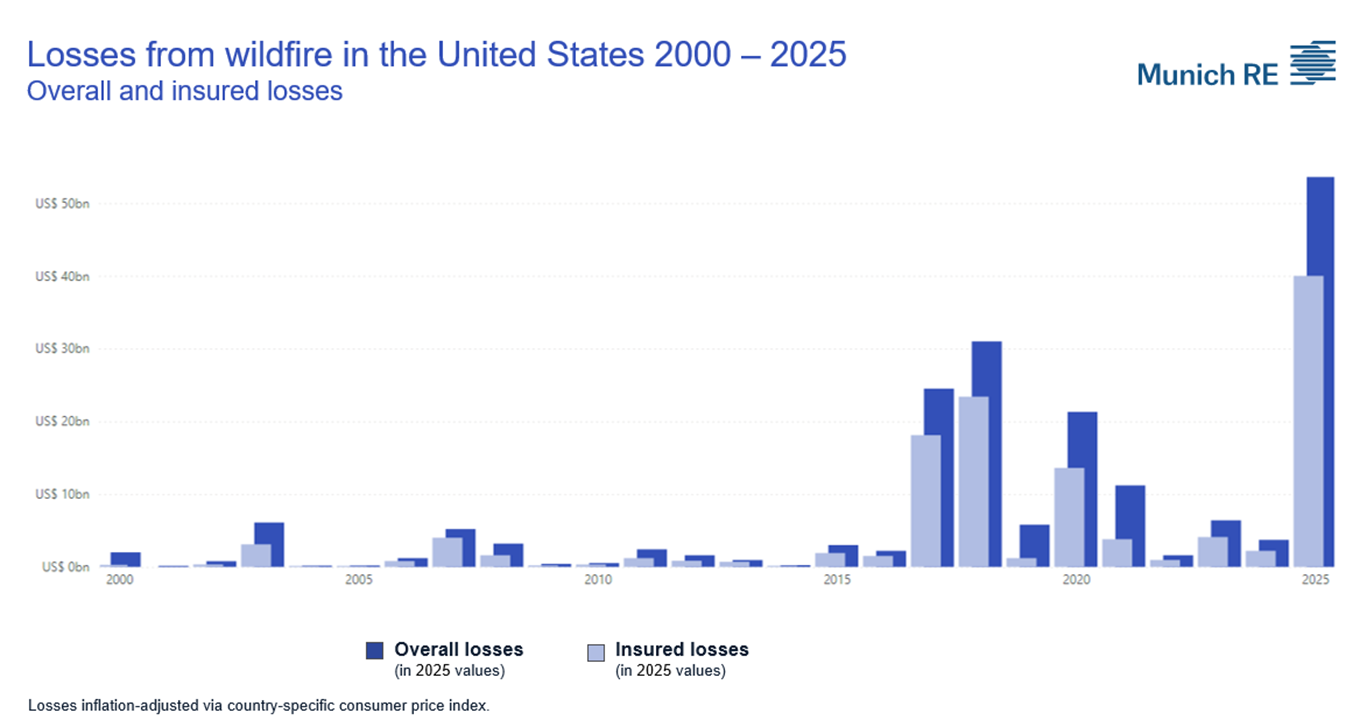
Source: NatCatSERVICE, January 2026. Munich Re's NatCatSERVICE is a global database containing loss data from 1980 onward for all types of natural disasters, excluding drought and heatwaves
Is wildfire risk still a California story?
California remains the United States' best-known wildfire hotspot, and the heaviest hazard and loss burden is still concentrated in the West. Yet recent events make clear that wildfire is not a regional niche. Oregon's 2020 fire season showed how prolonged heat, drought, and strong winds can drive large, fast-moving fires across a broad footprint. Colorado's Marshall Fire (2021) demonstrated that wind-driven grassland blazes can produce severe losses within hours, with public reporting linking ignition to electrical infrastructure.
These examples show that wildfire can no longer be dismissed as a Western utilities problem: risk materialises wherever elevated hazard conditions intersect with dense assets, critical corridors, and potential ignition sources. As wildfire risk becomes more relevant across regions, it is taking centre stage in regulation, resilience planning, and insurance.
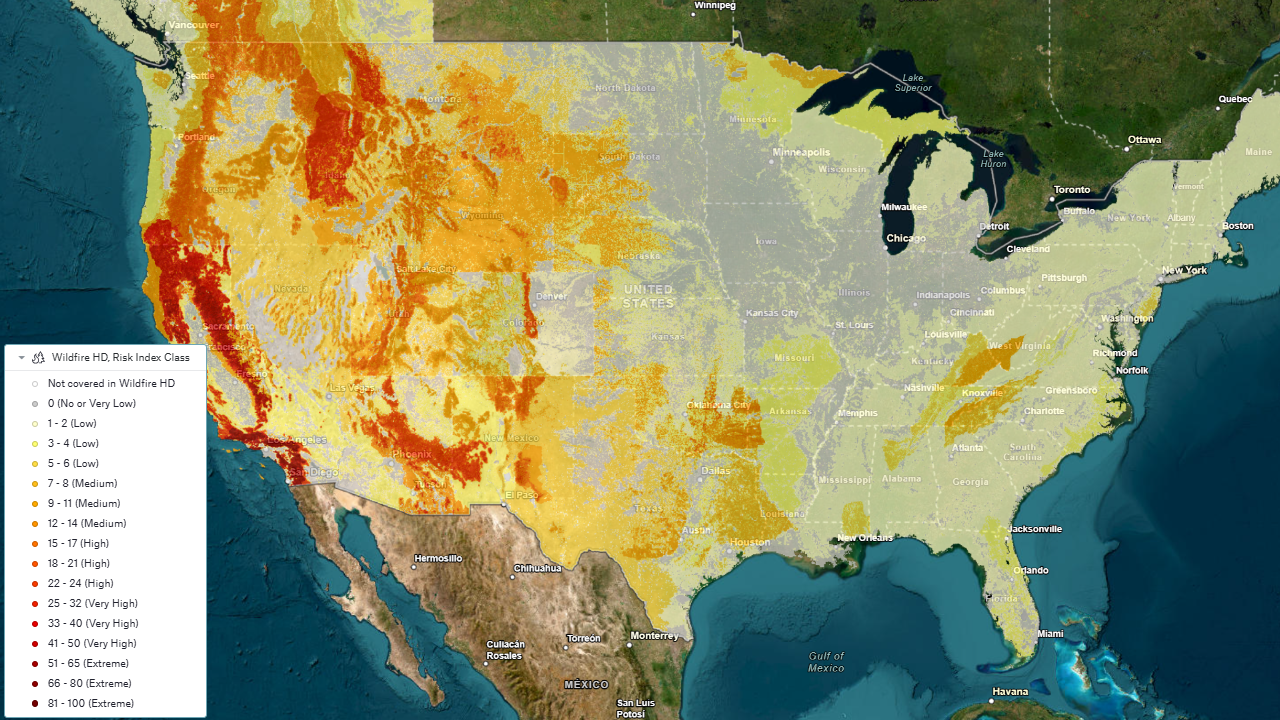
Source: Munich Re’s Location Risk Intelligence.
Table I:
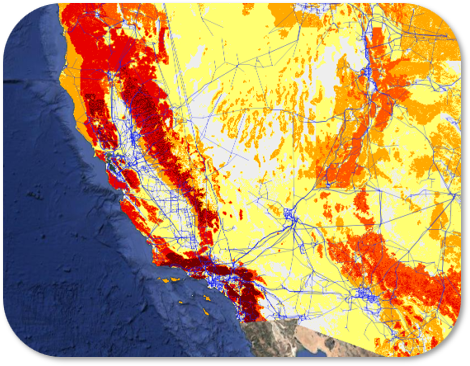
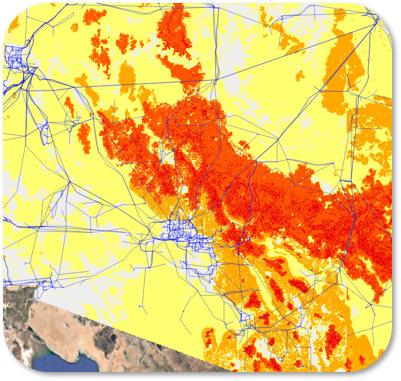
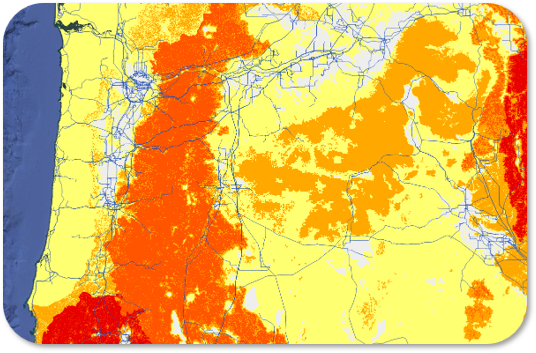
States with the highest share of analysed power lines in High, Very High, and Extreme Wildfire HD Risk Index classes
California
Arizona
Oregon
What are the implications for the power sector?
Following the devastating 2025 wildfires, the President of the United States asked the Department of Energy, the Federal Energy Regulatory Commission and NERC to develop new standards and best practices for wildfire mitigation in the power sector. The resulting report, due in May 2026, will directly influence how states and utilities are expected to manage wildfire risk going forward. Two themes dominated the workshop discussions:
- Risk-based prioritisation: Utilities cannot mitigate everything at once. Regulators increasingly expect utilities to identify the small share of assets that drive a disproportionate share of wildfire risk, and to focus investment there first.
- Granular spatial intelligence: Coarse, historic fire maps are no longer sufficient. Asset-level decisions require forward-looking, high-resolution hazard insight that reflects fire-weather conditions, vegetation and land use, and that can be linked to exposure along specific assets and corridors.
This is where the gap becomes visible. Many utilities, particularly outside California and among mid-sized operators, still rely on relatively coarse spatial data. As a result, capital-intensive mitigation programmes are primarily reactive, or may be difficult to justify.

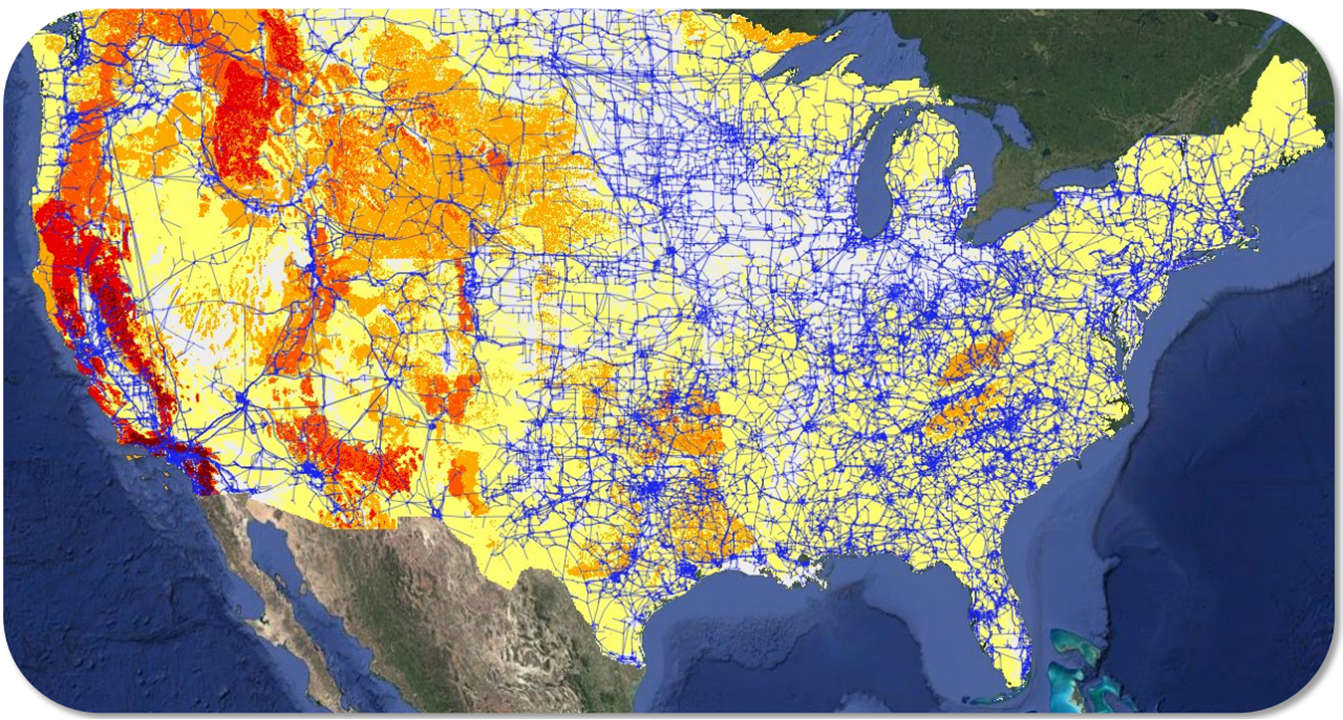
In the power sector, wildfire is a two-way risk: the grid is exposed to fire, smoke, and heat, and it can also act as an ignition source through equipment faults. Our analysis shows the exposure is highly concentrated – around 3% of US power lines fall into high or above wildfire risk. That concentration is the opportunity: it allows utilities and states to focus scarce resources and capital and to prioritise mitigation where it reduces risk the most.
How concentrated is wildfire exposure nationwide?
At the workshop, Risk Management Partners presented a nationwide analysis of wildfire exposure across the US grid footprint, based on the recently expanded Wildfire HD Edition and a database covering approximately 1.2 million km (c. 746,000 miles) of power lines – predominantly transmission infrastructure (typically >35 kV). Rather than focusing on isolated hotspots, the analysis provided a system-wide view that:
- identified highly exposed corridors along linear infrastructure,
- highlighted exposure concentrations across administrative regions, and
- enabled consistent comparison across utilities and states.
One key insight resonated strongly with regulators: while wildfire exposure in the US power grid is highly concentrated, it is especially prevalent around power lines that serve significant population and economic concentrations. A relatively small percentage of lines, substations, and regions account for a large share of potential wildfire losses. Without high-resolution modelling, these priorities remain invisible.
As a consequence, usage of spatial intelligence featured heavily in the workshop. Tools such as Wildfire HD help pinpoint where elevated hazard aligns with critical assets, supporting defensible prioritisation of capital-intensive measures such as vegetation management and undergrounding. They also help avoid creating new exposure by informing routing and siting decisions during grid expansion planning.
Table II:
Share of analysed power lines by Wildfire HD Risk Index band
| Extreme | 0.4% |
| Very high | 1% |
| High | 1.6% |
| Medium | 8% |
| Rest | 90% |
Source: Munich Re, Risk Management Partners.
Conclusion
Key steps for wildfire risk mitigation
| Step 1 | Establish an asset-level baseline by overlaying transmission and distribution data with high-resolution wildfire hazard insight. Identify the corridors and connection points that drive exposure. |
| Step 2 | Translate that visibility into a prioritised mitigation plan focused on the small share of assets where investment has the highest risk-reduction value. |
| Step 3 | Build the evidence trail regulators increasingly expect: a clear logic that links where you acted, why you acted there first, and how that action relates to quantified exposure and risk. |