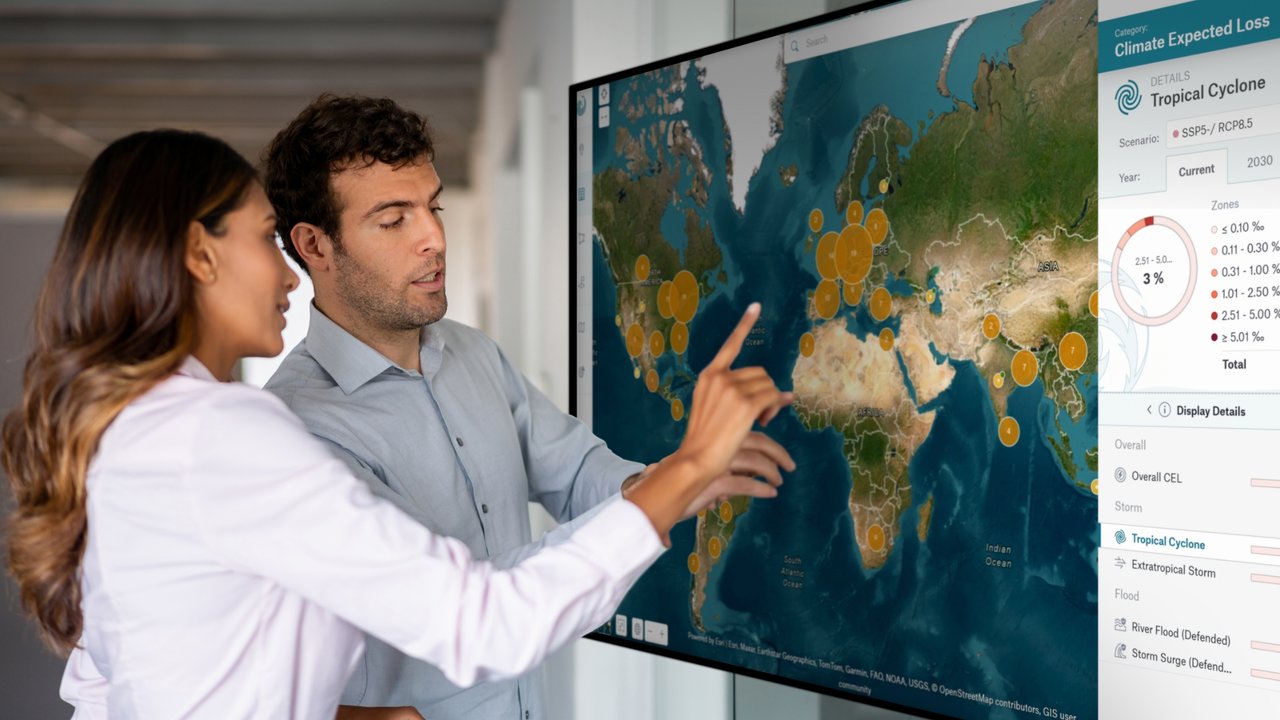
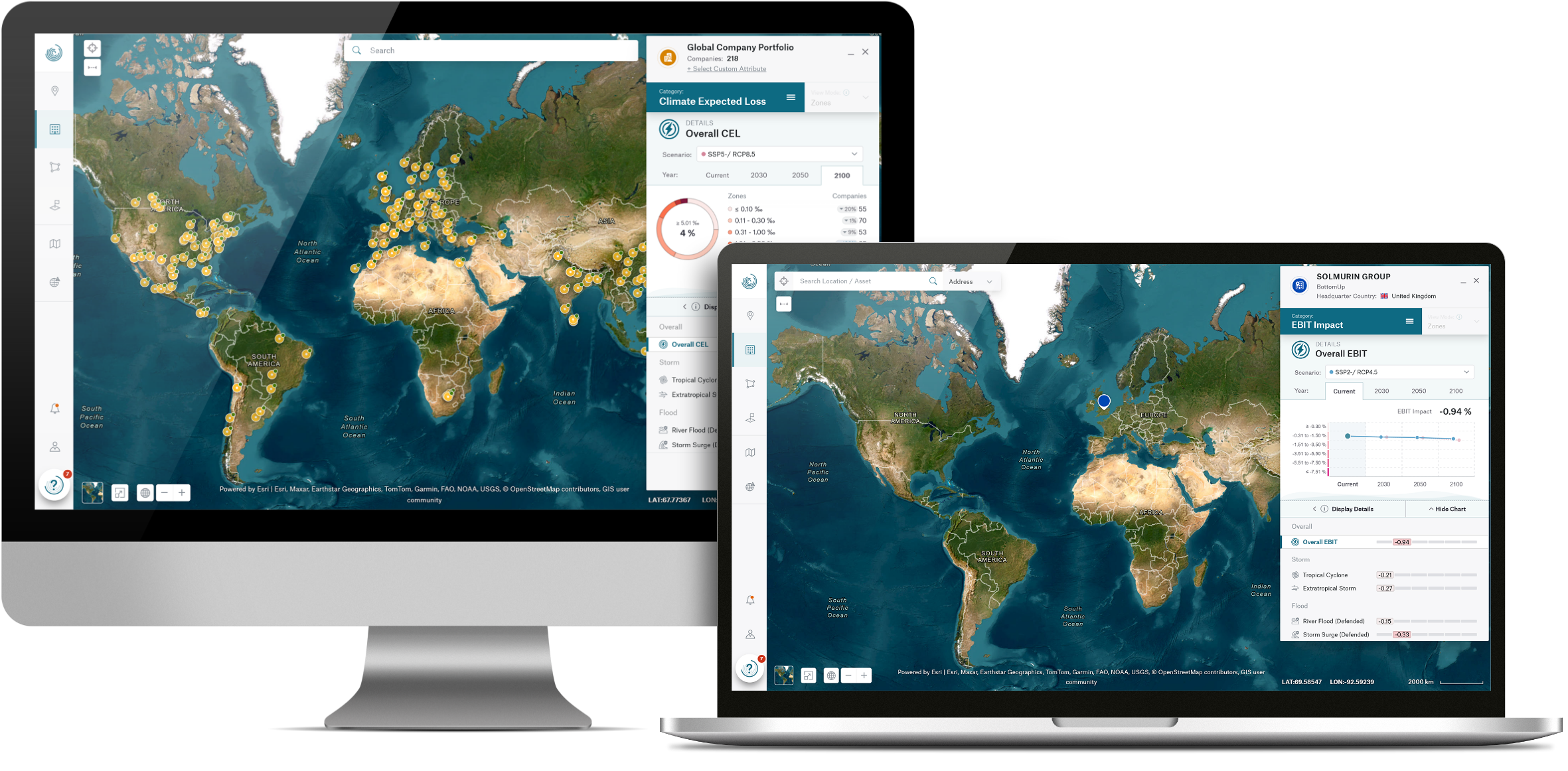
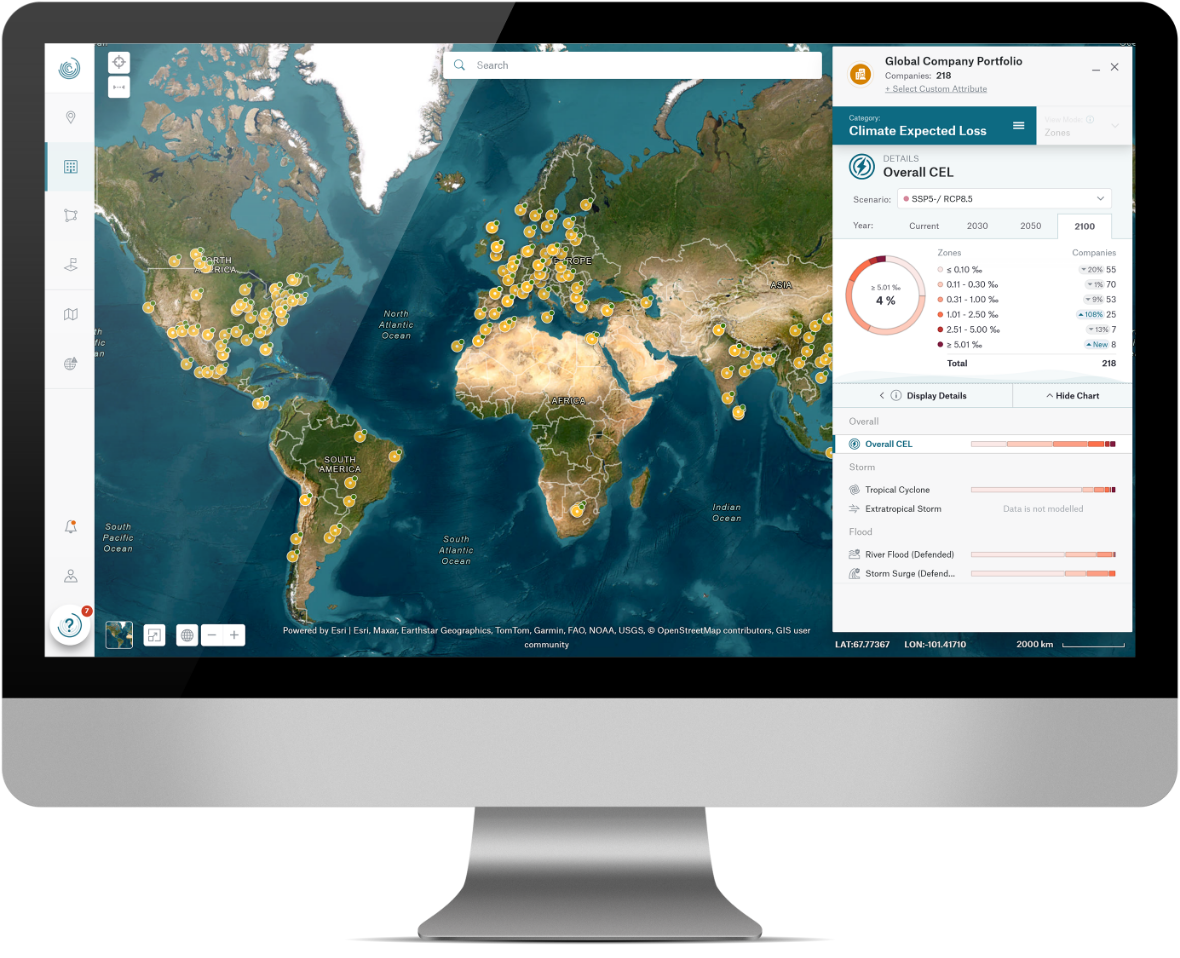
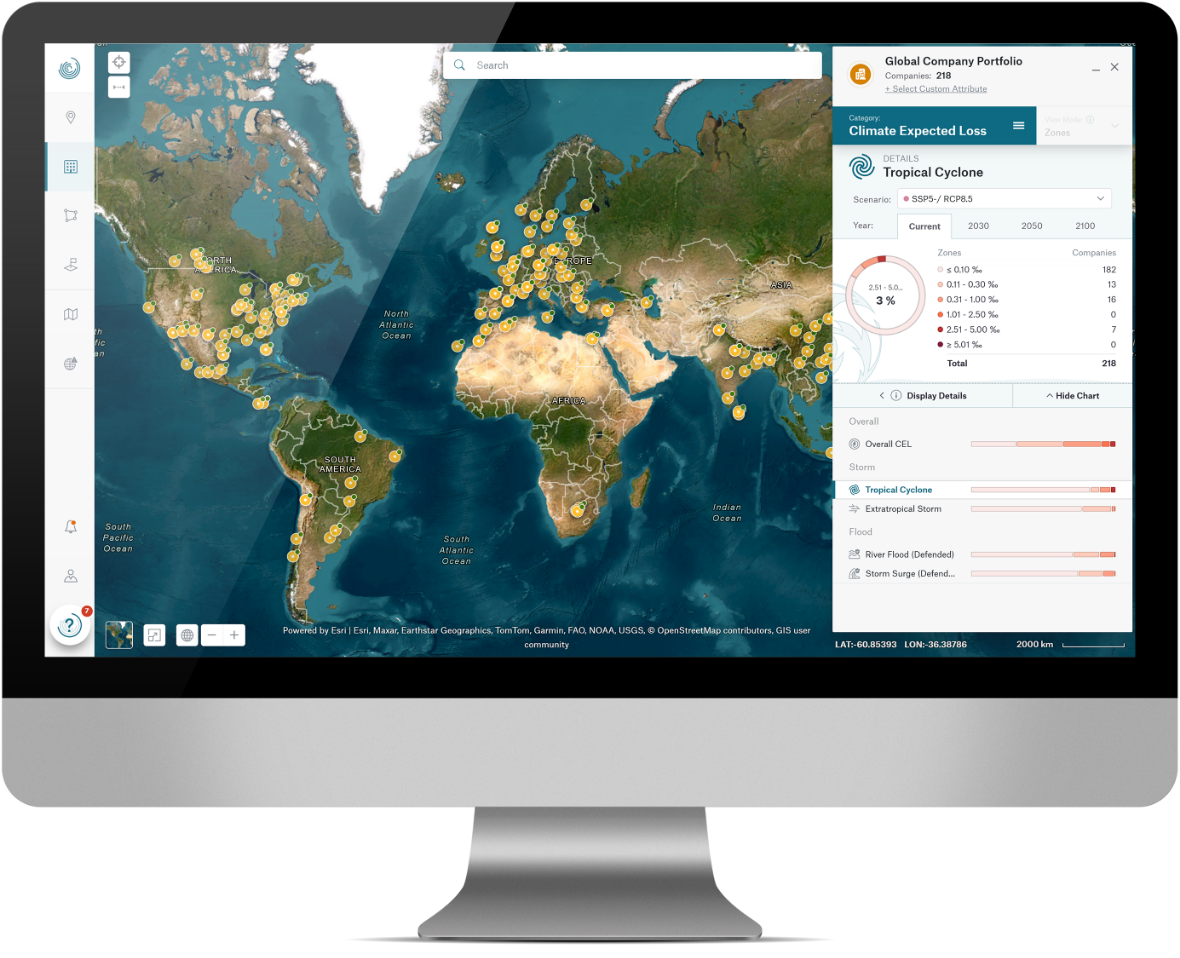
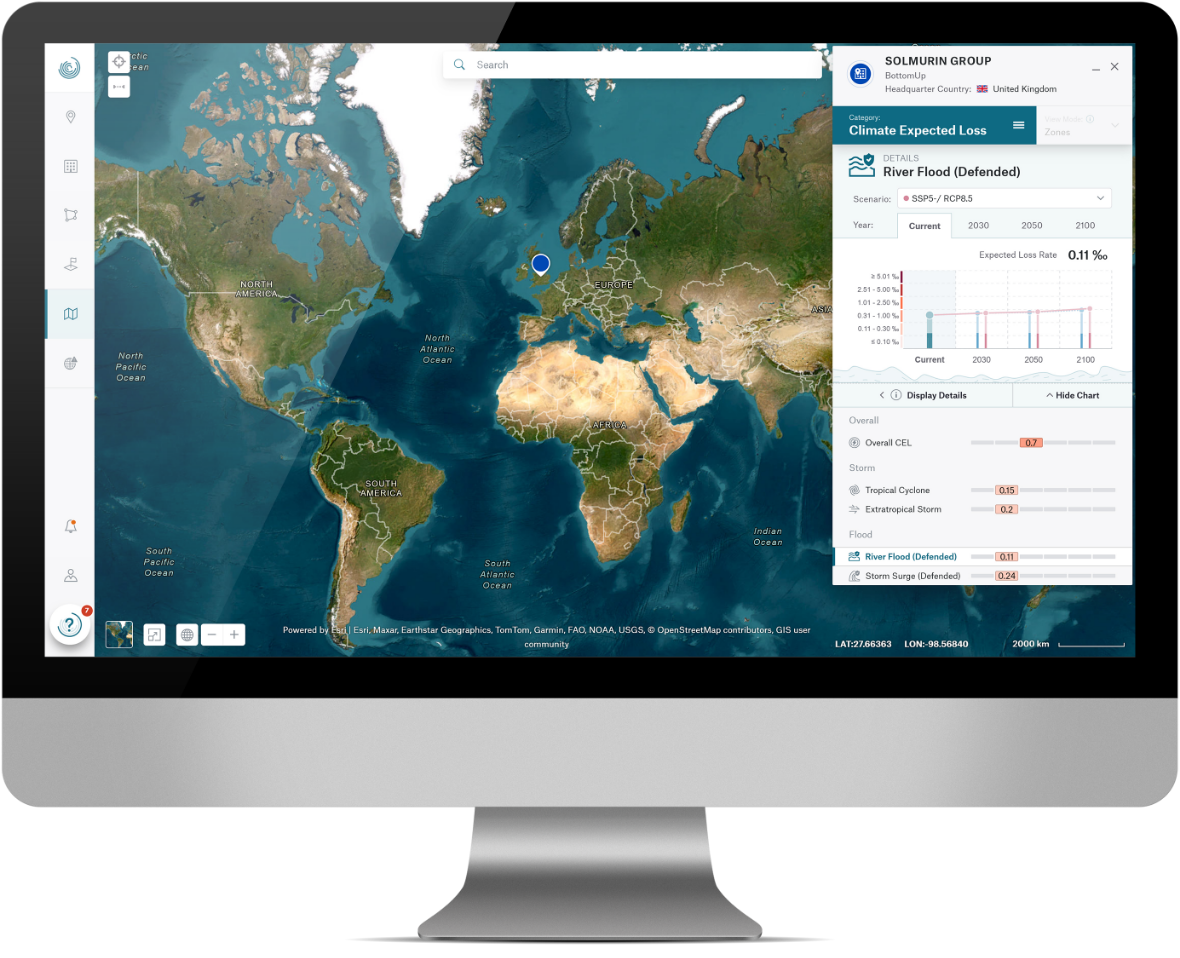
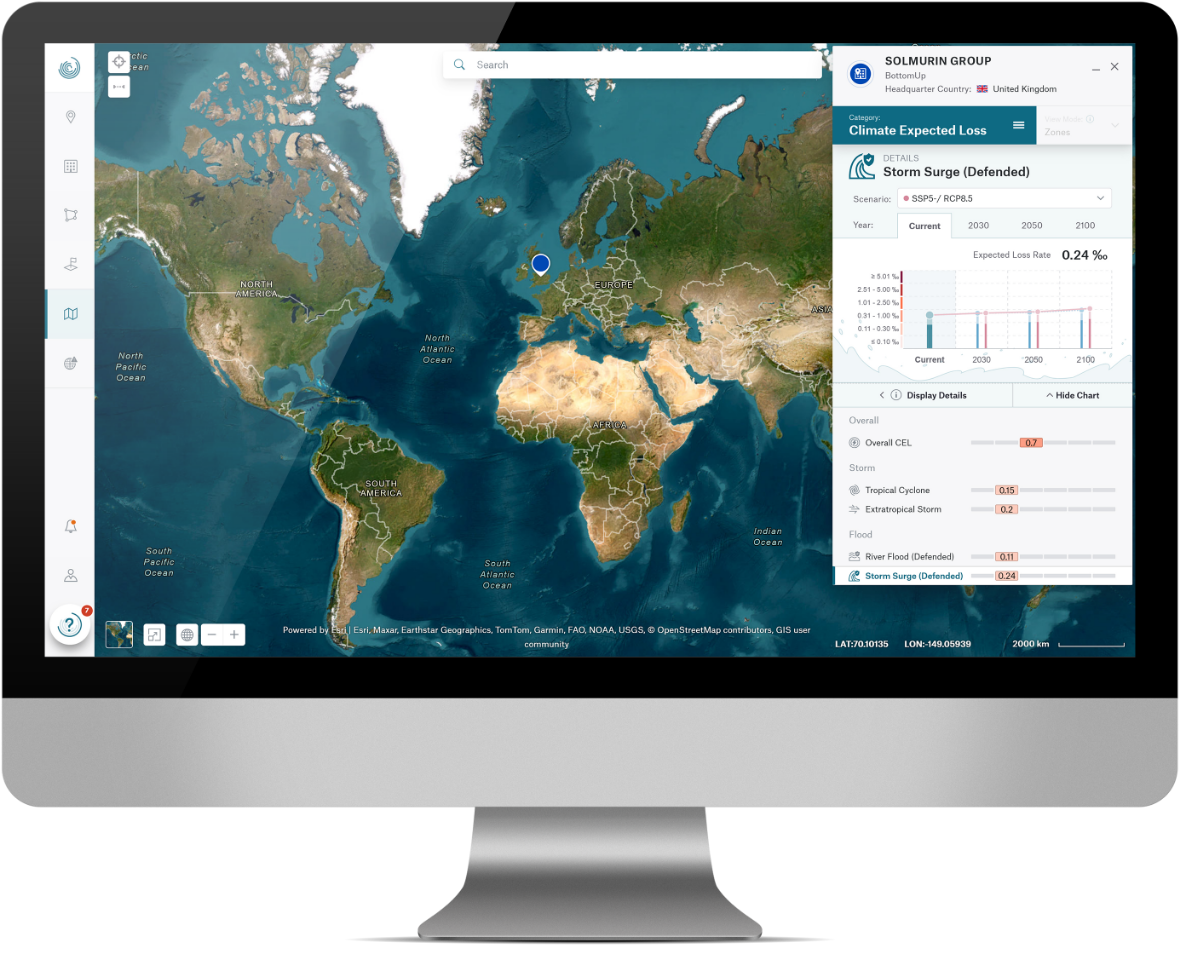
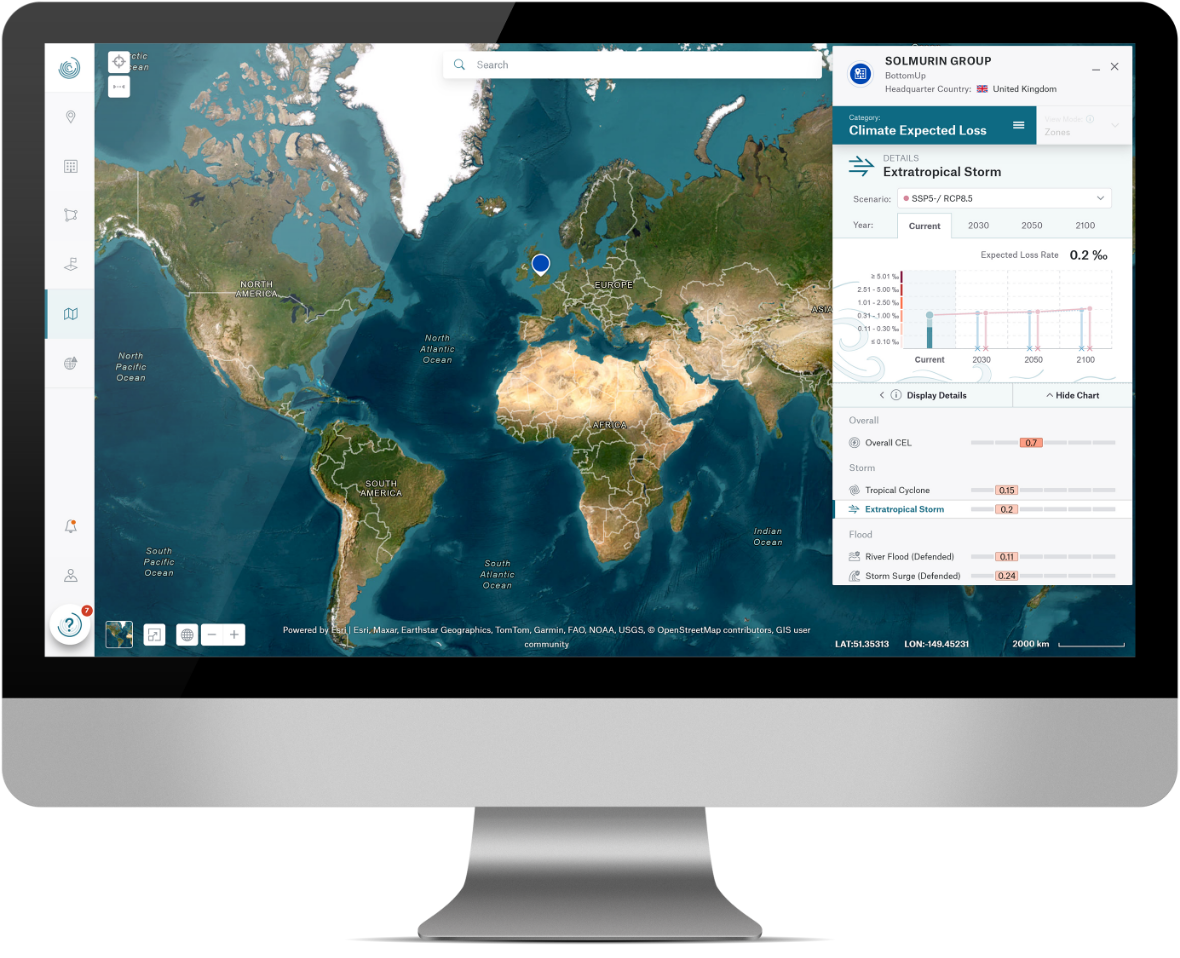
Company Climate Risk Edition is designed to quantify the financial impact of physical climate risk on corporate portfolios. Using Climate Expected Loss and EBIT Impact metrics, it enables banks, investors, insurers, and manufacturers to assess direct financial losses from natural hazards for more than 340 million companies worldwide. Projections are available to 2100. Company Climate Risk Edition is a module within Location Risk Intelligence, Munich Re's advanced SaaS platform for physical climate and natural hazard risk management.
Projected global economic losses of US$12.5tn from climate change by 2050 (World Economic Forum)
Assess the financial impact of climate risk on corporate portfolios
Physical climate risk is a major long-term threat to global growth. By 2050, climate could drive $12.5 trillion in economic losses worldwide, according to the World Economic Forum. Natural hazards such as tropical cyclones, extratropical storms, river floods, and storm surge cause severe damage. Extreme weather destroys assets, disrupts operations and supply chains, and erodes the earnings of corporations at scale. Such events weaken financial performance across industries and corporate sectors worldwide.
At the same time, climate-related losses strongly affect the institutions that provide capital to companies in the form of loans, bonds, and equity. Yet many banks and investors struggle to quantify the current and longer-term financial impact of climate risk on their corporate portfolios.
With Munich Re's Company Climate Risk Edition, you can assess the direct financial impact of climate-related events on entire companies and their assets. Powered by Munich Re's 140+ years of underwriting and global hazard data, the solution combines risk exposure, hazard intensity, and company fundamentals to translate climate risk into quantifiable financial metrics.
Gain a unified, financially meaningful understanding of climate risk across your portfolio. You reduce uncertainty, make faster and better decisions, and can steer lending and investment to stronger, more resilient companies.
The challenge: Corporate portfolios and climate blind spots
Unlike individual assets or mortgage portfolios, corporate portfolios often lack location-specific information. Financing institutions may be unaware of vulnerabilities across their corporate books and investments. Without precise data and scenario analysis, banks, asset managers, and asset owners risk mispricing or misallocating potential natural hazard costs.
Company Climate Risk Edition simplifies corporate portfolio assessment. You can assess direct financial impact at the company level, reduce uncertainty, make faster and better decisions, and steer lending and investment toward stronger, more resilient companies.
Key benefits at a glance
Get the full portfolio risk picture
Express physical climate risk to investments and loans in terms of direct financial impact metrics, Climate Expected Loss and EBIT Impact. Improve credit risk decisions and portfolio steering.
Achieve portfolio-wide scoring
Company Climate Risk Edition has access to millions of asset locations worldwide. Top-down (country/sector) and bottom-up assessment are available. This provides scoring across equity, bonds, and private credit for more informed decisions.
Rely on science-based scenario insights
Understand how corporate climate risk evolves across multiple time horizons and climate scenarios up to 2100. Perform stress testing, assess resilience, and plan long-term investments with confidence.
Meet disclosure requirements
Financial institutions are increasingly expected to disclose quantitative physical climate risk information across their corporate portfolios. Regulations and frameworks include CSRD, TCFD/ISSB, and EBA Risk Management Guidelines.
Protect your business by analysing risk exposure, vulnerability, and expected losses related to climate risk across your entire corporate portfolio. Company Climate Risk Edition delivers three core financial metrics:
Climate Expected Loss (CEL), expressed in ‰ (per mille), is the expected average annual loss due to physical damage to buildings and their contents caused by specific climate-related natural hazard events. Climate Expected Loss allows you to understand the expected asset value deterioration per year. You can make informed decisions on risk transfer requirements, and determine whether specific investments are financially sound.
EBIT Impact, expressed in %, quantifies physical climate risk in terms of the effect on a company, taking into account whether it is an asset-heavy company in relation to its operating profit.
Building on the aggregated company-level Climate Expected Loss, EBIT Impact (Impact on Earnings Before Interest and Taxes) scales the physical loss expectation by a company-specific financial ratio, relating the exposed asset base to the company's earnings capacity. The result expresses how large the expected annual physical damage is relative to operating profit. Credit committees and investment boards have a financial signal that they can directly interpret. EBIT Impact can be calculated for companies where revenue, tangible fixed assets, and operating profit data are present in our validated financial datasets.
Currently modelled for Overall Impact and the four perils Tropical Cyclone, River Flood, Storm Surge, Extratropical Storm. Additional perils will be added in future releases.
Company Asset CEL, expressed in ‰ (per mille), quantifies the expected average annual loss from physical property and content damage for each peril at individual company sites, where asset-level data is available.
This metric identifies which specific locations and which perils drive the most risk within a company. Users get the granular, auditable insights they need for detailed portfolio analysis, regulatory reporting, and targeted risk mitigation decisions.
Currently modelled for Overall Impact and four perils Tropical Cyclone, River Flood, Storm Surge, Extratropical Storm. Additional perils will be added in future releases.
In addition, for each Company Asset, the 1-in-100 year hazard intensity and damage will also be available for the four perils.
For further information, download our “Climate Company Risk Edition” brochure!
Years of Munich Re underwriting and hazard expertise
340m
Structured results for more than 340 million companies worldwide
2100
Forward projection horizon across multiple climate scenarios: 2030, 2050, 2100
Global coverage and modelling methodology
Capability
Detail
Number of companies
More than 340 million companies worldwide
Bottom-up modelling
Asset-level CEL aggregated to company level for companies with available location data. Available asset types include power generation, oil & gas, heavy industry, automotive manufacturing, mining, offices and commercial sites, and headquarters.
Top-down modelling
Country-average climate risk proxies applied for companies without asset-level data, weighted by gross output share and sectoral classification. Ensures full portfolio scoring even if clients face data gaps and asset level data is not available.
Time horizons
Current, 2030, 2050, 2100.
Climate scenarios
RCP 4.5, RCP 8.5 (Tropical Cyclone, River Flood); SSP2-4.5, SSP5-8.5 (Storm Surge) Due to limited scientific evidence for a climate signal, Extratropical Storm is modelled for current climate conditions only and assumed constant over time and scenarios.
Standardised outputs
Consistent analysis across sectors, regions, and corporate structures, ready for credit committees, investment boards, supervisors, and portfolio managers
Four key perils and overall impact metric
Company Climate Risk Edition provides a single consolidated view of a company's total acute physical climate risk exposure and models physical climate risk across four core perils:
The Overall Impact Climate Expected Loss (‰, per mille) aggregates the four modelled peril-specific Climate Expected Loss values, Tropical Cyclone, River Flood, Storm Surge, and Extratropical Storm, into a single company-level or asset-level metric. Available under both Bottom-up and Top-down methodologies. Note: Extratropical Storm is modelled for current climate conditions only and is held constant across time horizons and scenarios within the Overall Impact calculation.
Tropical cyclones are among the most destructive weather phenomena. Coastal regions and islands are particularly exposed, affected by the direct impact of a storm, as well as by secondary hazards such as storm surge. Modelled using Munich Re's NATHAN Tropical Cyclone zoning, with forward projections based on the HiFLOR model (NOAA GFDL). Projection years: Current, 2030, 2050, 2100. Scenarios: RCP 4.5, RCP 8.5.
River flood hazard data (provided by JBA Risk Management) offers state-of-the-art flood information at 30m horizontal resolution, available globally and is a recognised market standard. Includes flood protection measures (dams, dykes) globally. Projections use CMIP5 climate model outputs scaled to current inundation depth data. Projection years: Current, 2030, 2050, 2100. Scenarios: RCP 4.5, RCP 8.5.
Storm surges are short-term increases in mean sea level caused by wind stress and the inverse barometer effect, and can cause severe devastation where water height exceeds local topography or coastal defences.
Global storm surge model at approximately 30m resolution, validated against observed events, national flood maps, and long-term observational records. Projection years: Current, 2030, 2050, 2100. Scenarios: SSP2-4.5, SSP5-8.5.
Extratropical storms form in the transition region between subtropical and polar climatic zones, reaching peak intensity in late autumn and winter. Their damage potential is frequently underestimated.
Modelled using reanalysis data downscaled with national weather service data (DWD, KNMI, UK Met Office, Meteo France, BoM, NOAA). Peak wind speeds derived for 25+ return periods at approximately 1km resolution. Available for current climate conditions.
Analyse climate risk for a corporate portfolio. Strengthen credit risk assessment, portfolio monitoring, and stress testing with Climate Expected Loss and EBIT Impact metrics. Uncover blind spots and make risk-based decisions to protect against default. Manage downside credit risk and capital adequacy across corporate loan books. Steer capital toward companies built for the future. Identify companies requiring adaptation capital, and simplify climate-related disclosure.
Enhance portfolio resilience by identifying which companies are most exposed to physical climate risk. Screen portfolios for climate-sensitive companies to protect returns. Understand climate risk exposure through asset and company-level financial impact metrics for confident capital allocation. Satisfy reporting requirements with forward-looking quantitative data at the company and asset level.
Manage underwriting profitability, accumulation risk, and capital adequacy. Quantify how climate hazards could weaken the financial resilience of insured companies, to avoid mispricing and reduce loss potential. Ensure climate-aligned reporting to satisfy regulators and stakeholders.
Assess current and potential partners to understand your risk position and vulnerabilities, or benchmark against competitors to inform strategy. Understand the climate risk exposure of supply chain partners to build more resilient supply networks.
Climate risk is moving from the map to profit and loss. With Company Climate Risk Edition, leaders can quantify how physical hazards affect earnings, strengthen portfolio resilience, and steer capital with confidence. Analysing 340 million companies means there are no longer any blind spots in global portfolios.
David Fischer
Chief Product Officer
Risk Management Partners
Regulatory compliance is built in
Company Climate Risk Edition delivers climate-related financial metrics aligned with regulatory requirements including CSRD, TCFD/ISSB. Consistent, standardised outputs streamline disclosures and meet the expectations of supervisory bodies such as the European Banking Authority (EBA), Bank of England’s Prudential Regulation Authority (PRA), European Central Bank (ECB), and Basel Committee on Banking Supervision.
Regulation/Framework
How Company Climate Risk Edition supports compliance
CSRD
Provides physical risk data for climate scenario analysis across multiple horizons and pathways
TCFD / ISSB
Enables standardised, quantitative physical climate risk disclosure at company and asset level
EBA Risk Management Guidelines
Calculates Climate Expected Loss and EBIT Impact metrics for quantifying physical risk in credit portfolios
ECB stress testing, PRA statement, Basel Framework
Delivers future scenario data (2030, 2050, 2100) for climate-risk stress testing
Company Climate Risk Edition belongs to Location Risk Intelligence
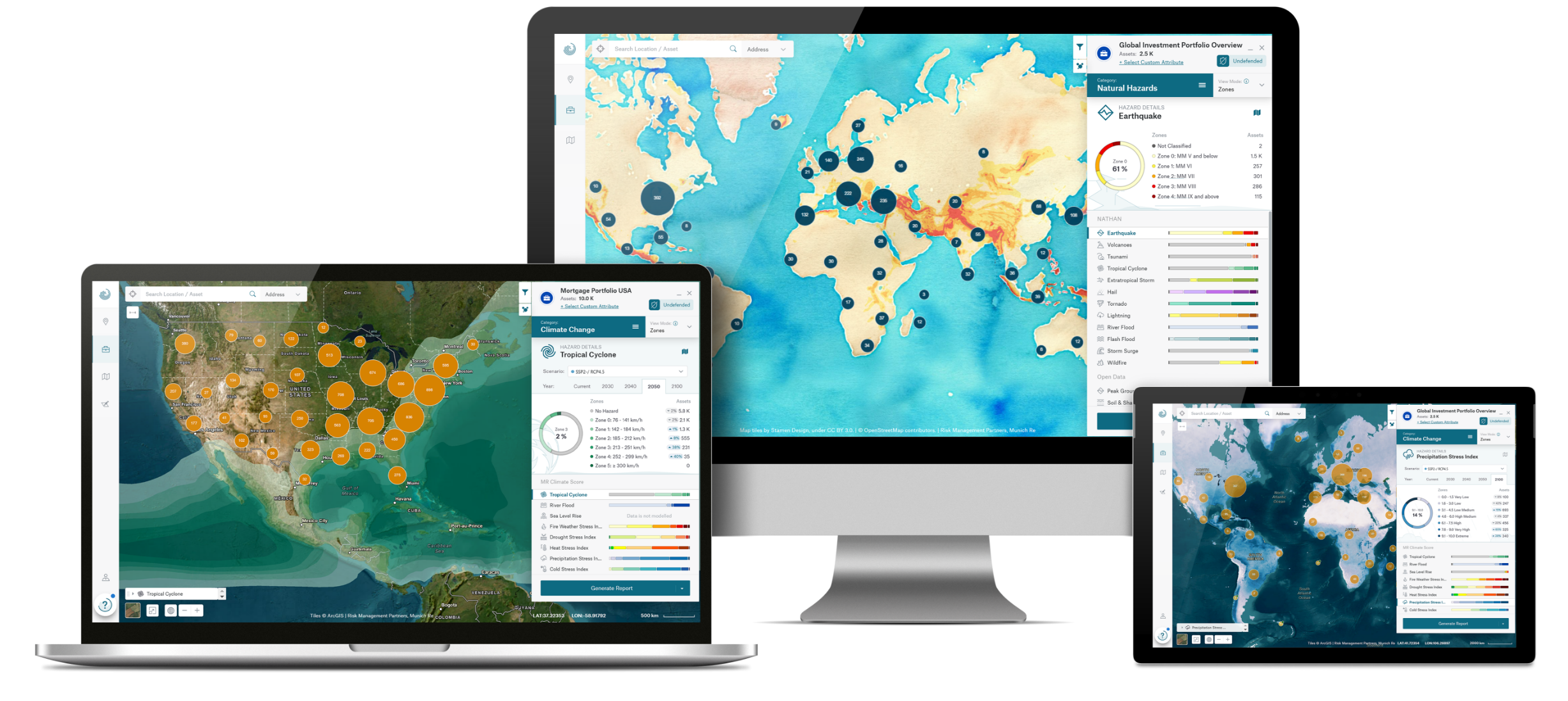
Company Climate Risk Edition is part of Location Risk Intelligence, Munich Re's advanced SaaS platform that enables companies to understand, measure, and manage physical climate risks. With the platform and its modules, you can manage physical risks from natural hazards and climate change, assess climate financial impact, and simplify reporting, all in one solution.
How do physical climate risks affect the financial performance of your corporate portfolio?
Company Climate Risk Edition is a module within Munich Re's Location Risk Intelligence SaaS platform. It enables banks, investors, insurers, and corporates to quantify the direct financial impact of physical climate risk on corporate portfolios. The key financial metrics are Climate Expected Loss and EBIT Impact metrics across more than 340 million companies worldwide.
Climate Expected Loss, expressed in ‰ (per mille), is the expected average annual loss due to physical damage to buildings and their contents from climate-related natural hazard events. It is calculated by combining the expected intensity of a hazard (for example, flood inundation depth or peak wind speed) for each return period with asset vulnerability curves that translate hazard intensity into a damage ratio. The result is a location-specific loss rate that can be aggregated to asset and company level.
EBIT Impact, expressed in %, quantifies physical climate risk in terms of the effect on a company's cashflow – taking into account how important its asset base is to generate its operating profit. Climate Expected Loss measures the expected annual physical damage rate relative to asset replacement cost. EBIT Impact expresses that damage relative to the company's earnings capacity, giving credit analysts and investors a directly comparable financial signal. EBIT Impact can be calculated for companies where revenue, tangible fixed assets, and operating profit data are in our validated financial datasets.
Company Climate Risk Edition provides structured results for more than 340 million companies worldwide. Where asset-level data is available, bottom-up modelling delivers granular, location-specific Climate Expected Loss and EBIT Impact outputs. Where asset data is unavailable, top-down modelling applies country-average climate risk proxies weighted by gross output share and sector. This ensures that no company is excluded from portfolio analysis due to client data gaps.
Company Climate Risk Edition models four acute physical climate hazards: Tropical Cyclone, River Flood, Storm Surge, and Extratropical Storm. The Overall Impact Climate Expected Loss metric aggregates all four perils into a single company-level or asset-level score. Tropical Cyclone, River Flood, and Storm Surge are available for future projection years (2030, 2050, 2100). Extratropical Storm is available for current climate conditions and is assumed to remain constant across time and scenarios. Additional perils will be added in future releases.
Climate projections are available for 2030, 2050, and 2100, in addition to current conditions. Tropical Cyclone and River Flood projections are available under RCP 4.5 and RCP 8.5. Storm Surge projections are available under SSP2-4.5 and SSP5-8.5, in line with the latest IPCC sea-level rise projections. This range of scenarios and time horizons supports CSRD, TCFD, and EBA stress testing requirements.
Yes. The solution delivers standardised, quantitative climate-related financial metrics, including scenario-based projections aligned with the disclosure requirements of CSRD, TCFD/ISSB, EBA Risk Management Guidelines, ECB expectations, and PRA supervisory requirements. Consistent outputs across sectors, regions, and corporate structures streamline regulatory disclosures and satisfy the needs of supervisors and governance bodies.
Bottom-up modelling assesses climate risk at the individual asset level for companies with available location data, for example production sites, offices, or power infrastructure, and aggregates results to the company level. Top-down modelling applies country- and sector-level climate risk proxies for companies without asset data, weighted by gross output share. Both methodologies produce company-level Climate Expected Loss outputs and EBIT Impact where financial data is available. Bottom-up modelling also produces asset-level Climate Expected Loss results.
Company Climate Risk Edition is designed to financially quantify climate risk in corporate portfolios. It aggregates physical climate risk across entire companies, including all their underlying assets, and expresses that risk in financial terms (Climate Expected Loss and EBIT Impact) that are directly relevant to credit analysts, portfolio managers, and investment committees. Other modules such as the Natural Hazards Edition or Climate Change Edition help businesses assess their own risks, real-estate assets or portfolios.
Get started with Company Climate Risk Edition today
Request a free personal demo to see Company Climate Risk Edition in action on your own portfolio or a sample dataset. Or speak with a specialist. We look forward to hearing from you!