What actually happened in the 2025 hurricane and typhoon seasons? Why were losses relatively low while physical risk was clearly high? What does that tell you about future tropical cyclone and climate risk? And what should decision makers change in their approach to scenarios now?
If you are responsible for risk, the following five questions give a concise recap of Munich Re’s 2025 hurricane and typhoon seasons report and translate it into practical implications for your portfolio.
#1: What is different about the 2025 tropical cyclone season?
It looks like a very energetic season that narrowly missed some of the world’s most exposed assets. In the North Atlantic, 13 named tropical cyclones formed, five became hurricanes, and thereof three reached Category 5. The total number of storms was slightly below the long-term average, but the share of very intense systems was unusually high.
In the Northwest Pacific, 28 tropical cyclones developed, 17 reached typhoon strength and five became super typhoons reaching Category 3-5. Many took a relatively southern track, frequently affecting the Philippines, China, Vietnam, and neighbouring countries, while Japan was largely spared. On the ground, this translated into highly localised catastrophes: Hurricane Melissa devastated parts of Jamaica, Haiti, and Cuba with wind speeds up to 295 km/h and preliminary losses near US$ 10 billion, while massive rainfall accompanying Typhoon Matmo caused severe flooding, despite less severe winds.
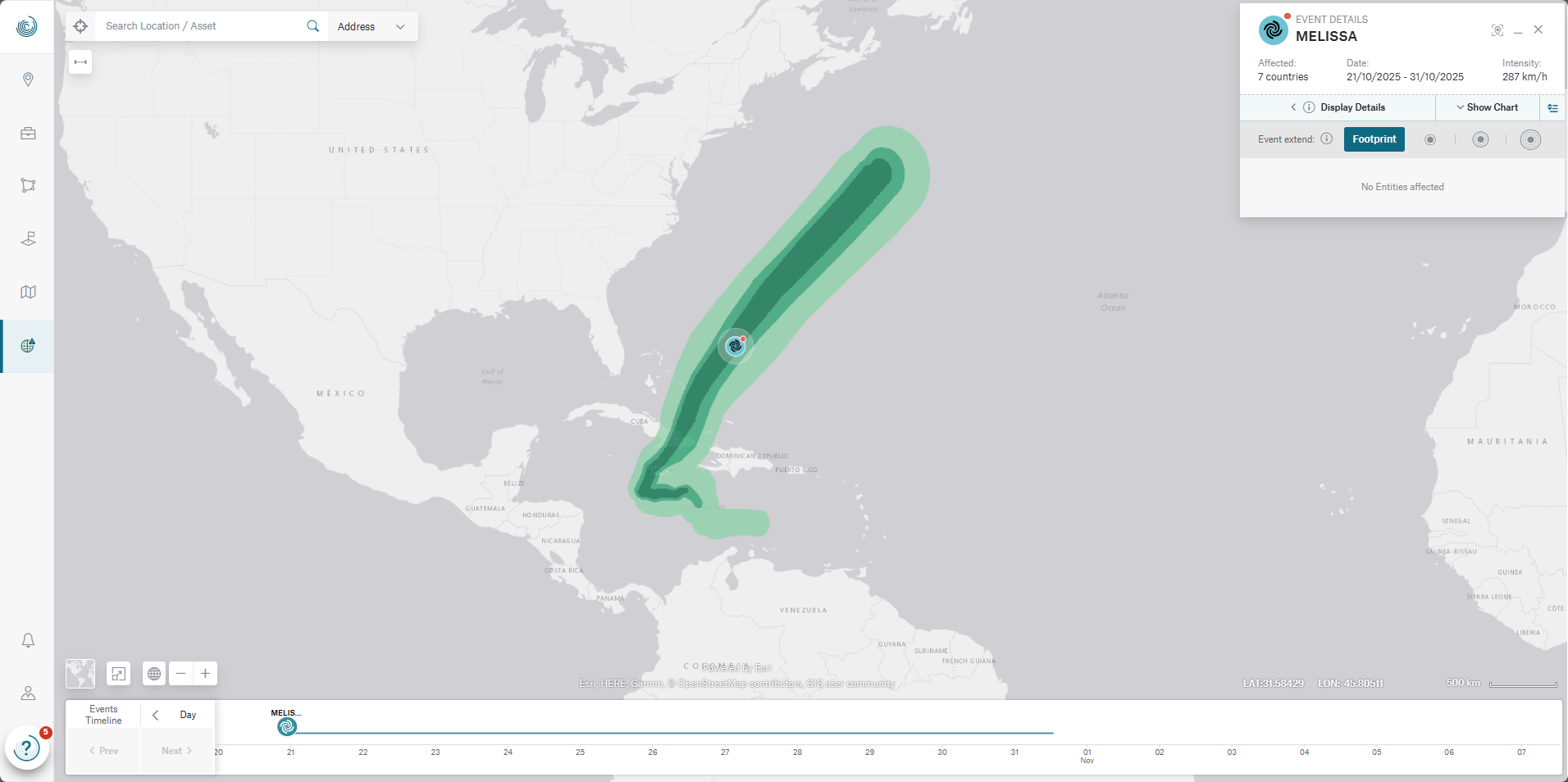
Hurricane Melissa Footprint in Location Risk Intelligence Events View
#2: Why did three Category 5 hurricanes and multiple intense typhoons not produce a record loss year for global (re)insurance?
Losses remained relatively low because the strongest storms missed many of the highest-value coastal centres. Dry Saharan air reduced cyclone formation in parts of the main development region, and an unusually positioned Azores-Bermuda High steered several major systems north-eastwards over open water instead of into the Gulf of Mexico.
Two Category 5 hurricanes, Erin and Humberto, released their full power over the ocean and spared large urban areas. By contrast, Jamaica, parts of the Caribbean, and several Southeast Asian countries saw intense local impacts from Melissa with lower insurance cover. The global loss picture therefore looks modest on average, while masking sharp regional shocks and a very narrow escape for some of the most insured coastlines, in particular in the USA.
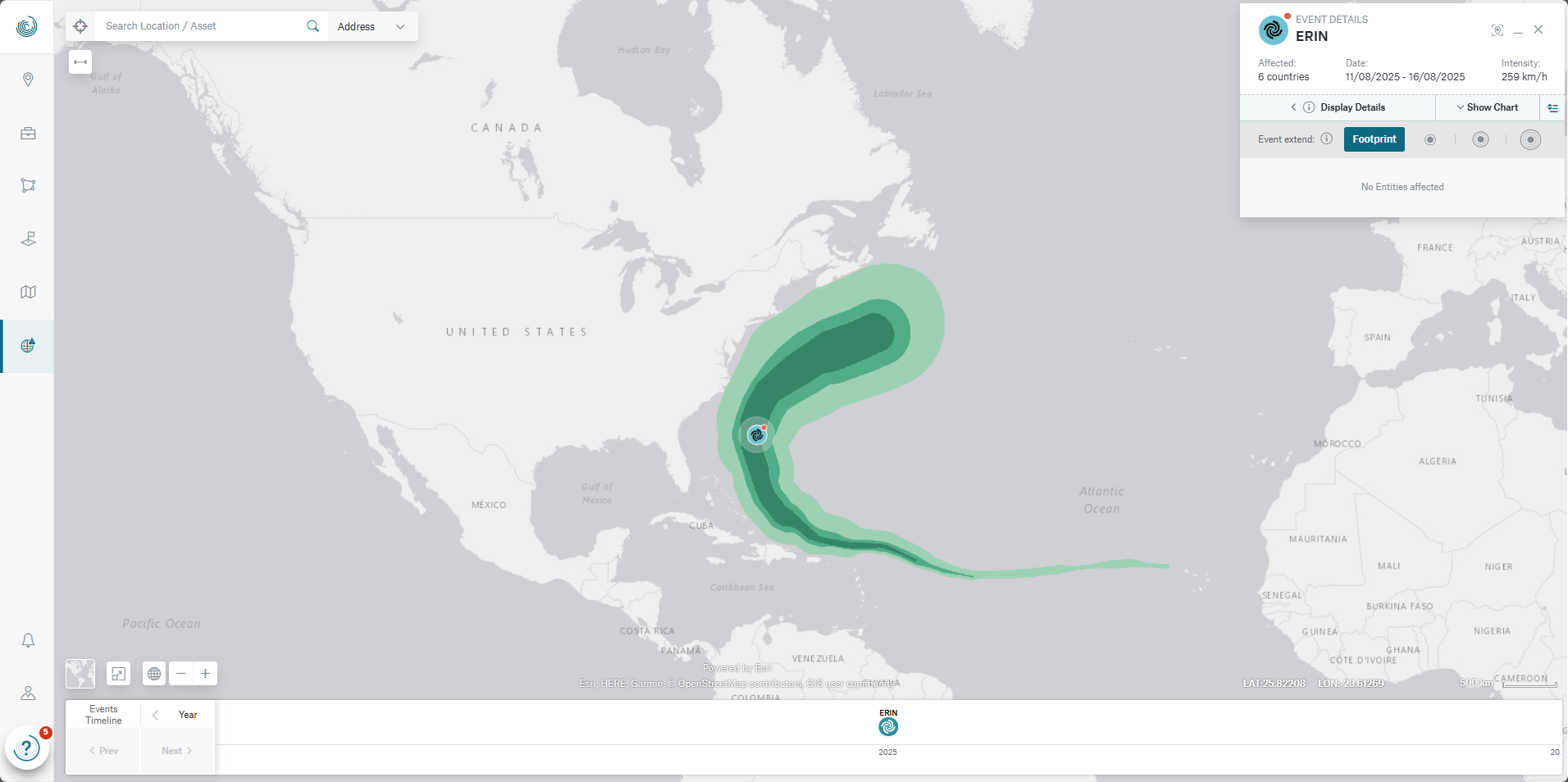
Hurricane Erin Footprint in Location Risk Intelligence Events View
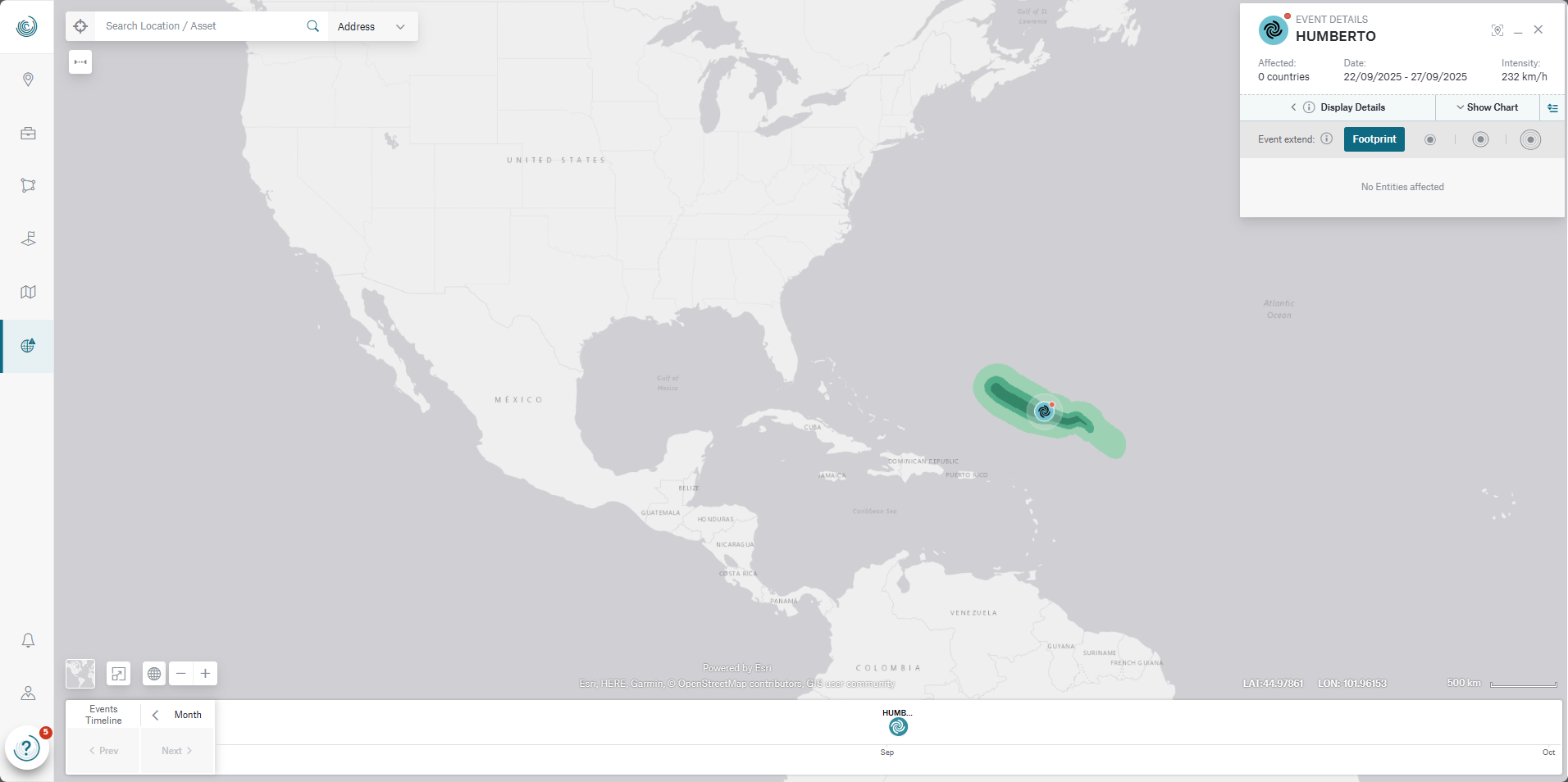
Hurricane Humberto Footprint in Location Risk Intelligence Events
#3: What lessons can risk managers learn from a season where below-average losses from gigantic storms coexist with record wildfire losses?
The untypical 2025 season offers a preview of the risk landscape you need to plan for. Climate science and Munich Re research indicate that warmer oceans and a warmer atmosphere could increase the likelihood and intensity of severe storms such as Melissa, even though individual seasons will always vary.
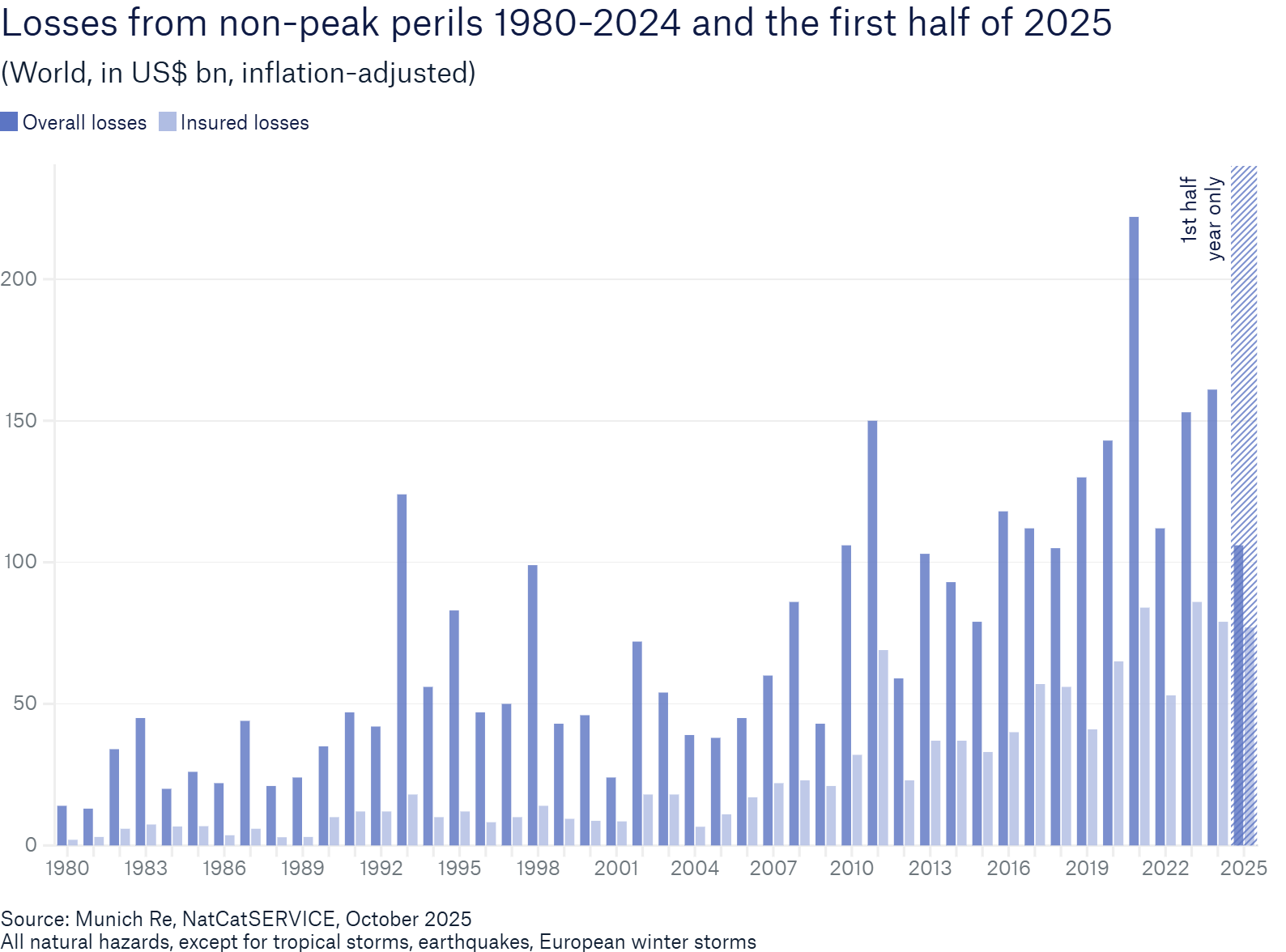
At the same time, the long-term rise in losses is increasingly amplified by so-called non-peak perils such as severe convective storms, floods, and wildfires. Recent Munich Re figures show that these non-peak peril events now account for a substantial share of global losses each year, with the first half of 2025 marked by record-breaking wildfires near Los Angeles. Peak perils including hurricanes and typhoons create volatility in single years, while non-peak perils shape the structural trend. Both are being impacted by climate change and both belong in forward-looking risk management.
#4: How do you avoid letting a season like 2025 loosen your risk appetite, pricing discipline or investment criteria?
You move the focus away from headline loss totals and towards event footprints and asset-level exposure.
- For real estate, this means asking which hotels, logistics parks or data centres have actually sat inside recent hurricane, typhoon, flood or wildfire footprints, and which have simply been fortunate by a small change in track.
- For banks, this means linking climate scenarios to real events at collateral locations in places such as Florida, Guangdong, Manila or Kingston.
- For insurers and reinsurers, it means stress-testing property and business interruption portfolios against alternative tracks of storms like Melissa or Ragasa.
- For corporates, it means treating ports, industrial corridors and supplier clusters as critical nodes within event scenarios, not just points on a static hazard map.
In each case, the aim is to use observed and live event data to challenge assumptions and anchor capital, pricing and resilience decisions in how the climate system behaves today.
#5: How do you turn a complex season like 2025 into practical insight for underwriting, credit, investment, ESG disclosure and business continuity planning?
Events in Location Risk Intelligence provides an interactive world map that overlays a large catalogue of past and live natural catastrophe events with your entities and portfolios, for hazards such as tropical cyclones, extratropical storms, floods, earthquakes and wildfires.
Within this view, you can filter by peril type, geography, date and severity and immediately see which locations have been inside or close to a given event footprint. Historical event data support site selection, underwriting, reinsurance and long-term investment or credit decisions by showing which locations are repeatedly affected.
During live events, automated alerts linked to specific assets, portfolios or user-defined Areas and Lines notify you when a footprint intersects your exposure, so that disaster recovery and business continuity plans can be activated in time. Intensity metrics tailored to each hazard, such as wind speed bands for tropical cyclones or affected area size for floods and wildfires, help you focus resources where the potential damage is greatest.
Used consistently, Events in Location Risk Intelligence turns seasons like 2025 into learning moments and a basis for prevention, not just post-event assessment.
Contact our expert