Though falling meteoroids can fascinate and terrify people alike, the consequences of an impact are usually negligible. Meteorite impacts on Earth are very rare. But they do happen, like in early March 2026, when a small one struck a residential building in the German city of Koblenz, crashing through the roof.
Earth is constantly bombarded by spaceborne objects. Most are no larger than a grain of sand and burn up when they enter the atmosphere due to their high speed of several tens of kilometres per second – what we commonly call shooting stars. Larger chunks with diameters of up to a few dozen metres are classified as meteoroids. They, too, heat up as they enter the uppermost layers of the atmosphere, and disintegrate in the thermosphere at an altitude of more than 80 kilometres. The remnants of these objects that make their way to the surface are called meteorites.
Though major impacts are extremely unlikely, they can have catastrophic consequences. When a meteorite struck near the Russian city of Chelyabinsk in the Urals in February 2013, the damage was substantial. The meteoroid, which measured nearly 20 metres in diameter and weighed an estimated 12,000 metric tons, entered Earth’s atmosphere at a shallow angle and a speed of 19 km/s. It exploded at an altitude of around 30 kilometres with roughly 30 times the force of the atomic bomb dropped on Hiroshima. Three minutes later, the shockwave reached Chelyabinsk, shattering windows in thousands of houses and injuring roughly 1,500 people through flying debris. A fragment weighing more than 600 kilograms crashed into nearby Lake Chebarkul. Scientists estimate that this type of event can happen every 50 to 100 years. However, meteorite impacts often go completely unnoticed because they happen in uninhabited areas or the ocean.
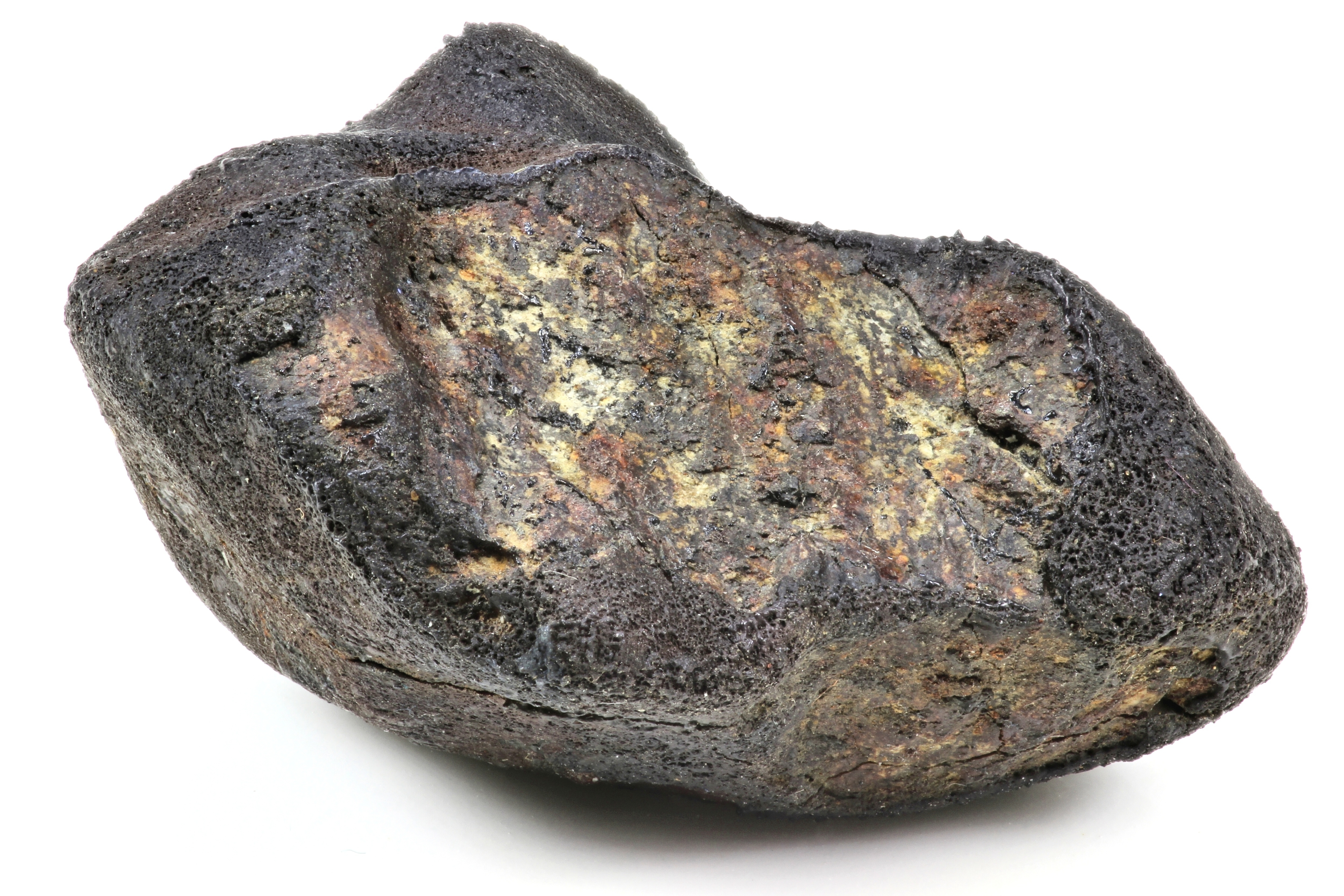
Fragment of the Chelyabinsk meteorite
Virtually all meteoroids – and the even larger asteroids – stem from the asteroid belt between Mars and Jupiter. More than 600,000 objects have already been identified in the belt and the total number is estimated at 30 million, more than 25 million of which likely have a diameter of less than 100 metres. The largest known asteroids are Ceres, Vestas, Pallas and Hygiea, each with a diameter of between 500 and 1,000 kilometres. Objects on this scale are also referred to as planetoids or dwarf planets. Nearly all of them are in planet-like orbits around the sun. Only when individual objects are affected by gravitational disturbances can they drift toward the sun and cross Earth’s orbit.
Very large meteorite impacts leave craters on the mainland. Currently, there are around 200 confirmed impact craters on land, the oldest and largest of which are several million years old. Among the most prominent are Barringer Crater in Arizona (Ø 1.2 km, ~50 thousand years old), Nördlinger Ries (Ø 24 km, ~15 million years old) and probably the most famous of all, Chicxulub Crater in the Mexican sector of the Yucatán Peninsula (Ø 180 km, 66 million years old). The impact that formed Chicxulub, presumably from an asteroid with a diameter of ten kilometres, was so powerful that the ejected material was hurled back into space, only to then rain back down on Earth and cause further direct destruction as far as thousands of kilometres from the original site. According to the current consensus, this event heralded the downfall of the dinosaurs and destroyed 90 percent of all life on Earth.
Underwater craters in the ocean are seldom found, as there are no distinctive visual clues, and because in deep-sea regions, medium-sized objects vaporise instantly and violently before they can reach the seafloor. One rare example: a roughly 100-kilometre-wide crater in the Pacific, which lies about 1,500 kilometres southwest of the southern tip of Chile at a depth of around 5,000 metres. Approximately 2.2 to 2.5 million years ago, an object measuring between one and four kilometres in diameter must have struck there. When it did, it produced a massive tsunami and run-ups of 40 to over 100 metres in Chile, Antarctica, New Zealand and likely also parts of Australia near present-day Sydney: up to four times higher than the most powerful tsunamis ever sparked by earthquakes.
General risks in connection with meteorites
Major asteroid impacts are extremely rare. Small events leave no traces and do no harm, or at worst, only to satellites or space stations – or as now in Koblenz. Further, there is no increased or acute threat in connection with this hazard. However, the limits of predictability should be taken into account: around 30 percent of the potentially dangerous asteroids – that is, those whose orbits take them very close to Earth – have now been identified. Yet the orbital projections are subject to small but constant changes, which can lead to major deviations over the years. A further limitation on predictability concerns comets, which mostly consist of dust and frozen gases. They chiefly originate from the outer regions of our solar system and, due to their elliptical paths, cannot be directly observed for the longest time (decades to centuries). As a result, most comets have yet to be discovered.
Potential defence strategies and technologies almost exclusively concern the aerospace field, but have yet to be developed and tested. Previous missions such as DART 2022 (impact of a massive probe on the asteroid Dimorphos) have shown promising results in terms of deflecting objects from their path. Further missions will follow. However, detecting and characterising near-Earth objects is and will remain particularly important, with the NEO Surveyor mission planned for 2027 set to contribute to this work.
In the event of an asteroid or comet impact, the consequences for objects with a diameter of around 30 to 500 metres are similar to those for conventional natural hazards like tsunamis, storms, fires, earthquakes and volcanic eruptions, but more extreme. As far as vulnerability is concerned, all surface-based protective measures remain largely ineffective in view of the massive energies involved.
If a large meteorite with a diameter of 50 to 100 metres were to hit an urban region, it would likely result in an accumulation event and catastrophic damage. The likelihood of this happening, however, is estimated at far less than once every 3,000 years and therefore, from a global perspective, up to 100 times lower than that of the greatest losses from other natural disasters such as storms or earthquakes.
In the event of a conceivable meteorite impact, many lines of standard insurance policies (all risks, fire, comprehensive, life, etc.) would be affected. All risks policies provide full cover for impact, shockwave and fire damage. Conversely, in named perils policies – like most standard homeowners’ insurance policies – fire damage is usually fully covered, but not impact or shockwave damage. Natural hazards insurance, on the other hand, usually provides no cover for meteorite impacts.
Our expert