Insights from Munich Re’s 2025 survey

Corporate-Owned Life Insurance (COLI) and Bank-Owned Life Insurance (BOLI) have long played a central role in the financial strategies of U.S. corporations and banks. These products are primarily used to fund employee benefit liabilities, particularly nonqualified deferred compensation plans for executives.
In a previous article, we examined COLI/BOLI market dynamics, focusing on the factors driving sustained growth and key takeaways from the 2025 National COLI Directors Meeting. Despite noting potential regulatory headwinds, industry leaders remain optimistic, driven by increasing demand for portfolio diversification and innovative product designs.
This article focuses on what’s shaping COLI/BOLI underwriting today, drawing on findings from Munich Re’s recent survey of carriers active in the market.
Survey participants reflect market evolution
Key underwriting trends
Upward pressure on limits
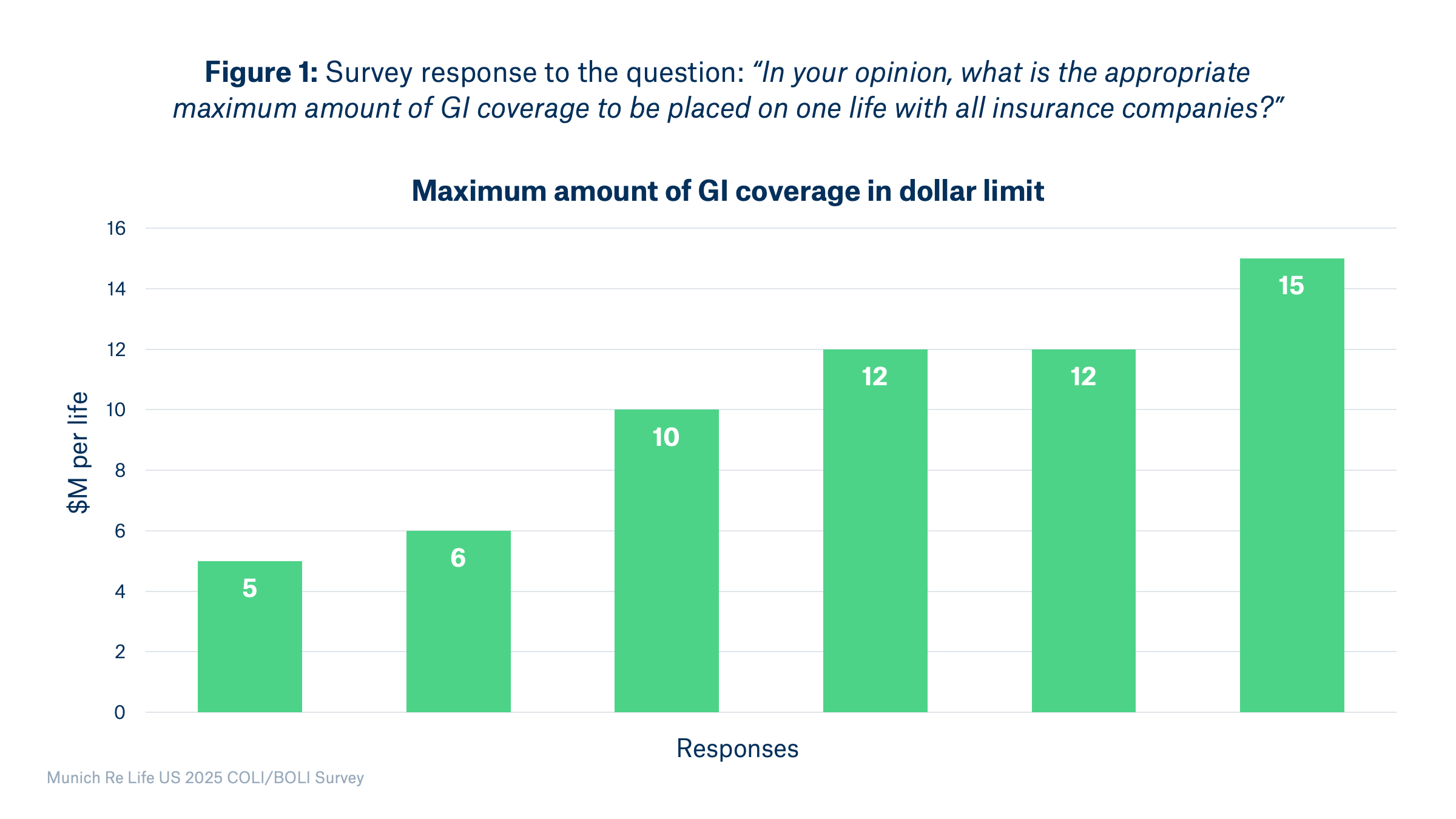
COLI/BOLI products are typically underwritten on a guaranteed issue (GI) basis. Based on this reason, the maximum issue limits are capped compared to fully underwritten cases. The current industry standard for the maximum amount of GI coverage to be placed on one life with all carriers is $10 million.
However, in recent years, underwriters have increasingly received requests to raise the threshold for GI coverage. This trend was confirmed in our survey, where participants favored defining the maximum GI coverage using a dollar limit. Suggested thresholds ranged from $5 million to $15 million (Figure 1).
Emerging interest in data-driven underwriting
Challenges and best practices
Survey participants identified familiar underwriting challenges, such as aligning with producer expectations and managing limited resources, but noted that these issues are exacerbated by the specialized and niche nature of the COLI/BOLI market.
Two key challenges stood out;
Capacity constraints: As noted earlier, rising maximum issue amounts and per-life multiples are driving carriers to seek additional capacity on more cases than in the past.
Underwriting resources: COLI/BOLI is a highly specialized market, and many carriers have only a small number of underwriters with experience in this line of business. Combined with the increase in industry retirements, this has made it increasingly difficult for carriers to find and retain experienced COLI/BOLI underwriters.
As a result, many carriers are engaging with Munich Re for guidance and capacity on complex underwriting scenarios. Based on our experience, we recommend the following best practices:
Establish internal training programs to develop new COLI/BOLI underwriters. Stress the importance of transparency, data confidentiality, and ethical practices.
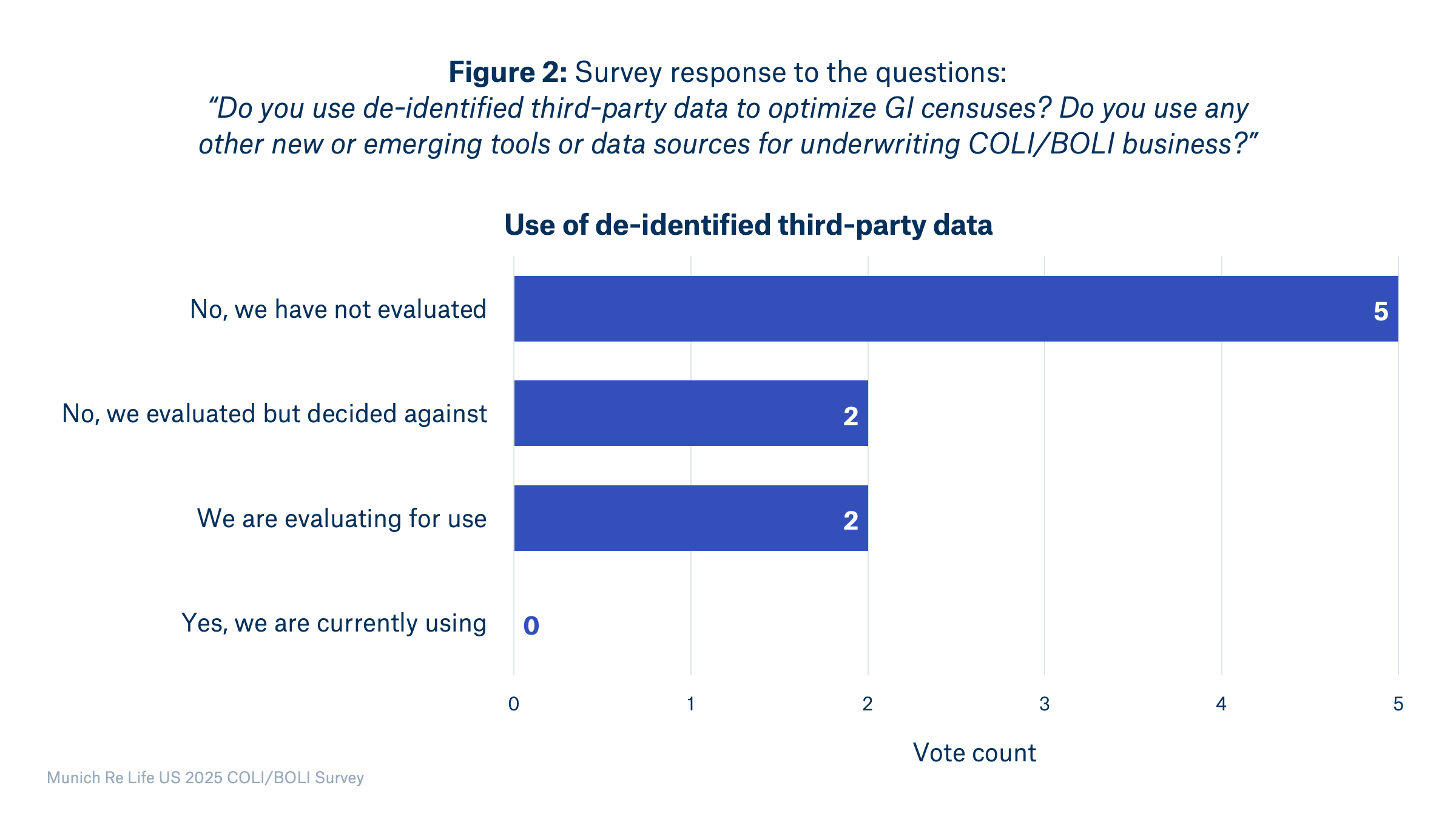
Employ emerging technologies, including de-identified third-party data, to streamline underwriting and improve risk assessment.
Establish clear assumption-setting protocols to align with internal risk tolerance.
Engage reinsurance partners proactively to secure additional capacity on large cases.
Looking ahead
Contact the author