About this episode
Learn about the evolving use cases and practical benefits of electronic health records (EHRs) in life insurance underwriting with experts from Munich Re and MIB. In this episode, Greg Dewey (Munich Re), John Myslinski (Munich Re), and Carolyn McAvinn (MIB) explore how EHRs are being leveraged beyond traditional APS replacement, including for traditional underwriting, point-of-sale evaluations, and post-issue audits. The discussion highlights findings from Munich Re’s retrospective study on EHR value, the operational and cost efficiencies of EHR-first approaches, and the growing role of digital data in streamlining underwriting workflows.
The conversation also covers industry trends, such as the shift toward automated decision-making, the importance of raw data access, and strategies to drive further EHR adoption. Whether you’re an underwriter, actuary, or insurance professional, this episode offers actionable insights and forward-looking perspectives on integrating EHRs for improved risk assessment and customer experience.
Some views and opinions expressed on this podcast may not necessarily reflect those of Munich Re Life US or its affiliates. Commentary provided in this podcast should not be construed as legal, underwriting, financial, or other type of advice.
Participants
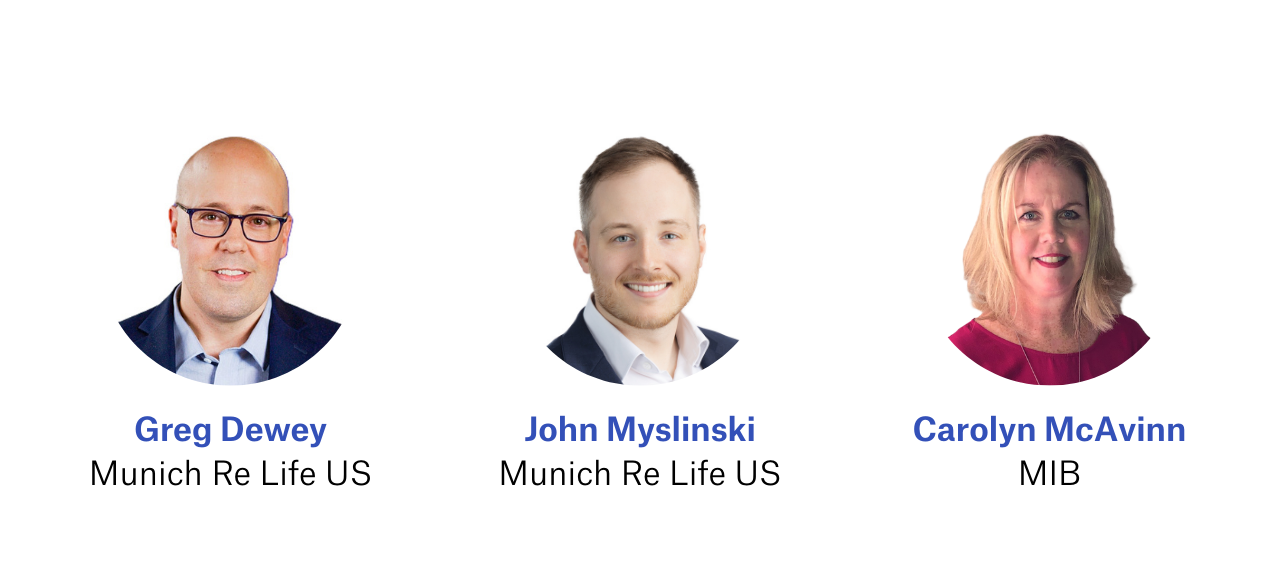
Greg Dewey (host) is Second Vice President of Underwriting Services at Munich Re Life US, where he leads a team of facultative underwriters focused on delivering expert risk assessment solutions. With over 20 years of experience, Greg brings deep expertise from previous positions at direct carriers, spanning operations, strategy, research and development, and automation.
John Myslinski is Director of Integrated Analytics at Munich Re North America Life, where he has worked for over seven years. He leads data science initiatives for Munich Re and serves as AI Governance Lead for the company’s North American life businesses. Before focusing on EHRs, John applied advanced analytics and integrated new data sources to support assumption development, pricing, inforce monitoring, and risk assessment. Earlier in his career, he held various pricing roles at Munich Re and a direct life insurer. John is a Fellow of the Society of Actuaries.
Carolyn McAvinn is Director of Underwriting Innovations at MIB, where she leads efforts to enhance data access and usability across the MIB Medical Data Solutions platform. She also partners with MIB members to advance technology adoption through underwriter education. With over three decades of experience in life, disability, and long-term care underwriting—including roles in automation, accelerated underwriting, and underwriting management—she brings deep industry insight and strategic vision to her work. A frequent speaker and respected thought leader, Carolyn is known for advancing conversations around the transformative impact of electronic data to improve underwriting efficiency, enhance fraud detection and prevention, and optimize clinical insights for risk assessment.
Episode Transcript
Greg Dewey:
Welcome to our latest podcast discussing electronic health records in underwriting. Today we're going to focus on specific use cases. I'm Greg Dewey of Munich Re. Joining me today are my colleague John Myslinski and Caroline McAvinn from MIB. So Carolyn, let's go ahead and start with you for our first question. Where are clients using EHRs today?
Carolyn McAvinn:
Hi, Greg. Thank you for having me. Many clients still want to use EHR data as a replacement for traditional medical records. So APS is typically how we refer to that. For the last five years, quite honestly, everybody that we meet with is starting as an APS replacement. And they want that data to look, act and feel like an APS looks. So we spend a lot of time, in early days, communicating, recommunicating, and educating that EHRs are their own unique piece of data. While robust and containing a lot of the same information for risk assessment, they are unique; it is unique.
The good news is, while people are still using it for that, today the industry is a lot more open-minded about using the information in different places. So whether that's contestable claims or in the post-issue audit space, people are really thinking more broadly about how to use this data and really using it anywhere risk assessment is happening. So we're seeing a lot of that. We're doing a lot of encouraging for people that are a little more cautious about using EHR, or replacing with an EHR, to explore – use that post-issue audit space where cycle time isn't as challenging, and play around with the data even if you're not going to act on it. We're seeing a lot of use there as well.
Greg Dewey:
Fantastic. Thank you for that, Carolyn. John, let's get your perspective.
John Myslinski:
Thanks, Greg. When I think about this, I think about Munich Re's AUW survey. From that, we can see that the most common use cases for EHRs within an AUW program is for kick-outs and post-issue audits, like Carolyn had mentioned. From our perspective that totally makes sense. These are the two easiest places for EHRs to be inserted into an AUW program, operationally speaking. So kick-outs are a great place to use EHRs, because it's cheaper and faster than an APS. You don't have to figure out how to incorporate them into a rules engine, because this path of your AUW program requires a human review anyway, so there's less material process changes needed to get your hands on EHRs.
Post-issue audits are another great place for much of the same reasons, and even more so because we've seen clients have a lot of success with something like an offline batch ordering process. So getting some post issue cases, working with a vendor to get EHRs on them in a less automated way, even further reducing that – call it barrier to entry. One interesting thing from our AUW survey is that there was no one using EHRs within their rules engine today without human review. And again, from that survey, we can see that this is the North Star the industry wants to move to. Thirty percent of respondents see this happening in the next one to two years, and another 52% see it happening in a more distant future. Clearly, the vision’s there, but it's going to take some time to build out functionality. What's really exciting is that Munich Re and John Hancock have begun using EHRs in an automated way without any human intervention. So we've worked with John Hancock to begin to make automated decisions on certain impairments and push the boundaries.1
Carolyn McAvinn:
I'm glad you brought that up, John, because we're seeing that, too. Even if clients don't necessarily know how to use the raw data, we have several that are inquiring with us to receive not only the PDF – the human readable PDF output – but they want the raw data as well, even if they're not ready to put it in an engine, even if they just want to store it somewhere, they want to be collecting that. So when they have time to integrate or to study it, that it's there for them. So one change we recently made as a result of this is we are now surfacing not only that PDF from our platform, but the raw data, too. We did that recently, as a result of the Clareto acquisition, they were they were doing that on their platform. So we really challenged ourselves to say: Why aren't we doing that? So that's something new that we're offering, for all the reasons that you just mentioned.
Greg Dewey:
Great insight. Really appreciate that, and it's exciting to see the progress that we've made over the last few years. Moving on, Munich Re recently conducted a large retrospective study aiming to uncover use cases where EHRs deliver value. What did the study find?
John Myslinski:
At Munich Re, we conducted a large retrospective study, ultimately to quantify the incremental value of EHRs as new evidence in various underwriting frameworks. The way we set this up was that we worked with several participating clients to order EHRs in a large number of cases that had already been underwritten. Then we re-underwrote these policies using different subsets of information, and studied how decisions changed under the varying sets of information. The three papers we published were, number one – the non-fluid accelerated underwriting paper where we looked to answer the question: What value do EHRs provide atop disclosures through an application, MVR, MIB and Rx or Dx? The second paper was fluid underwriting. Here, we looked to answer the question: Can EHRs replace labs? The third study was APS underwriting: Can EHRs replace APS? The high level findings were – for paper one, the non-fluid accelerated underwriting, EHRs were a clear winner. For scenario two, the fluid underwriting, EHRs were also a clear winner. For scenario three, that APS case, EHRs weren't as clean of a one-for-one replacement. But there were clear pockets where EHRs provided the same value as APSs, and I think that makes sense with what Carolyn had said earlier.
Greg Dewey:
Let's go through the use cases. So how can EHRs be used for post-issue audit and random holdouts?
John Myslinski:
We think of EHRs as enabling a fast and comprehensive review of policies to validate automated decisions. Detecting misrepresentation and overall monitoring AUW program performance. EHRs can do this without interrupting the customer experience. Particularly if you think about some of the most commonly misrepresented things like smoking status or BMI, EHRs are unique in their ability to provide rich data in those specific dimensions, quickly. But that's not all, right? EHRs also provide a rich history on diagnosis, procedure, medications, labs, family history. Not only do you get coverage of the main drivers of misrepresentation, you can more holistically monitor your AUW experience with one piece of evidence. This is where Munich's Automated EHR Summarizer can really aid, because our summary report was designed by underwriters for underwriters. We quickly highlight the smoking status, BMI, vitals and then flag all underwriting-relevant risks, which allows the underwriter to review what would otherwise be raw EHRs much more quickly.
Carolyn McAvinn:
When we talk about EHRs, they are a digital alternative to the more invasive requirements. The fluids, somebody coming to your home or your work to have an invasive procedure – weigh you, measure you – do all those things. We can do that with an EHR. We see that a lot of the information in that traditional exam visit is there in the records – medication, smoking status, the vitals, the reason for the encounter, the overall health history – and what we're seeing more and more is the clinical notes are showing up. I think that was an early day barrier to use is people felt like you couldn't get that nuanced information about severity or compliance; you couldn't get that. It’s showing up more and more – the technology is getting better. So the digital medical for either full underwriting at time of initial review for application, at post-issue audit, random holdouts – there's that opportunity to not have to bother the client. Clients don't want to do that anymore. They don't want to shop that way anymore.
The other good thing about this data that plays better than a traditional APS is the whole special authorization [“special auth”] experience. That’s in double-digit territory for APSs. What we see in our search activity data is that only about 6% of the searches are resulting in the need for a special authorization. And it's not that we require it or that the data source requires it. There are just some doctors or health care organizations out there that still want it. But 6% – that alone, for organizations like Kaiser, that doesn't require a special auth. There's a win right there. Even if you just want to start in the early days with a Kaiser type of search, it's such a better customer journey to remove that level of friction. What it does to the service time and the cycle times is – we're talking days and sometimes hours or minutes versus weeks or months of waiting for these records. The way the structure is coming in and playing to automated engines, the cost savings, which is a fraction of what these medical records cost, what we can do quickly and less expensively for these risk assessment production workflows is just revolutionary.
Greg Dewey:
Yeah, absolutely. Go ahead, John.
John Myslinski:
That reduction in special auth. I think that's really, really big. Because if you think about the customer experience for a random holdout today, where you thought you were going automatic, everything looked good. Then there came back the request for a special auth, or you had to wait weeks for an APS. That's a big holdup, and people are going to drop out of the process and negatively impact your cost of customer acquisition. Anything you can do to smooth over the experience in that bucket, that's really exciting.
Carolyn McAvinn:
It is. One, it catches everybody by surprise when we provide that stat – the 6% versus 30%. Everybody is – Oh, sign me up. So that is huge. For that random holdout or post-issue audit play for this record, say you've gone through the process, you're trusting your requirements, but you want to trust and verify. You want that EHR post-issue, and then you can't do that? Or, for an APS, you can't do that because now you have a special auth? You're giving up a disclosure play, potentially, and maybe a mortality slippage scenario. If nothing else, people should be using this data in post-issue audit.
Greg Dewey:
I absolutely agree with that. It’s really been interesting and exciting to see the progress. I think initially to the point we definitely wanted to replace an APS with the EHR, and now to see that there's actually other use cases that really are effective and really help from a time, from a financial perspective. It's really good to see the progress in people finding where that data plays well in the market and really leaning into it when it does.
Carolyn McAvinn:
It's so funny because we've been doing this for over five years now, and almost every initial conversation goes the same – people can't really expand their mind about using it elsewhere. Then that light bulb goes off after a few conversations, or they think of just initial ways to improve everything in their workflow environment.
Greg Dewey:
Very good. Let's move on to the next question. When we talked about the use case, John, you mentioned EHR as replacing an APS. Carolyn, as we look at that, what are the efficiency and the cost benefits of going down that path?
Carolyn McAvinn:
What we touched on a little bit in the last question was the cost. Not only is it cheaper, but it's a predictable flat rate. You're not working in the APS world of per page, where it's really tough to predict what your budget dollars are needed for this. It's very transparent. It's very straightforward. We’re getting this data in days, hours, minutes versus months and weeks. What we see in our data is that about 75% of the searches come back within that first day, and then a subset coming back within minutes. We see about 20% coming back in five minutes. So cycle time and cost savings is a no brainer for the win for this product.
But now, we're really looking at the content more. I know Munich is looking at it, based on your surveys. We look at it more randomly. I get in there with a very critical underwriting eye about what content is in there that I know underwriters need for mortality or morbidity evaluation, and 80% of the time, smoking status, vitals. Clinical lab, which I argue is – okay, it's not an insurance lab. It's not what we all grew up with or are used to, but it's the clinical lab that complements a client's health history – medication information. You can get a lot of robust information from this data. So the content play is there as well. Those clinical notes are coming in 60% of the time; we're seeing that more and more.
You really can get what you need from this data, and our clients were telling that as well. What I always say is, I think we're at a point that we need to challenge some of the underwriters to say: Do you have enough information with the electronic health record in combination with your other data? You probably do. What are you really looking for from the APS that you think is missing? I 100% believe that we're at a time where we can replace or at least have it as our first requirement and pivot to an APS if you need to. We've built our architecture at MIB to be able to do that. If we can't surface the EHR, we will auto-pivot to the APS or to some of our partnerships to augment the file, if need be.
John Myslinski:
When I look to the results of our retro, it showed that, within the framework of our study, EHRs were not a one-to-one replacement for APS. In our study, 87% of the time, adding an APS did not change the decision made with an EHR. That echoes Carolyn's point about challenging underwriters, but it also shows that 13% of the time, EHRs missed something. That proves that EHRs are not a perfect one-to-one replacement. But when we dug into what was in that 13%, we were typically looking at highly impaired cases with complicated comorbidities, or where the EHRs didn't provide a lot of data. So, to maybe flip that around, if you're ordering APSs for something like age and amount, or because of a single Rx/Dx rule, or a specific impairment, then EHRs can absolutely replace APSs.
Building upon what Carolyn said about the ability to pivot to an APS, in our paper, we also looked at the cost-benefit in terms of evidence costs when doing this EHR-first approach. If you think about it, if you order EHRs first and the EHR is sufficient, then you've saved on evidence costs. If you order an EHR first and the EHR is not returned or insufficient, and then you pivot to APS, you've, in a sense, doubled your evidence costs. There's a break-even point where, if there's enough cases where the EHRs are sufficient, that benefit more than outweighs the cost. That's what we saw on the retro study.
Carolyn McAvinn:
I like the idea of reframing the whole question. It’s not replace -- should we replace APS? How can we be more efficient? How can we augment? How can we layer other tools on it, being a summary service or anything to bring efficiency to the review process for the underwriters? I love the idea of you saying breaking even. Maybe we can even use some of those dollars to make life easier for the underwriter, who is now really burdened with complex case review all day because the engines are taking care of the easy things. That should be what our whole conversation is about. Is one better than the other? No. It depends on how you're comparing them, and what can we do in the whole process to use the right piece of information first?
John Myslinski:
It's the right piece of evidence, or right pieces of evidence, for this applicant. That's going to be very different for different applicants.
Carolyn McAvinn:
It's not better. It's different.
John Myslinski:
Yes.
Greg Dewey:
Well said. Really appreciate the conversation there. Moving forward, how are EHRs used at the point of sale and for light-touch accelerated underwriting? John, let's start with you on this one.
John Myslinski:
For this use case with EHRs, we're looking at applicants who couldn't be issued instantly for one reason or another, but still have the potential to be issued. I think sleep apnea is a good example of this. If you have an applicant who's disclosed sleep apnea, you typically won't have enough information from their application disclosures, Rx/Dx, or MVR to make a decision on that case. But you know that with very specific data points, you could get there. If you pivot to an EHR, you can get the sleep study information – the pre- and post-treatment AHIs and CPAP compliance from the EHR in order to make that decision. In this case, the applicant discloses sleep apnea, and instead of ordering an APS, you order the EHR and have the underwriter review the EHR. Then you can make that light-touch decision and be very confident in it. Here you've saved on evidence costs from not having to order the APS, and you've saved on – call it the customer experience dimension – because you can issue the policy in a matter of days, and you have complete confidence in that decision.
Carolyn McAvinn:
John touched more on the types of scenarios that promote light-touch underwriting. I'm going to take the angle of the point of sale. The EHRs allow whoever is looking at the record at point of sale, whether it's a distribution partner or somebody in a direct-to-consumer position, anybody who's first in contact with the customer. What a great tool to perform an evaluation about disclosure – the medical history, information about severity, or really even determining – is this person in trouble that I want to move forward, either with cost or the process? It's also an opportunity to determine what carrier is best for this client? What product is best for this client? It's a great first view that gives the potential to really guide the sale. We have customers that are not only carriers, or members in MIB's case, but we have customers that are at point of sale and are sitting in the distribution seat – this data is perfect for that scenario. Electronic digital data is just so perfect to provide that full breadth of a prospect's medical history and really insurability, in general. Again, without that invasive visit by an examiner, labs taken, or a long APS process initiated.
Greg Dewey:
I think you hit the nail on the head there. It's trying to create that less invasive experience, and there's so much competition between companies to improve that from a customer experience perspective. It’s just really critical to have tools like this in your tool belt to really make significant progress from the time that we use labs or we use an APS, this is really empowering our industry.
Carolyn McAvinn:
If you sit on the carrier side, you don't want to be receiving a bunch of applications for business that's not really suited for your underwriting philosophy. It’s more time on your underwriters, on your resources. It's more expense for you to go through the underwriting process and pay for it, to then say: This isn't really even the type of business that we want.
Greg Dewey:
Well said. Thank you, Carolyn. Shifting gears a little bit. We've talked about EHRs and the progress we've made. How would we continue to drive further adoption of EHRs?
Carolyn McAvinn:
Great question. At a high level, there are two main drivers of increased adoption. One is access to more data, and the other is developing tools and solutions that enable a better usability experience for underwriters. At MIB, we are in the process of really working out a workflow to explore a different access process beyond the HIPAA consent process. That’s one way we think is going to drive more adoption. The second way is to further enhance the tools that we use on top or layer on these records to make life easier – whether it's summary services, whether that's information to dedupe the data or normalize it, or create it in a consolidated data output view for engines. These are the two tracks that, to me, are really going to increase adoption and usability, for both the human underwriter and the engines that are doing some of the analysis on this business.
John Myslinski:
Yeah, I totally agree with Carolyn. I think the better data, better tooling, the better summaries, the better structured data. You know, we talked earlier about just getting your hands on EHRs and looking at the raw data, looking at summaries and getting familiar with it. I believe when carriers get more accustomed to what's in an EHR, the comfort, the confidence and the expectations will build from there. Soon, EHRs won't be, quote unquote, new data, but just data.
There's a lot of natural pressure in the life insurance industry to balance the customer experience, the mortality slippage and evidence costs. With that in mind, we look at the non-fluid accelerated underwriting retro results – that was scenario one – and find that EHRs provide all this benefit atop traditional AUW evidence. To me, it begs the question: Why not order EHRs first? Born out of that line of thinking, we're working on an EHR-first product with MIB that aims to put EHRs at the center of underwriting, to give carriers that competitive edge that they're looking for.
Carolyn McAvinn:
I'm really looking forward to this because I think that's what's missing in the market. There are some summary tools. As a result of the Clareto acquisition, we are offering a tool to consolidate, so we're doing all the things that we can do now to consolidate the data in that one format. But what's missing in the market is that content review and being able to really support the market in that straight-through processing space – to be able to go into the record, gather everything that's needed, feed the engine, and deliver that next big thing. I'm super excited about our collaboration in working on that and bringing that to the market, and teaching everybody about the value.
Greg Dewey:
I agree with that, both of you. Going back to John's comment, I really like the concept of EHR-first. To tee that up, that will actually be our next podcast, getting into more detail about that. I think it's a very good concept to start with certain data and then decide from there – what is the applicant profile based on age, face amount, medical history, non-medical history – what is appropriate? We've seen people in the industry say it's not necessarily that we're going to have these very strict routine requirement charts. We're going to look at a little bit more individualized, where yes, you’ll have parameters to make decisions around a case, but it really is: What do I have? What do I truly need after getting an EHR? I’m very excited about that path as we go forward.
Carolyn McAvinn:
I am, too, Greg. The age and amount requirements – you and I have been living in that world forever. For the last few years, there has been a lot of conversation about a personalized approach, but now we have the tools to really support that and give underwriters a little bit more control over the case versus this black and white chart that you have to follow.
Greg Dewey:
Very much so. Thank you, Carolyn and John. I really appreciated the conversation today. Hopefully, it's helpful to our listeners.
Carolyn McAvinn:
Thank you for having me.
John Myslinski:
Thank you.
Greg Dewey:
I want to say thank you to our listeners. We really enjoyed the conversation. I hope you got something out of it. As I mentioned, our next podcast will discuss the concept of EHR first. We look forward to that and appreciate your time today. Thank you very much.
Contact