insurance 2026

Uncertainty stemming from factors, including access to capital, artificial intelligence (AI) implementation, and unpredictable regulatory actions, is creating management liability risks for private companies. These contribute to a challenging operating environment in 2026 and beyond, which can lead to adverse financial results and generate claims. To mitigate these risks, private companies and their risk and insurance advisors should look closer at their exposures and risk transfer options.
Uncertainty in access to capital adds stress
Private companies face difficulty in accessing capital on favorable terms, amid ongoing stress in capital markets and persistent inflation. Uncertainty in access to capital poses a significant risk for private organizations, as it can lead to a spiral of negative consequences.
Several measures suggest capital markets are under stress and potentially heading for a downturn. For example, the cyclically adjusted price-to-earnings (CAPE) ratio for stocks is close to an all-time high. In the past, CAPE ratios exceeding 25 have preceded market crashes, such as the 2000 dot-com implosion and the 2008 global recession. In August 2026, the CAPE ratio on the S&P 500 Index is about 41.1, its highest level since 2000 and far above the historic average of 16.
Other factors driving market volatility include economic uncertainty and the Federal Reserve’s decision to stop issuing forward guidance on monetary policy changes. The current interest environment has pushed U.S. long-term borrowing costs to their highest level in nearly two decades.
Inability to secure working capital at cost-effective rates can compound operating challenges. Geopolitical and energy volatility can also bump inflation and increase expenses. This combination of factors may threaten growth plans or force companies to curtail them, missing out on opportunities and falling short of investor expectations.
Underperformance invariably draws scrutiny from investors, which can result in allegations of poor decision making, and second-guessing of board and management actions. As investors become dissatisfied, claims against directors and officers are more likely.
Questions brokers should ask:
- What are my client’s primary sources of working capital?
- What are the immediate and longer-term consequences if funding is reduced?
- What contingencies does my client have for loss of funding?
- How do existing risk transfer solutions mitigate financial exposures for my client?
- What other private management liability coverages could help strengthen my client’s insurance program?
Rise of private credit raises risks
To obtain funding in a turbulent market, many private companies are turning to private credit markets instead of traditional bank loans. Private credit is growing due to its ability to offer customized financing and flexibility for borrowers with imperfect credit or low collateral, but it also introduces risks for private company borrowers.
$1.5t – $2t
Estimated private credit market holds
50%
Private credit market growth
between 2020 – 2025
$5t
Estimated to reach in 2029
The private credit market is estimated to hold between $1.5 trillion and $2 trillion in assets, according to the Financial Stability Board (FSB). Morgan Stanley data shows the private credit market grew by 50% between 2020 and 2025, and it could reach $5 trillion by 2029. The private credit industry’s growth trajectory began following the global financial crisis in 2008, as lending regulations tightened for banks. Participants offering private credit include asset managers, pension funds, private equity firms, and banks through financing arrangements and strategic partnerships. The FSB notes that private credit is concentrated in a few industrial sectors, including but not limited to technology, healthcare, and services.
Among the risks in private credit are:
- Limited transparency. A lack of transparency can cause investors to challenge board decisions about financing, particularly if the company encounters financial trouble.
- Liquidity pressure. The private credit industry has not been tested in an economic downturn, and investor pullback in one or more of the sectors reliant on private credit could trigger liquidity pressure on lenders as well as borrowers. This may force borrowers into strategic pivots, layoffs, or shutdowns, any of which could trigger claims against directors and officers.
- Financial instability. Private credit firms themselves are facing redemption pressures, which increases financial instability for borrowers.
- Lack of internal communication. Finance and operational risk management may operate in silos rather than collaboratively when it comes to credit facilities. Communication between these functions is important to provide perspective on the risk impact to the organization and its directors and officers.
Questions brokers should ask:
- How reliant is my client on private credit?
- What would happen if my client’s private credit sources had to withdraw credit due to redemptions or other pressures?
- What would happen if my client had a liquidity problem and couldn’t pay its private creditors?
- What plans does my client have to restructure debt in the event its credit sources shrink?
- Does my client’s existing management liability program adequately protect against this sort of exposure?

AI introduces unanswered questions
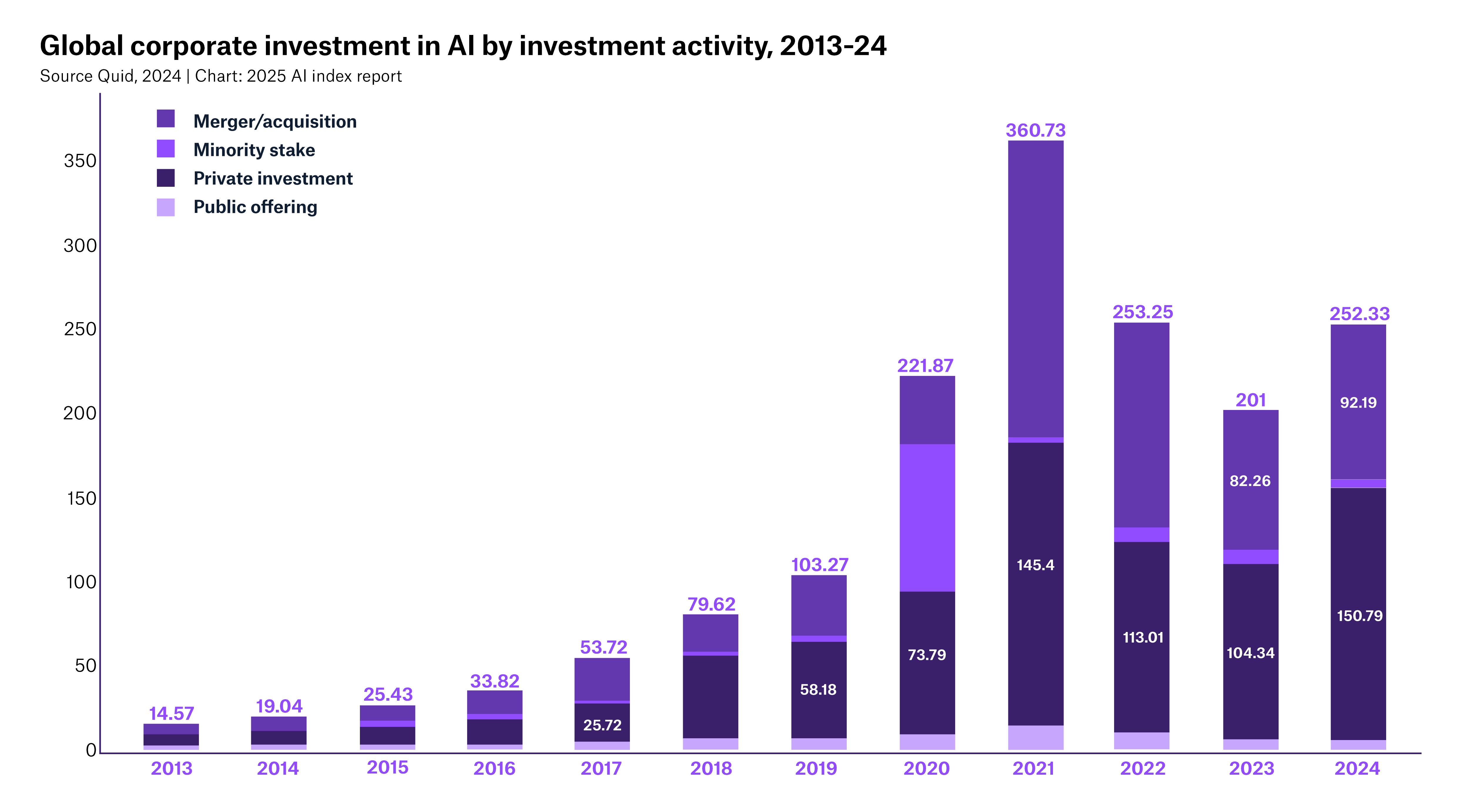
The investment boom in AI is clear, but the payoff for investors is opaque. A record $150.79 billion of private investment went into AI projects worldwide in 2024, according to the Stanford University Institute for Human-Centered Artificial Intelligence. More than two-thirds of private investment in AI is in the United States, led by AI infrastructure, research and governance, and followed by data processing and data management. The nature of these investment areas means they apply broadly to industries and not solely to the construction of data centers and software development. Massive inflows of capital — particularly into AI companies and data centers — aren’t yet showing returns for investors. This suggests the risk of a market correction in AI overinvestment is high.
For private companies, AI investment and implementation introduce unanswered questions. For example, what happens if a company is forced to reduce or pause its AI implementation plans? Investors may allege overconfidence, poor diligence, or misallocation of capital. In this way, AI risk can be linked to board oversight, not just the technology itself.
Another question AI raises is corporate governance over the technology. AI governance gaps exist at smaller and private companies. Many lack relevant technology expertise on their boards, have few or nonexistent AI governance procedures, have little to no budget for staff with AI management skills, and may be pressured to adopt AI without safeguards. These decisions could return to haunt directors and officers.
Questions brokers should ask:
- What are my client’s plans for AI in its business?
- What controls and governance practices are in place or intended around AI?
- Does my client already have or intend to recruit directors with AI skills?
- What would happen if my client failed to meet its objectives for AI? How would this impact the business goals?
- How prepared is my client for natural hazards that could disrupt its data center and use of AI?
- How does my client’s risk management program address AI exposures? What exclusions should my client be aware of; e.g., cyber?
Unpredictable regulatory and government oversight
Regulatory and government oversight are difficult to predict in 2026. Further complicating this situation for private companies is ongoing volatility from the imposition of tariffs, court decisions, and government policies, which create significant challenges in managing supply chains.
It’s virtually impossible to predict how court rulings, reversals, and policy decisions will play out in the broader economy. Instability and unpredictability in regulatory and government oversight translates into operational and financial planning risk for private companies.
Management decisions made as policies shift face the risk of challenges; claims may allege boards should have foreseen the outcome.
Questions brokers should ask:
- How does my client stay up to date on current government policies and regulations that impact its business?
- What processes does my client have to ensure compliance with relevant regulations?
- What are the consequences of compliance failure for my client?
- How does my client incorporate changes in government policy into its financial planning?
- How can my client strengthen its risk management and compliance program in a shifting environment?
Conclusion
Lingering uncertainty, evolving risks, ongoing growth in litigation, and private organizations’ limited resources equate to significant risks and exposures for directors and officers. This combination of factors calls for selecting insurance partners with deep expertise in private management liability. Private management liability insurance can play an important role in bridging gaps for directors and officers.
Munich Re Specialty – North America’s management liability solutions
Experts