Watch the webinar

Summary
Natural hazard events may already be eroding the operating profit of one in six globally significant companies. This insight is based on an analysis of more than 8,000 organisations worldwide by using Company Climate Risk Edition. However, the risks are not evenly distributed.
Financial institutions that can identify which companies in their portfolios could be exposed are better positioned to plan investment and steering. Climate risk assessments indicate potential losses that can be mitigated through prevention and insurance. Banks, investors, and insurers can use the results to start targeted conversations with counterparties on whether and how they are prepared to cope with climate risk to avoid profit strains.
Do you know how many companies in your portfolio are at risk of being hit by natural hazard events every year and what this means for their operating profit?
Ask this question to a gathering of loan managers, credit risk analysts, asset managers, or investors. Few people, if any, will answer “yes”. That may be about to change. Quantifying climate risk across company portfolios has just become easier.
With Company Climate Risk Edition, delivered through Munich Re’s Location Risk Intelligence Platform, banks, investors, and insurers can better translate the physical exposure of assets into financial impact at the company level. The results do not include counterparties’ prevention and insurance covers to reduce vulnerability. However, equipped with natural hazard insights, users can initiate valuable conversations with their portfolio companies about what mitigation or adaptation measures could help prevent or counteract the earnings hit.
Translating hazard events into financial metrics
To illustrate this quantification of climate risks, we ran a sample analysis of more than 8,000 globally significant organisations. We measured how four different acute natural hazards on average can theoretically affect the companies’ earnings potential today, in 2030, and 2050. The metric we used was the potential impact on EBIT, earnings before interest and taxes, which measures an organisation’s operational profitability. Of course, preparedness and prevention measures could help ringfence the estimated financial effect.
Our findings showed that one in six companies worldwide already faces a potentially meaningful or significant annual drag on earnings due to natural hazard events, if they had insufficient precautionary measures or insurance. By 2050, under a high-emissions scenario, this could increase to one in five companies.
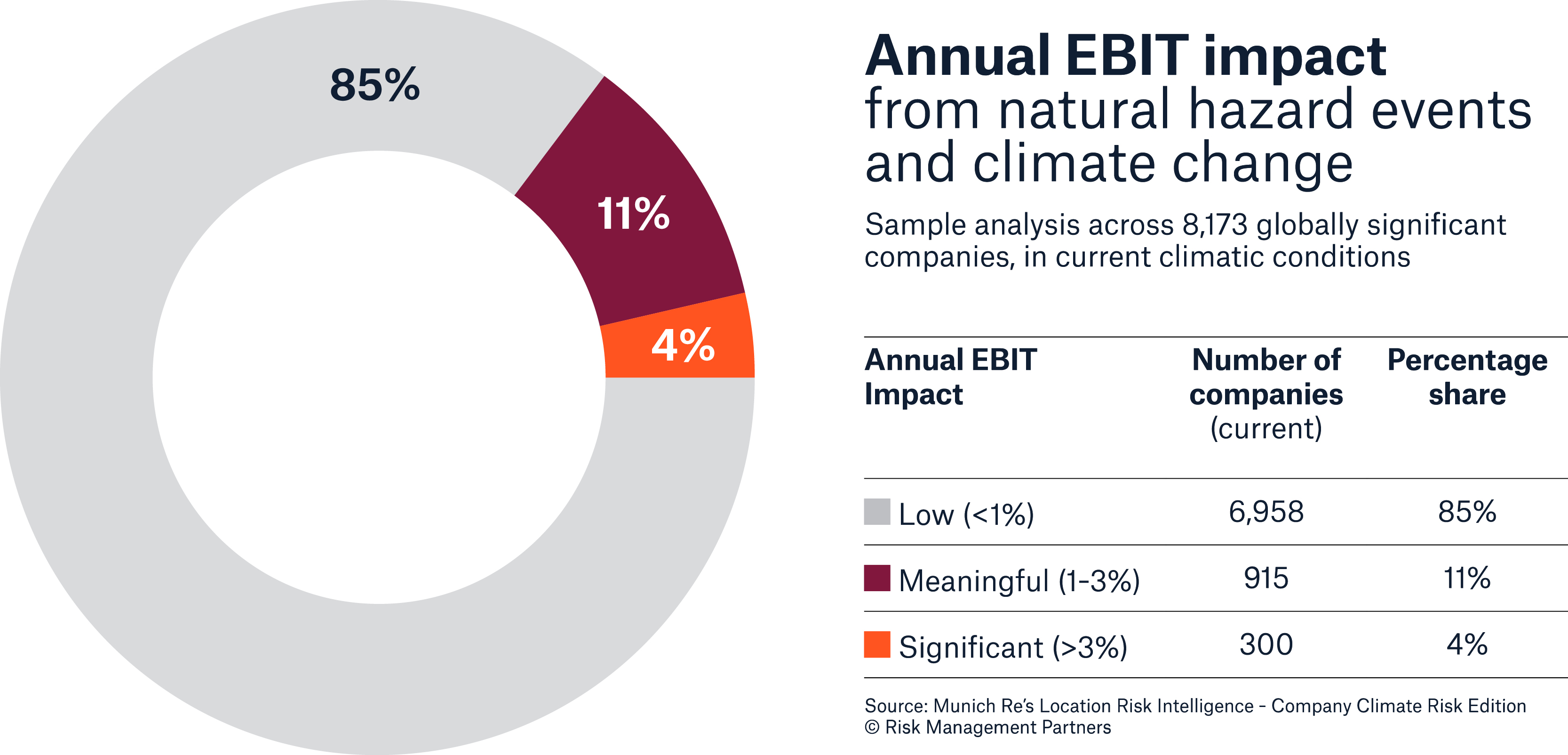
A similar pattern emerges among the world’s largest listed firms, including the 1,320 included in the MSCI World Index. Today, around 1 in 14 of them faces a potentially meaningful expected average annual impact on operating profit from natural hazards. As climate change continues to influence the frequency and severity of weather-related events in many regions, physical damage and its consequences are likely to increase, possibly affecting around one in ten companies by 2030.
While these results take existing public flood defences against river flood and storm surge into account, any private adaptation measures or insurance coverages that companies have put in place to prevent natural catastrophes affecting their cashflow are not included.
Risks spread very differently across companies
One important aspect of acute climate risk is that it is unevenly distributed, and it affects the earnings of companies very differently. The financial impact largely depends on how strongly an organisation’s cash flow relies on its physical assets and production sites, as well as on any prevention measures they take.
For example, flooded office spaces are typically less critical for companies with a manufacturing focus, while damage to production facilities or infrastructure can significantly disrupt operations and earnings.
Importantly, our analysis focuses only on property and content damage from four perils: tropical cyclone, river flood, storm surge, and extratropical storm. Other physical risks from natural hazards and climate change are not included, nor are extended effects, such as on business interruption and supply chains, so the total financial effect is likely to be significantly higher.
At the same time, the estimations are expressed on an average annual basis and could be higher or lower in a given year. And, as noted before, while public flood defences are taken into account, private adaptation measures or insurance coverages to prevent losses are not included.

Acute physical climate risks can affect the earnings of companies very differently – banks and investors need to focus on the companies where these risks can have meaningful or significant impacts on the operating profitability of companies. This is what Company Climate Risk Edition is about.
Why even “small” climate hits can limit growth
Let’s look at how natural hazard risks can erode profitability in a theoretical example. Assume that a typical business increases its operating profit at nominally 5% per year. Inflation, let’s say 2%, already reduces this. The inflation-adjusted real EBIT growth is then closer to 3% – broadly in line with long-term global GDP growth. At annual weather-related losses of 3%, the company faces stagnation. Annual hits of this size can kill profit growth.
At a significant impact of more than 3% of operating profit each year, a company that does not reduce its risk through prevention potentially faces continual income erosion, or death by a thousand cuts. Over time, a business suffering such a significant annual EBIT impact from climate-related events would probably lag behind its peers, having higher business costs but far less capital to reinvest. Of course, this would not happen in isolation: a company faced with this type of scenario should be incentivised to consider risk mitigation measures to avoid such losses.
This gradual erosion of earnings often remains invisible in conventional financial models that lack location-specific physical risk data. This raises more questions for banks, investors, and insurers:
If one of your corporate counterparties lost 3% of its operating profit every year due to floods, storms, or cyclones, would that show up anywhere in your models today? And is this counterparty already taking any adaptive measures – such as engineering measures or insurance?
Implications for banks and investors
Identifying which counterparties are at risk is key. Banks need to be able to identify companies in their corporate lending portfolios that face a meaningful or significant potential annual impact on their operating profit. These exposures may not be fully reflected in traditional financial models, and as climate hazards intensify, the gap between modelled and actual credit risk may widen.
At the same time, our climate risk analysis reveals business opportunity. By pinpointing elevated exposure, banks can more easily identify which counterparties require capital for adaptation measures. When the risks are better quantifiable, financing flood defences or storm-resilient infrastructure may make commercial sense.
For investors, the logic works in both directions. Long-term portfolio resilience depends on recognising counterparties with a negligible climate impact, their “climate alpha” selection. Managing their higher risk “climate beta” companies involves underweighting the ones that could see a meaningful or significant annual EBIT impact from climate change, particularly those counterparties that do not or are not willing to take adaptive measures or procure sufficient insurance coverage.
The solution behind the analysis
Munich Re’s Company Climate Risk Edition enables this type of analysis at scale. Top-down modelling covers more than 340 million companies worldwide across four perils, as well as an aggregate Overall Impact under multiple climate scenarios.
At the foundation of the analysis is the asset level Climate Expected Loss (CEL), that measures the expected average annual loss from physical damage at individual sites. These asset-level risks are then aggregated to derive a company-level CEL, reflecting the overall loss outlook of a company.
Building on this, the edition translates physical risk into potential financial impact. It relates asset values to operating profit as an estimate of EBIT impact, expressed on an average annual basis. While not an exact prediction, it does provide a direct link between climate exposure and financial performance.
Taken together, these metrics give credit committees and investment boards a clearer view of climate risk across company portfolios. Being able to assess the potential financial impact helps them to steer lending and investment toward stronger, more resilient companies.
Want to understand more about climate risk in your company portfolio? Request a personal demo of Company Climate Risk Edition.
Frequently Asked Questions (FAQ)
What is Company Climate Risk Edition?
Company Climate Risk Edition belongs to Location Risk Intelligence, Munich Re's SaaS platform for managing physical risks associated with natural hazards and climate change. The Climate Expected Loss and EBIT Impact metrics support users in quantifying the potential financial impact of climate risk on corporate portfolios.
What does the EBIT Impact metric show?
EBIT Impact is the expected average annual physical damage of the asset base of a company, expressed as a share of their operating profit. A meaningful impact (1–3%) signals risk of growth stagnation. A significant impact (above 3%) could result in earnings erosion over time. These do not take company-level precautionary measures into account.
What is Climate Expected Loss (CEL)?
CEL is the expected average annual loss from physical damage to a company’s assets, expressed in per mille (‰) of total rebuilding and content cost. The Company Asset CEL provides the metric for an individual site. Factors such as downtime are not included, so the total financial effect is likely to be significantly higher.
Which natural hazards are modelled?
Company Climate Risk Edition models four perils: tropical cyclone, river flood, storm surge, and extratropical storm. Results are provided for each peril individually, as well as in an aggregated metric, as Overall Impact CEL.
What climate scenarios and time horizons are covered?
The solution provides results for current climatic conditions as well as for future climate scenarios based on IPCC pathways. Available scenarios include SSP2/RCP 4.5 and SSP5/RCP 8.5 with projection years for 2030, 2050, and 2100. Reporting data is aligned with CSRD and TCFD/ISSB requirements, as well as EBA Risk Management Guidelines, PRA supervisory requirements, and ECB stress-testing.
How does Company Climate Risk Edition handle companies without asset-level data?
Where asset-level location data is available, the Company Climate Risk Edition applies a bottom-up approach, modelling risk at the individual asset level and then aggregating up to the company level. For companies without such data, a top-down methodology is used. This estimates company-level Climate Expected Loss (CEL) by combining country-level average risk results proxied through the company’s geographic revenue footprint and sector profile. Known office locations are also incorporated where possible. In this way, the edition covers more than 340 million companies