Request a demo

Summary
Understanding nature-related risks helps organisations protect the ecosystems that people and economies rely on. With world-class biodiversity datasets integrated into Biodiversity and Nature Risk Edition, companies can see where habitats near their sites, assets, and investments are under pressure. Location-level data helps them to prioritise action where it counts.

If we're serious about safeguarding the natural systems that underpin our economies and societies, we need robust data to guide decisions.
We spoke with Hannah McCartney, Innovation Unit Programme Manager for the Natural History Museum in London, which develops the Biodiversity Intactness Index (BII). We asked how insurers, real estate investors, and other sectors can benefit from assessing nature risk through Munich Re’s Location Risk Intelligence.
Much of the global economy depends on having intact nature and ecosystems. What role can indices like the Biodiversity Intactness Index play in protecting that value?
To one degree or another, every company depends on nature, whether that's crops grown for food and drink, timber used in construction, or the healthy ecosystems that provide clean water, pollination, and climate regulation. The challenge is that ecosystem health and biodiversity have traditionally been difficult to quantify, and therefore difficult to incorporate into business settings. You cannot manage what you cannot measure.
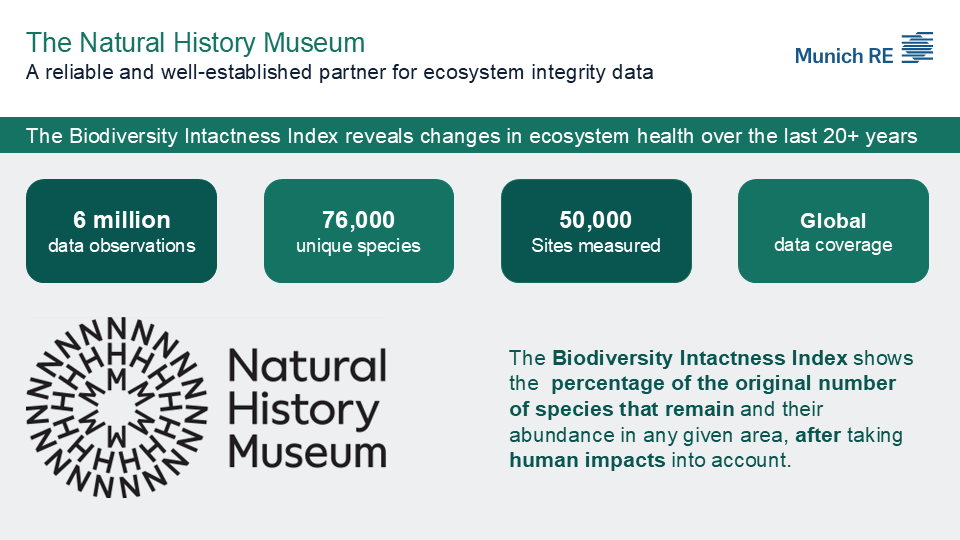
If we're serious about safeguarding the natural systems that underpin our economies and societies, we need robust data to guide decisions. That's where indices like the Biodiversity Intactness Index can play an important role. The BII calculates how much of a region’s biodiversity is still present, and whether populations of local species are at healthy levels. By making biodiversity visible, the BII helps organisations identify risks, track progress, and spot opportunities to protect and restore nature.
Why is it so important to have location-based data?
Biodiversity is inherently local. The species present, the pressures they face, and the way ecosystems respond can vary dramatically from one place to another.
Different biomes also respond differently to human pressures. The impact of land-use changes in a tropical rainforest, for example, can be very different from the impact of the same activity in a grassland, wetland, or temperate woodland. Understanding local context is essential if we want to make informed choices about nature.
Our collections at the Natural History Museum span more than 200 years. Combined with observational data, they help us understand what species were present, where they were found, and how biodiversity has changed over time. That historical and location-based information allows us to build a much richer picture of the state of nature today and how it may change in the future.
For businesses, it means they can move beyond broad assumptions and understand the biodiversity context of a specific site, asset or investment. This helps them target action where it can have the greatest impact.
What else makes the Natural History Museum relevant to the business world?
The Natural History Museum is known for being a beautiful building full of dinosaur skeletons, but it is much more than exhibitions. It is also a world-leading research institution with over 350 scientists, a comprehensive research programme, and one of the largest natural history collections on earth.
The Museum’s knowledge, research, collections, and data are combined with cutting edge ecological modelling to create tools like the Biodiversity Intactness Index. Ultimately, the museum's mission is to create advocates for the planet. We do that by sharing the evidence people need to make decisions that help people on planet thrive.
How do you see insurers, banks, or real estate investors using biodiversity intactness data?
I can see each industry using the BII in slightly different ways, but ultimately for the same purpose: understanding nature-related risk and opportunity.
If you're insuring, investing in or building assets in a region where ecosystems are under pressure, the risks are going to be higher, both in terms of impact on nature and in terms of financial materiality. The BII helps by providing evidence that organisations can use to mitigate risk, reduce impacts, identify restoration opportunities, and track progress over time.
For other businesses, it may be about Taskforce on Nature-related Financial Disclosures (TNFD) or the Science Based Targets Network (SBTN) reporting. The BII is a tool that can be used in these frameworks and helps businesses to understand their impacts and dependence on nature across their supply chain.
What is Biodiversity and Nature Risk Edition?
Biodiversity and Nature Risk Edition is delivered through Location Risk Intelligence, allowing companies to assess climate and nature risks on one platform. Based on Munich Re natural hazard risk expertise, the solution integrates the Biodiversity Intactness Index from the Natural History Museum and world-class datasets from the Integrated Biodiversity Assessment Tool (IBAT). Banks, insurers, investors, and corporates can better understand nature-related impacts and simplify disclosures under TNFD, CSRD, and other frameworks.
Why is it significant that BII data is being integrated into Munich Re’s Location Risk Intelligence?
Biodiversity is incredibly complex. There are millions of species, all responding differently to human pressures, and that complexity can be overwhelming for businesses. Without platforms like Munich Re's, that science risks remaining within academia. It's valuable in its own right, but its ability to drive change at scale is limited.
Integrating BII into Munich Re’s Location Risk Intelligence Platform is a big step, because it moves biodiversity science from the academic journals into real-world workflows. When biodiversity data is embedded into the systems businesses use, it reaches the people who can change outcomes on the ground. And that is how we scale impact.
By putting cutting edge science into the hands of businesses, investors, and decision-makers, we are helping more people understand their relationship with nature and empowering them to take action.
On a personal note, what excites you most about your work?
What excites me most is seeing where science can make a real difference. My background is in economics, so I really enjoy working at the intersection of science, business and policy, and helping translate complex research into something that can inform strategy.
Of course, I work at the Natural History Museum, so I'd be lying if I said the dinosaurs weren't a big part of the appeal! I'm also passionate about the Natural History Museum's mission to create advocates for the planet.
I would love to see organisations using Location Risk Intelligence and the BII to identify opportunities to avoid harm, support restoration, and improve biodiversity outcomes in the places where they operate.
Opportunities are waiting. Learn how to understand, measure, and manage nature risks with Biodiversity and Nature Risk Edition.
Frequently Asked Questions
What is the Biodiversity Intactness Index?
The Biodiversity Intactness Index is a science-based metric developed by the Natural History Museum that measures changes in the biodiversity in a region despite human activities compared to a natural baseline.
Why does biodiversity matter for businesses?
Virtually all organisations depend directly or indirectly on healthy ecosystems for resources and services such as clean water, pollination, timber, climate regulation, and resilient supply chains.
Why is location-based biodiversity data important?
Biodiversity is highly local. The species present, the pressures they face, and the way ecosystems respond can vary significantly from one place to another.
How can organisations use biodiversity data in risk assessment?
Companies can use biodiversity data to understand nature-related risks and opportunities at site, asset, or investment level, helping them prioritise action where it can have the greatest impact.
Why is integrating the Biodiversity Intactness Index into Location Risk Intelligence significant?
Integrating BII into Munich Re’s Location Risk Intelligence brings biodiversity science into business workflows, making it easier for companies to assess nature-related risks and support better outcomes for nature.