
By Michael Duffy, Vice President – Claims Client Manager, Munich Re US
Human trafficking has traditionally been viewed through the lens of criminal law and human rights. Increasingly, however, it is becoming a significant liability exposure for insurers and reinsurers.
Civil litigation related to trafficking allegations is no longer focused solely on individuals who are doing the actual trafficking. Plaintiffs are increasingly pursuing businesses and institutions alleged to have benefited from, enabled, ignored, or failed to prevent trafficking activity. Hotels, financial institutions, technology companies, transportation providers, labor contractors, employers, and public entities have all become litigation targets.
As a result, human trafficking is emerging as a casualty risk that sits at the intersection of social inflation, institutional liability, evolving legal theories, and complex insurance coverage issues. Claim frequency continues to rise, plaintiff theories are expanding, and insurers are increasingly being asked to evaluate losses involving severe allegations, uncertain damages, protracted litigation, and potentially significant aggregation concerns.
The legal framework
The modern litigation landscape stems largely from amendments to the Trafficking Victims Protection Reauthorization Act (TVPRA). While the original statute, enacted in 2000, focused primarily on criminal enforcement and victim protection, subsequent reauthorizations significantly expanded civil liability. In 2003, Congress created a private right of action that allowed trafficking victims to file civil lawsuits. In 2008, liability was expanded further to include businesses and organizations that knowingly benefited from a trafficking venture they knew or should have known was engaged in trafficking.
That “should have known” standard is particularly important from a liability perspective. It provides plaintiffs with a pathway to pursue organizations that may have had no direct involvement in the trafficking itself but are alleged to have overlooked warning signs, failed to implement safeguards, inadequately supervised operations, or failed to act when indicators of trafficking were present.
The U.S. Department of State recognizes two primary forms of human trafficking: commercial sex trafficking and forced labor. Importantly, trafficking is defined by exploitation, not transportation. As a result, allegations can arise in ordinary commercial settings where defendants are accused of facilitating, overlooking, or benefiting from the exploitation of victims rather than directly participating in the underlying criminal conduct.
A rapidly expanding litigation trend
The exposure is no longer theoretical.
Federal civil trafficking litigation has increased dramatically in recent years, culminating in a record number of filings in 2025 and marking the fourth consecutive year of record growth. While sex trafficking litigation continues to dominate, forced labor claims are also increasing and may represent an important source of future exposure.
Human trafficking cases by year and type (2003-2025)
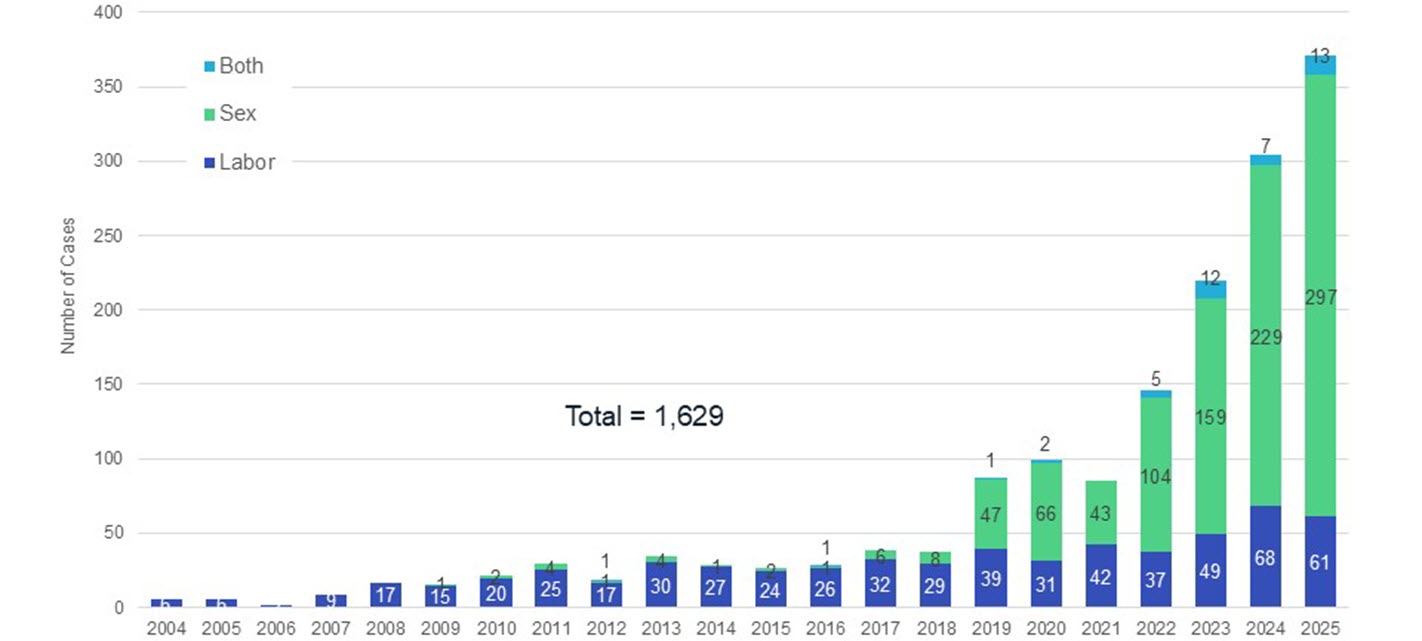
Recent verdicts and settlements demonstrate the severity potential of these claims. In 2025, a Georgia jury awarded $40 million against a hotel operator under the TVPRA, including $30 million in punitive damages. That same year, three Philadelphia hotels reached a $17.5 million settlement arising from sex trafficking allegations. Exposure extends well beyond the hospitality industry. Between 2023 and 2026, major financial institutions, including JPMorgan Chase, Deutsche Bank, and Bank of America, collectively agreed to pay more than $430 million to resolve claims brought by survivors of Jeffrey Epstein’s trafficking enterprise.
Developments in trafficking ligation share several characteristics commonly associated with emerging casualty exposures:
- Expanding theories of liability
- Increasing plaintiff sophistication
- A growing focus on non-traditional defendants
- Nuclear verdict potential
- Significant punitive damage exposure
Why hotels became ground zero
Although trafficking litigation has expanded into numerous industries, the hospitality sector remains the primary target. More than two-thirds of sex trafficking lawsuits filed in 2025 were brought against hotels and motels.
Sex trafficking cases by type of defendant (2025)
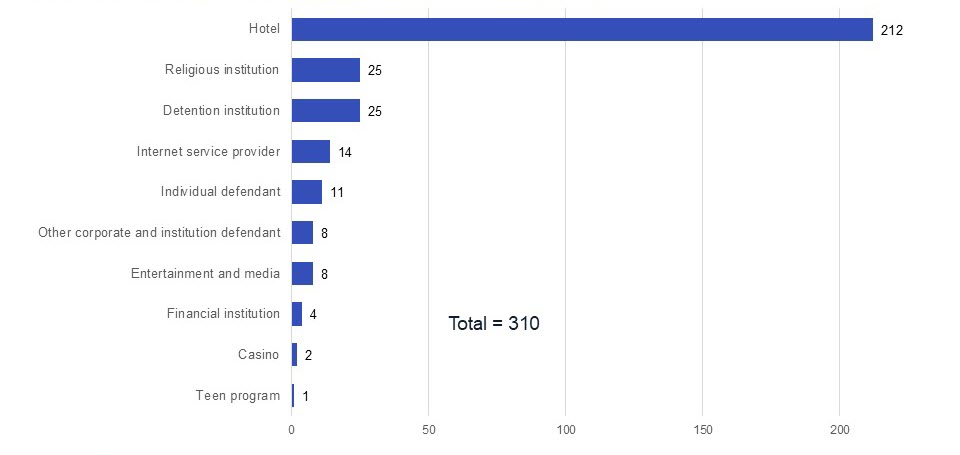
From a plaintiff’s perspective, hospitality defendants often represent attractive litigation targets due to a combination of factors, including highly sympathetic victims, allegations of recurring misconduct, readily identifiable defendants, extensive operational documentation, and the potential availability of insurance coverage. Plaintiffs frequently argue that trafficking activity occurred openly, that warning signs were missed or ignored, and that businesses profited from room rentals while failing to intervene. Whether ultimately proven or not, this narrative is relatively easy for juries to understand and can create significant litigation risk.
Why these claims are challenging for insurers
Trafficking claims rarely fit neatly within traditional liability frameworks.
They often involve overlapping allegations of negligent security, premises liability, failure to supervise, abuse and molestation, institutional negligence, and intentional misconduct by third parties. At the same time, many of the factors that ultimately drive claim value remain uncertain during the early stages of litigation, making reserving particularly difficult.
Liability frequently hinges on what a defendant knew, should have known, or reasonably could have discovered. Determining those facts often requires extensive discovery involving employee testimony, training materials, surveillance footage, internal communications, prior incidents, and corporate policies. It can take years before liability exposure becomes reasonably clear.
Damages create another layer of uncertainty. Alleged injuries are tragic, often span extended periods of time, and typically include severe emotional distress, PTSD, psychological trauma, lost earning capacity, and other noneconomic damages. Plaintiffs frequently argue that defendants prioritized profits over victim safety, creating fertile ground for “Reptile Theory” trial strategies, which can lead to inflated awards and punitive damage. There is significant potential for runaway jury awards.
Coverage issues can be equally complex. Courts continue to wrestle with questions surrounding occurrence-based coverage, abuse and molestation exclusions, assault and battery exclusions, trafficking exclusions, intentional act exclusions, public policy defenses, and allocation across multiple policy periods. These issues are playing out in courts across the country. Outcomes may vary significantly by jurisdiction and policy language.
Importantly, even when indemnity obligations remain uncertain, many courts to date have found insurers have a duty to defend. Defense costs alone can become a major driver of ultimate loss, particularly when accompanied by parallel coverage litigation or when a reservation of rights triggers independent defense counsel obligations.
Beyond hospitality: the next wave
Although hotels have received most of the attention to date, trafficking litigation is steadily expanding into other sectors.
Claims have been filed against:
Financial institutions, including JPMorgan, Deutsche Bank, and Barclays
Technology companies, including Salesforce
Social media platforms, including Meta
Transportation providers, including Uber
Many of these cases remain in relatively early stages, but the trend is clear. Plaintiffs are increasingly seeking to extend liability beyond traditional premises-based defendants to organizations alleged to have facilitated, supported, enabled, or benefited from trafficking activity.
For insurers, the implications extend beyond Commercial General Liability coverage and may involve Technology E&O, Financial Institution Professional Liability, D&O, Excess Liability, and other specialty lines.
Public entity exposure
Plaintiffs are increasingly pursuing allegations against public entities, which represent another area of growing concern, including child welfare agencies, foster care systems, juvenile detention facilities, school districts, universities, law enforcement agencies, and other organizations responsible for vulnerable populations.
Rather than focusing on the TVPRA’s “knowingly benefited” standard, these cases often center on allegations that a governmental entity knew or should have known an individual was at risk of trafficking and failed to protect, supervise, report, or intervene.
From an insurance perspective, these claims can implicate public entity liability programs, law enforcement liability coverage, constitutional rights claims, abuse and molestation exposures, and excess liability.
Could forced labor be the next wave?
If sex trafficking litigation represents the first major wave of TVPRA expansion, forced labor litigation may represent the second.
The number of organizations that could potentially face allegations related to forced labor is significantly broader than the population of defendants traditionally associated with sex trafficking claims. Staffing firms, labor contractors, agricultural operations, construction companies, manufacturers, logistics providers, and supply-chain participants may all face scrutiny under evolving theories of liability.
For insurers and reinsurers, the more significant question may not be individual claim severity, but aggregation potential. Unlike many sex trafficking cases, forced labor allegations could lend themselves to large groups of similarly situated claimants asserting common allegations against the same defendants. That dynamic could support multidistrict litigation, mass tort structures, and potentially class certification.
Even where indemnity coverage remains disputed, the defense burden alone could be substantial.
Conclusion
Human trafficking litigation is evolving from a specialized area of civil litigation into a broader casualty exposure with potentially significant implications for insurers and reinsurers.
These claims often involve multiple defendants, expanding theories of liability, uncertain damages, prolonged litigation, and complex coverage issues. Allegations may span years, trigger multiple policy periods, and combine intentional criminal conduct by traffickers with negligence-based allegations against businesses and institutions.

For insurers and reinsurers, the challenge is not simply evaluating today’s trafficking claims. It is anticipating where plaintiff theories may expand next, how coverage law may evolve, and whether emerging areas could become the next significant source of loss.
The industry has faced similar questions before with asbestos, opioids, PFAS, and sexual abuse litigation. Human trafficking may not follow the same path, but the trajectory is increasingly difficult to ignore.
Sources- The Human Trafficking Legal Center, Featured Publications
- U.S. Department of State, Fact Sheet, Office to Monitor and Combat Trafficking in Persons
- Morgan Lewis. (2026, February). TVPA’s Quiet Shift to Enterprise Litigation: A Corporate Primer on Human Trafficking Liabilities.
- Foley & Lardner LLP. Human Trafficking Liability Is No Longer Theoretical: TVPRA Exposure, Victim Remedies, and What Hotels Should Do Now (Jan. 2026).
- Public court filings and settlement reports referenced throughout this article
- Anderson Kill. Insurance Companies Cannot Check Out: Courts Reject Insurance Companies’ Efforts to Avoid TVPRA Defense Obligations. Anderson Kill Insights, 2025.
- Reuters. Understanding Labor Trafficking Laws as Litigation Surges. Reuters Legal Industry, August 7, 2025.
- Cole, Joseph K. Civil Lawsuits Under Human Trafficking Statutes Are on the Rise: Recent Decisions Find Coverage for Policyholders Under CGL Policies. Shumaker, Loop & Kendrick LLP, Oct. 3, 2025.
- Coe, Richard E., Jake Kramer, Brendan P. McHugh, and Liam Williams. Global Supply Chains and Trafficking Victims Protection Reauthorization Act (TVPRA) Lawsuits. Faegre Drinker Biddle & Reath LLP, Oct. 3, 2024.
- Sine, Richard. Hotels Scrutinized in Wake of Sex Trafficking Cases. Business Insurance, May 5, 2026.
- Burns, Matt, and Tim Fletcher. Is Human Trafficking the Next Big Liability Exposure for Insurers? Gen Re Knowledge Center, September 22, 2025.
Our expert

Solutions

Disclaimer:
Products and services provided by Munich Reinsurance America, Inc. (“Munich Re US”) and its affiliates. Any descriptions of coverage contained in this report are meant to be general in nature and do not include nor are intended to include all of the actual terms, benefits, and limitations found in an insurance policy. The insurance policy and not any content reflected in this report will form the contract between the insured and insurance company and governs in all cases. The inland flood coverage endorsement is not intended to satisfy any mandatory flood insurance requirements of the policyholder’s lending institution for their mortgages or loans. Coverage to satisfy these requirements is available through the National Flood Insurance Program (NFIP). This Inland Flood Coverage Endorsement is not affiliated with the NFIP.
*North America (P&C Re) is a description for the reinsurance business operations of affiliated companies in the Munich Re Group, including Munich Reinsurance America, Inc., that share a common directive to offer and deliver property and casualty reinsurance products and services. North America (P&C Re) reinsurance products are offered by and provided through reinsurance companies licensed in accordance with the laws and regulations of individual jurisdictions. Products and services are not available in every, and may vary by, jurisdiction.