
50% to 80%
of claims filed due to thunderstorm-related losses
$10bn
in estimated property damage across the US each year
“Hail is the costliest sub-peril of severe convective storms, compared to tornado and wind,” he told IB. “It’s also escalating in its frequency as well. We´re seeing the cost of roofing materials jump up in the US by around 18% since 2020—so it´s a complex problem.”
And while hail can strike anywhere, some US states bear the brunt. As Wood told IB, Texas is by far the most prone to these storms—after all, it’s in the middle of the meteorologically favorable area for production of hail. Other hail-prone states include Kansas, Oklahoma, Nebraska, and Missouri—together forming what meteorologists often call "hail alley."
When density matters
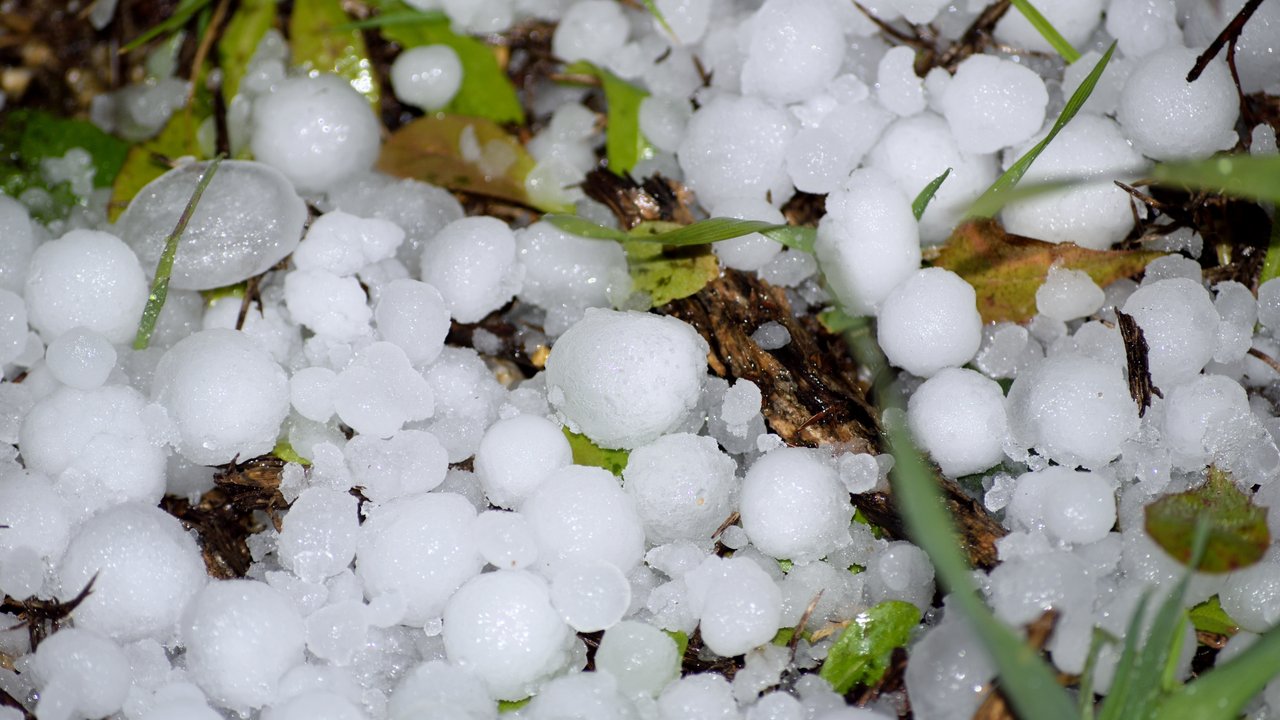
Meteorologists commonly report hailstone size in relation to coins or sports balls. In a 2021 hailstorm in Texas, the largest hailstone ever recorded was found with a diameter of 6.42 inches—roughly the size of a pineapple. However, the true damage potential goes deeper than size alone.
“Scientifically speaking, from a meteorological standpoint, size is important. Even hailstones that might not be particularly large or dense can cause significant damage if they are driven by strong winds,” Wood explained. “You can have very soft hail or very hard hail. Hard hail that´s the size of a US quarter or approaching golf ball can be very damaging—but a soft golf ball hail might not cause much damage.”
Additionally, wind-driven hail can significantly increase the extent and severity of damage, leading to higher losses.
Some storms, however, can reach catastrophic levels.
“You can get baseball or softball-sized hail, which is more rare, but incredibly costly,” added Wood. “Sometimes you’ll actually see the softball-sized hail puncture completely through a roof and go into the living space, causing not only damage to the roof but also the contents inside. That happens maybe a couple times a year in the US.
Enter Project ICECHIP
To better understand the life cycle of hail, from formation to impact, Wood recently participated in one of the most ambitious hail studies ever conducted: Project ICECHIP.
“Project ICECHIP is the largest research study ever undertaken for hail. It took place in the US for six weeks, and I was fortunate enough to participate for one week along with colleagues from Munich Re and the Insurance Institute for Business and Home Safety (IBHS),” Wood told IB. Funded by the US National Science Foundation, the project involved “over 100 total researchers,” with international participation from Germany, Australia, Canada, and the US.
“We had participants deploying instruments measuring hail that was falling and hitting the ground—[using tools] like mobile radars,” added Wood. “They were also launching fake hailstones in unpopulated, open areas up into the wind updrafts going into the storm to measure how hail would grow. During the week that I was there, one of those actually measured 160 miles per hour winds moving upward in the storm...and we later found softball-sized hail and larger five-inch hail on the ground not too far away.”
Researchers collected, over 10,000 hailstones—the highest amount of hailstone data ever collected according to Wood. But the study didn’t just focus on meteorology.
“We had essentially model roofs where they had different types of material...when the hail fell, [we measured] how the different types of roof materials responded to the hail. Some were more traditional, and some were more hail resistant.”
Learn more about how Munich Re Specialty – North America is turning challenging property risks into opportunities:
Preparedness, protection, and public awareness
For the insurance industry, mitigation begins with public education, as Wood explained.
“It´s really about communication with the insureds about mitigating hail risk,” added Wood. “Protecting your windows [for example], you can have storm shutters and awnings that can take that hit, because when windows are damaged by wind-driven hail, now you´ve got the rain coming in...increasing the damage.”
Parking your vehicle in a garage or carport when a storm is on the way can be critical too. Daytime storms are often the most problematic—there are a lot of surface lots where cars are exposed. One innovative solution to address this is quickly gaining traction.
“You´re placing an inflatable balloon cover—but [made of thicker material that can inflate]—around your car; when the hail hits that, it bounces the hail off.”
On the structural side, roof maintenance remains paramount. “Roofs naturally age in sun and rain and cold and heat...that can cause gaps or cracks,” Wood added. Even minor wear “can strip the granules off of a asphalt shingle roof. At seven to 10 years, they become more vulnerable to hail.”
Testing the roof: IBHS analysis
Munich Re works closely with IBHS, which conducts real-world shingle testing.
“They go out to home improvement stores where contractors will buy that material. Then these ‘roof farms’ are placed throughout the US, as a roof in Wisconsin might not age the same as a tropical environment like South Carolina.”
Munich Re Specialty even hosts one of the IBHS’s aging farms at American Modern in Cincinnati, Ohio: “We have some picnic areas that are covered by four or five small roofs... IBHS comes out every year to take a sample of shingles off to see how it ages,” added Wood.
Re/insurer as researcher: Munich Re’s multifaceted role
From Munich Re’s standpoint, as both a (re)insurer and an industry thought leader, they’re wholly committed to proactive risk management.
“Supporting IBHS is a huge part—we fund and serve as active members, both on the reinsurance and primary side,” Wood added. “It’s important to have that research and education out there. Participating with them in research studies like ICECHIP, where we want to gain more knowledge...and communicate that to our partners and the insureds.
Munich Re has analyzed the effects of changes in climate on weather-related natural disasters. We focus on the risks involved, loss prevention, and new risk-transfer concepts.
“Munich Re [also] has great loss control experts who do a lot of in-person work, trying to better understand those damages and mitigation. In addition, over the past five decades, Munich Re has analyzed the effects of changes in climate on weather-related natural disasters. We focus on the risks involved, loss prevention, and new risk-transfer concepts. We produce materials like thought leadership pieces, industry conference presentations, and more...to try to communicate how we as an industry can move forward in resiliency and mitigation for not only hail but all perils.”
Learn more about how Munich Re Specialty – North America is turning challenging property risks into opportunities: https://www.munichre.com/specialty/north-america/en/solutions/property.html.
Learn more about how Munich Re Specialty – North America is turning challenging property risks into opportunities:
Our expert

Related material

Related solutions

properties.trackTitle
properties.trackSubtitle