Summary
- Nature risk is no longer tomorrow’s problem. It’s increasingly reshaping investment decisions, reporting requirements, supply chains, board priorities, and risk management today.
- That message came through clearly at the TNFD & Biodiversity Risk Reporting 2025 conference in London on 6 November 2025, where Risk Management Partners joined around 200 investors, corporate sustainability leaders, and reporting specialists.
- The consensus: nature-related risk has increasingly moved from an “emerging topic” to a de‑facto management task for financial institutions and corporates – and there is growing recognition that understanding the interdependencies between climate and nature risk is essential.
Reality check: the numbers are already material
The discussion in London was anchored in evidence that is hard to ignore:
- According to WWF’s Living Planet Report 2024, the average size of wildlife populations has plunged 73% since 1970.
- Invasive species cost the global economy more than US$ 423bn each year, with costs having at least quadrupled every decade since 1970 (Source: IPBES, 2023). This already exceeds the total global losses from all natural catastrophes worldwide in 2024 (around US$ 320bn, according to Munich Re’s NatCatSERVICE).
- Five of the top ten 10‑year business risks are climate‑ and nature‑based: extreme weather, biodiversity loss and ecosystem collapse, critical earth system change, natural resource shortages, and pollution (Source: World Economic Forum Global Risks Report, 2024)
What this means for risk leaders: Loss of ecosystem services (water filtration, pollination, coastal protection, cooling) increasingly shows up as operating volatility, increase in food prices like cocoa, and value‑at‑risk in portfolios. Waiting for “perfect data” might no longer be a viable strategy.

© Informa Limited, 2025 “TNFD & Biodiversity Risk Reporting” event, London, UK
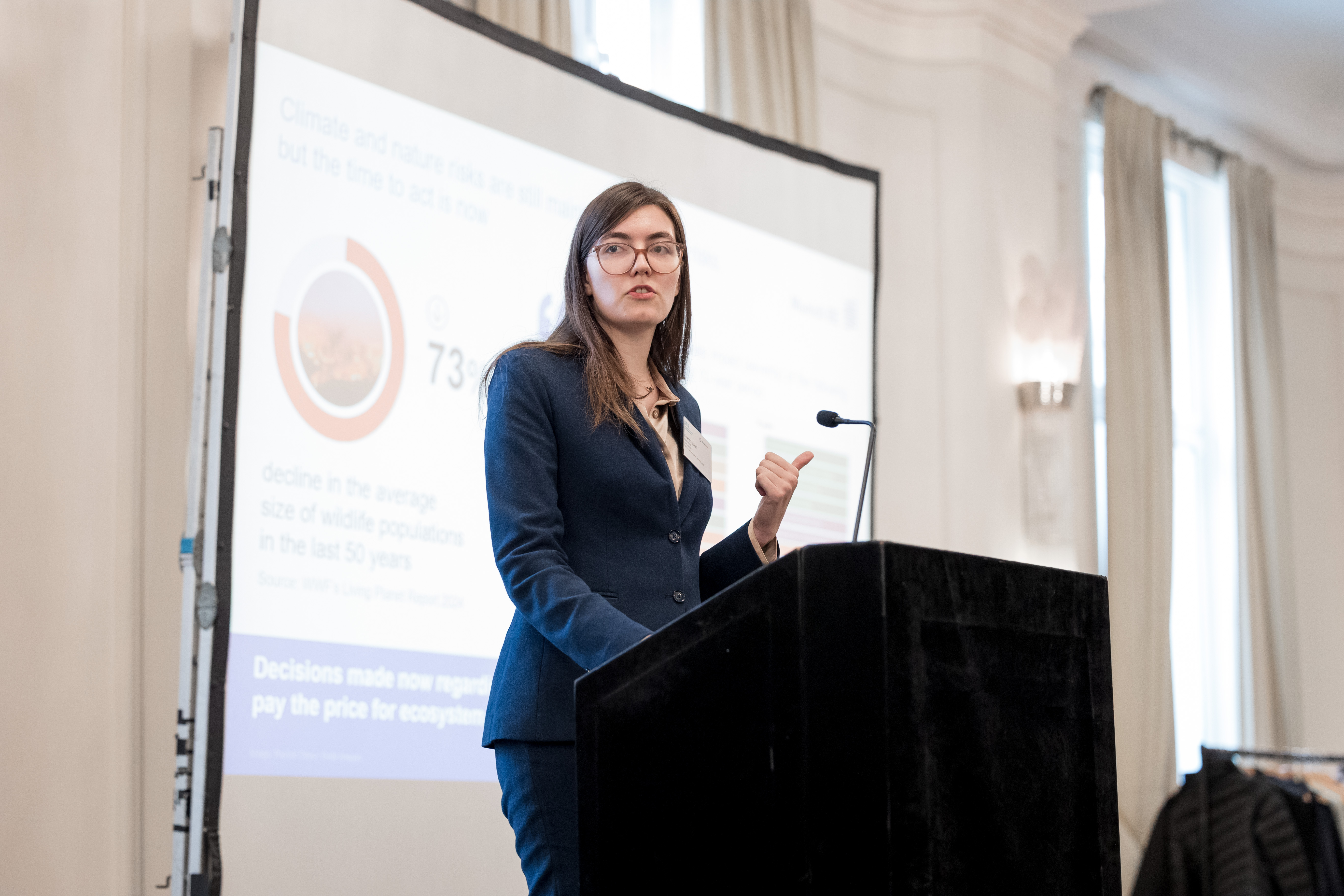
© Informa Limited, 2025 “TNFD & Biodiversity Risk Reporting” event, London, UK
Climate change and nature loss are intertwined
Businesses often separate climate and biodiversity into different teams, tools, and reports. Risk doesn’t. Consider the following feedback loop:
- Climate change accelerates nature loss through heat, drought, wildfire, flooding, and ocean warming.
- Nature loss amplifies climate risk – by eroding the ecosystems that buffer impacts: mangroves and wetlands that protect coasts, forests that stabilise slopes and regulate local climates, soils that retain water.
- Nature‑based solutions deliver dual benefits: afforestation, wetland restoration, urban greening, and mangrove rehabilitation can reduce hazard exposure and restore ecosystem services such as flood protection, cooling, pollination, and water quality.
From maps to action: how risk assessments help
Our mission at Risk Management Partners is straight-forward: turn location‑based climate and nature insights into decisions that improve clients’ resilience and performance. Inside Location Risk Intelligence, we are currently working on operationalising TNFD’s LEAP approach to help clients move quickly and pragmatically.
Locate: Map where your organisation interfaces with nature across operations, supply chains, and investments. Locate ecologically sensitive and water‑stressed locations using an ecologically sensitivity score in line with TNFD’s guidance.
Evaluate: Understand dependencies and impacts in those locations: reliance on local water resources, critical ecosystem services, land‑use patterns, and potential drivers of nature loss.
Assess: Identify risks and opportunities and assess their materiality for your business. Define which risk and opportunities should be prioritized and which mitigation measures are already in place. Based on the assessment results, actions should be defined.
Prepare: Translate insights into action: site‑level adaptation, portfolio steering and underwriting guidelines, supplier engagement, and TNFD‑aligned disclosures. Support CSRD, EBA and EU Taxonomy reporting with defensible, auditable evidence.
Stay tuned for more info on this development – a product update will follow soon! You can subscribe to our newsletter here to stay in the loop.
Closing the gap: managing residual physical risk
Adaptation plans themselves are exposed to physical climate risks – from natural catastrophes to adverse weather patterns that can disrupt operations or derail nature-based projects. Where residual risk remains, innovative risk transfer can help protect both assets and adaptation measures.
Parametric insurance solutions allow clients to define in advance which hazards they want to cover (for example heatwaves, frost, droughts, wildfire, storm or flood), which trigger thresholds apply, and which payout levels they need. Once an agreed trigger (such as a specific wind speed, rainfall amount or temperature level measured by an independent data provider) is reached during the coverage period, a pre-defined payout is made quickly.
Because payouts are not limited to physical damage, clients can use this liquidity to mitigate losses, stabilise cash flows and strengthen business continuity – including keeping critical climate and biodiversity projects on track.
Conclusion: one problem, connected solutions
For us, it was encouraging to see how the conversation is shifting: from “Should we consider nature?” to “How do we act on climate and nature together?”
To us, climate and nature risks are two sides of the same coin. The organisations that will lead on resilience will be those that link analytics with action, blend engineered and nature-based measures, report with confidence – and strategically insure the remaining material risks once they have done what they can to adapt.
Several speakers stressed that organisations cannot wait for a hypothetical state of “perfect” nature data before acting. With robust datasets already available, the priority is to focus on material hotspots, use pragmatic metrics and launch pilot projects rather than standing still under the weight of complexity.
At Risk Management Partners, our answer is to support clients with integrated analytics (Location Risk Intelligence), robust frameworks (TNFD, CSRD, EU Taxonomy, EBA alignment) and innovative risk transfer (parametric insurance) – so that biodiversity is not just a reporting topic, but a core part of resilience and strategy. More on this soon!
Experts