Download our whitepaper “Wildfires in North America”

Munich Re’s
Wildfire HD Edition
Use high-resolution maps to detect wildfire risk and avoid losses
Wildfire losses are rising. So are the risks
Wildfire losses don’t start with fire. They start with blind spots. Wildfire HD Edition precisely identifies risk exposure in the world’s most wildfire-prone countries. It covers the entire continental United States plus Alaska, Australia, Greece, and the core risk regions of Canada (Alberta and British Columbia).
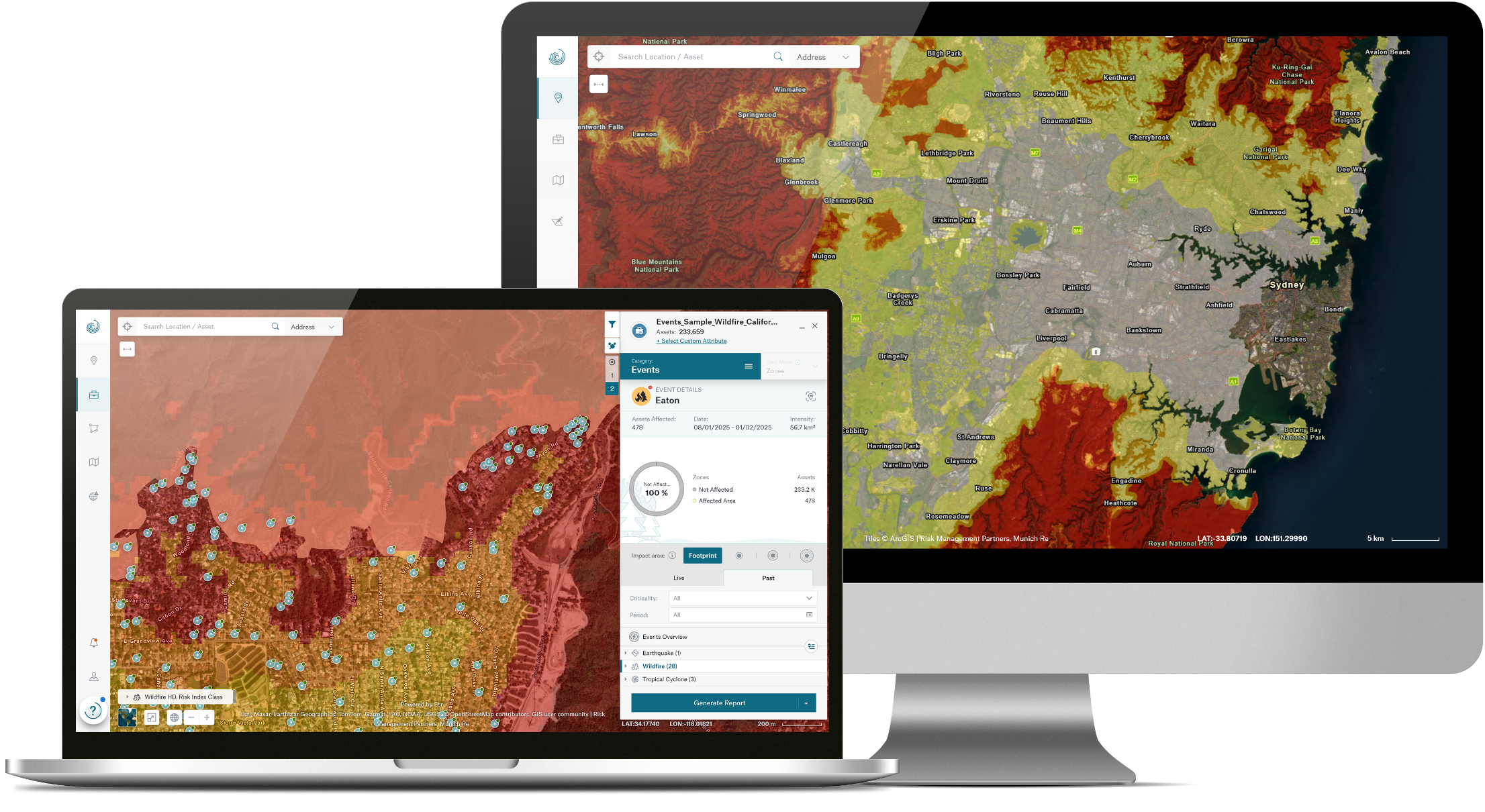
Providing high-resolution maps with granularity down to 30 metres, Wildfire HD Edition lets you evaluate risk exposure for individual locations or entire portfolios.
Precise data and analysis help you identify key zones with high-risk and high-value locations. For example, if you manage insurance portfolios or investments in wildfire-prone regions and need highly accurate data to support underwriting, lending, site selection decisions, or regulatory expectations
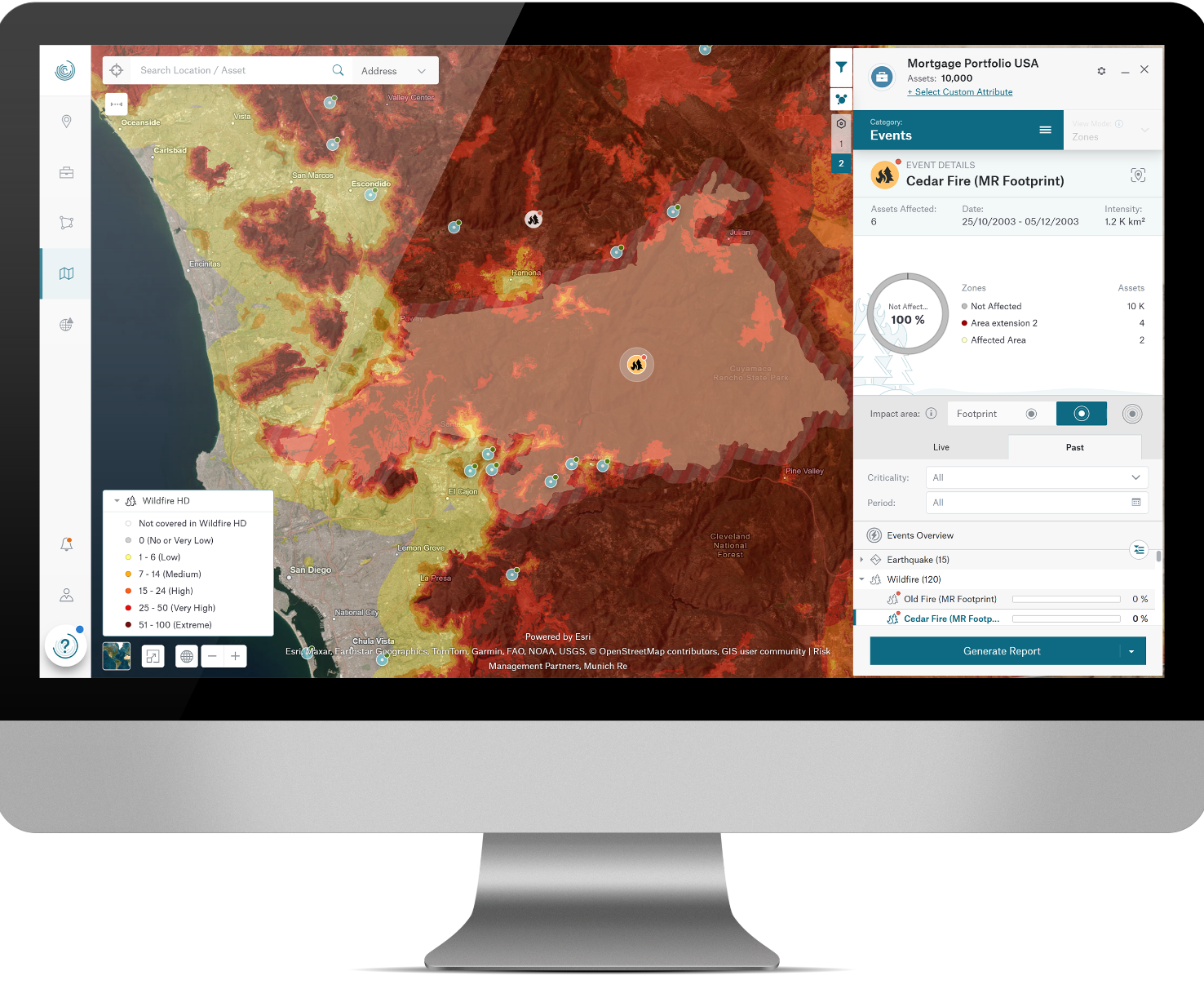
Munich Re’s Wildfire HD Edition turns wildfire risk into a competitive edge
Factor wildfire exposure into your business decisions to avoid misjudgement that leads to damage and losses. Use Wildfire HD Edition’s high-resolution maps to identify risk to assets within 30 metres. Perform detailed assessments and easily generate reporting data.
- Make better decisions: Evaluate wildfire exposure of specific assets or portfolios accurately with Wildfire HD Risk Index. Leverage Munich Re’s proven loss experience and in-depth risk analysis. Build confidence with decisions based on verifiable data.
- Elevate strategic planning: Understand which properties are at risk. Use event-based analysis to mitigate wildfire hazards more effectively.
- Simplify portfolio management: Upload entire portfolios to visualise wildfire risk levels and exposed values. Spend less time with processes and more on strategy.
- Improve underwriting: Determine whether to insure, finance, or operate key assets in high-risk regions based on accurate data. Set accurate pricing and reduce losses.
- Intensify investment due diligence: Investigate previous wildfire events affecting assets or portfolios. Safeguard your investments to strengthen investor confidence.
- Lower credit risk: Assess locations precisely thanks to the granular level of detail, including the latest vegetation data. Stop the guesswork and protect your portfolio.
- Ensure regulatory compliance: Meet physical climate-risk disclosure requirements with detailed reports. Reduce your reporting effort while improving transparency.
For further information simply download our “Wildfire HD Edition” brochure!
What makes Wildfire HD Edition exceptional for risk analysis and assessment
Granular data and high resolution
Wildfire HD Edition uses land-use data at a 30-metre resolution, providing detailed wildfire hazard assessments for each pixel. Get precise risk evaluation at a micro level, including proximity to dense vegetation in wildland areas.
Comprehensive data integration
The tool integrates multiple data sources, including slope, elevation, population density, building density, climate regions, eco-regions, and wind patterns. The data is available via our web-frontend or via API, for flexible integration into your existing systems.
Event analysis and validation
Munich Re conducts boots-on-the-ground analysis with local firefighters to understand fire behaviour and suppression efforts. Wildfire HD Edition incorporates detailed event analysis with ground validation, ensuring that the risk models are accurate.
Risk Index
Munich Re has calculated a comprehensive Risk Index. Ranging from 0-100, the Risk Index reflects the normalised severity of wildfires and likelihood of property loss in regional hazard zones as well as from property-specific risk factors.
Risk Scores
The Risk Score represents a classified Risk Index used for a baseline evaluation. Risk Scores incorporate Munich Re’s claims experience and scientific assessment of climate change impacts. You find out exactly how many properties are in each of six risk classes.
Customisable report options
Wildfire HD Edition provides the data in the way you can use it best. Visualise the results and risk scores clearly with tables and charts. Create customisable reports in multiple formats, such as Excel, CSV, or PDF.
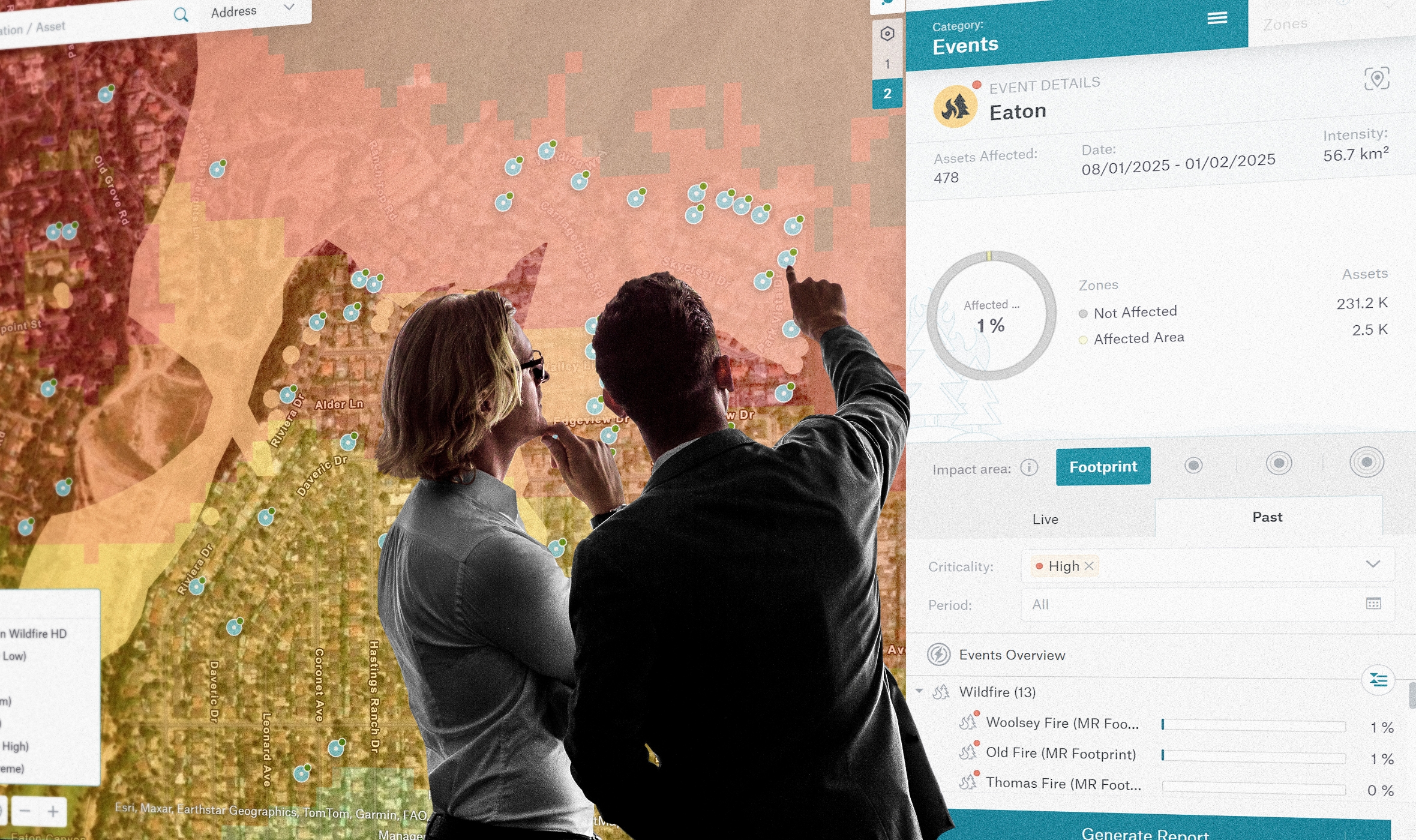
In early 2025, California experienced the highest wildfire losses in the past century
Wildfires in the Los Angeles area destroyed record-breaking US$ 53 billion in value, with insured losses of nearly US$ 40 billion, according to Munich Re NatCat SERVICE.
What contributed to the high losses were exceptionally strong winds that pushed the flames into urban areas with densely built high-value homes. Such extreme events put huge pressure on insurers. Banks lose mortgage properties, or their own offices are damaged.
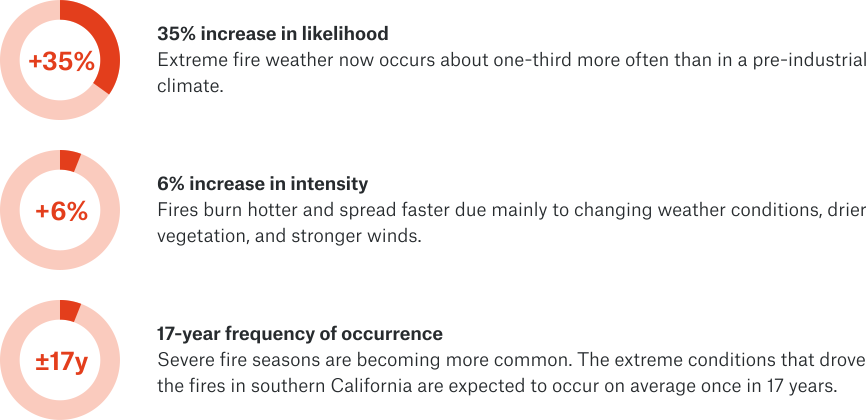
Methodology: How does Wildfire HD Edition work?
Wildfire HD Edition combines macro-level hazard data with micro-level drivers. At the macro level, climate is the key factor influencing wildfire activity. Weather conditions such as temperature and precipitation determine the vegetation and the natural fire probability.
Wildfire HD Edition maps adopt the Wildland-Urban-Interface definition, used by Volker Radeloff (2005) and Susan Stewart (2007) for determining the micro-level hazard situation. The key principles are:
- The most destructive fires begin in dense wildland areas and spread into Wildland- Urban-Interfaces.
- The closer a building is to large, densely vegetated wildland areas, the greater the chances of it being affected by wildfire.
- Densely populated areas are affected less often by wildfire than rural areas. The firefighting effort is higher in urban areas, so to save lives and properties.
Further key hazard variables in the Wildland-Urban-Interface include vegetation type and cover, distance to vegetation, population density, wind, slope, and building density.
In Wildfire HD Edition, the Wildland-Urban-Interface is 1.5 miles (2.4 km) wide and divided into five zones. The extremely high resolution, down to 30 metres, lets companies evaluate the risk of urban locations and high-value properties that border dense vegetation.