Munich Re’s
Climate Change Edition
Gain a clear understanding of tomorrow’s climate-related risks today.
Climate Change Edition helps you manage risk exposure associated with climate change. The edition delivers 13 Climate Hazard Scores under various IPCC-aligned climate scenarios, and 15 Natural Hazard Scores providing current and historical data to support decision-making and help organisations build resilience. Banks, insurers, real estate investors, and risk managers can stress-test asset portfolios and simplify reporting. Climate Change Edition belongs to Location Risk Intelligence, powered by Munich Re's natural catastrophe database and climate modelling expertise.
Do you know how climate change is reshaping your business? Make sure you can assess and understand how climate change is impacting your risk exposure to hurricanes, hurricanes, floods, droughts, and other natural hazards for different climate scenarios up to 2100 - so you don‘t miss anything.
With this modular SaaS solution, you can bring your analysis and assessment of the physical risks associated with climate change to the next level.
Building on one of the world’s most comprehensive databases for natural disasters as well as hazard modelling under different climate scenarios, this edition provides detailed information on the physical risk exposure for all locations worldwide, transforming data into clear structures for individual risk assessment.

Extreme weather events are becoming more likely and might affect your business
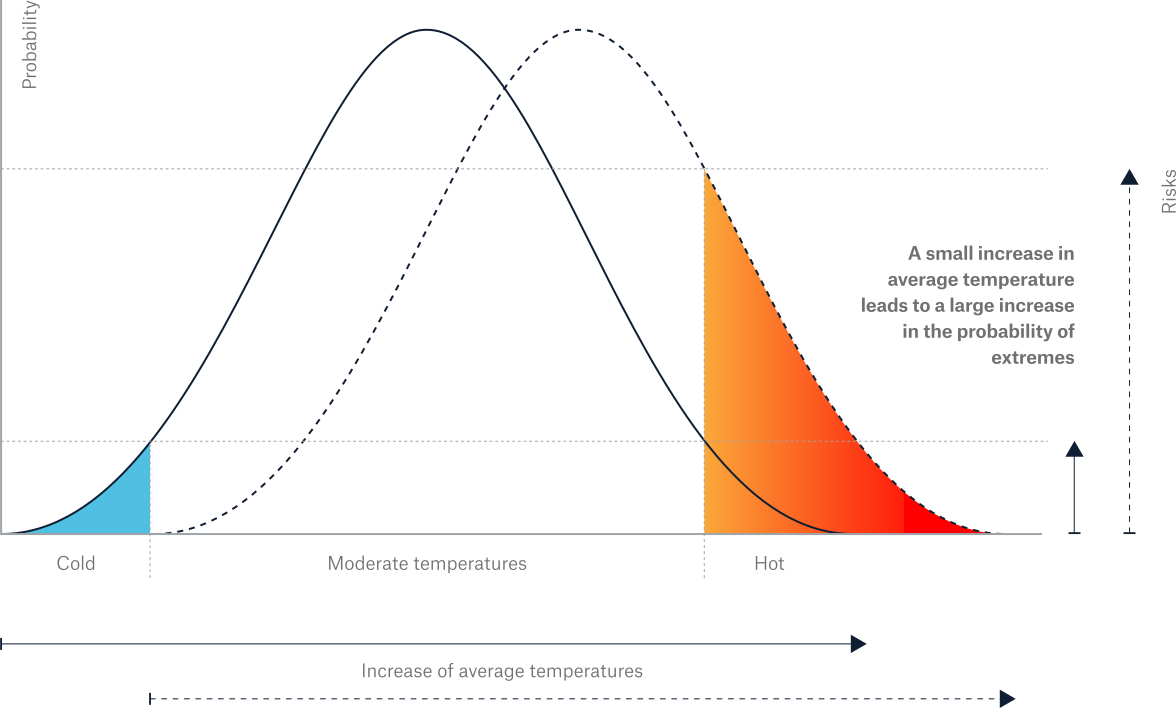
Source: Munich Re, based on IPCC
Climate Change Edition serves professionals across industries who need forward-looking climate risk data. With science-based insights, insurers, banks and lenders, real estate investors, corporate risk managers, pension funds, and regulators can better understand the consequences of climate change and make more confident decisions.
Turn climate risks into business opportunities with Climate Change Edition
- Invest safely: Check the risk of individual assets or entire portfolios using the Climate Change Edition’s set of global warming scenarios, looking into the future until 2100.
- Avoid revenue losses and reputational damage: Identify potential risks from climate change before they materialise in your assets and portfolios to proactively steer your investments towards profitable and secure returns now and in the future.
- Maintain your business continuity and resilience: With the globalisation of almost all business sectors, it is vital that your supply chains remain future-proof and exposed to as little climate risk as possible. With Climate Change Edition you can stay on top of things — worldwide.
- Keep an eye on the future of your business: With Climate Change Edition you can not only protect your business by anticipating the threat of natural disasters, but also assess how markets are changing and where new opportunities are emerging for your company.
- Identify risks quickly and reliably: Thanks to Climate Change Edition, you can easily identify areas of high risk concentration and assess them with an overall risk score or a detailed risk evaluation consisting of over 30 individual risk scores.
- Meet your increasing disclosure obligations: Climate Change Edition provides you with sound answers to the increasingly extensive regulatory and voluntary requirements relating to the disclosure of your climate change risk exposure, creating the transparency you need.
Thanks to the detailed and meaningful assessment of physical risks from natural disasters and climate change using the Climate Change Edition, we can make an informed credit decision in our risk analysis.


Prepared for anything. Today, tomorrow and even in 2100!
Benefit from comprehensive coverage of all relevant climate risks without the need to consolidate or harmonise the data, as all the required information comes from one source and is delivered in an identical format.
Global data coverage gives you access to data of consistently high quality worldwide, so you can rely on it no matter where your assets are located. Munich Re uses these data models itself for its own day-to-day business.
Understand all aspects of climate change thanks to four available climate scenarios and five different time projections up to 2100. Five-year-steps are available via API.
Based on the latest scientific models, data is produced using the internationally recognised IPCC criteria, which ensures that companies work with reliable and accepted data.
Gain trust and transparency through more than 60 underlying climate change variables which are optionally available for the purpose of understanding climate change and its consequences in detail.
Use expert knowledge, such as the two “defended” and “undefended” data calculations, to adapt your risk assessments to both scenarios and display the different scores.
Benefits for insurers, banks, real estate, corporates
Insurance
Banking
Real estate
Corporates
Scientific framework and modelling approach

Climate change is a critical issue facing both the global community and businesses. The Intergovernmental Panel on Climate Change (IPCC), a United Nations body, established a framework which formed the basis for the Paris Agreement in 2015.
With the release of its 6th assessment report in 2023, the IPCC redefined what “cutting edge” climate change modelling means. Previously, climate change scenarios had only considered the development of concentrations of greenhouse gases, characterised in a set of Representative Concentration Pathways (RCPs). Now the IPCC has adopted a more holistic approach to expected developments in the 21st century. They now endorse using Shared Socioeconomic Pathways (SSPs) in the modelling of future scenarios.
These embed the existing RCP scenario framework into a more holistic set of realistic story lines for the ways in which humanity could respond to the challenges which climate change poses to us all. By providing climate risk data range of different SSP scenarios, Location Risk Intelligence supports the seamless integration of physical risks into risk-aware decision-making.
Available SSP scenarios in Climate Change Edition
SSP Scenario / IPCC Label
What it means for your risk assessment
SSP1-2.6
Sustainability
Lowest projected hazard intensification. Useful for optimistic baseline planning and best-case investment scenarios.
SSP2-4.5
Middle of the road
Central estimate. The most widely used scenario in TCFD risk assessments and regulatory stress tests.
SSP3-7.0
Regional rivalry
Significant intensification of flood, storm, and heat hazards. Standard stress-test scenario for risk management.
SSP5-8.5
Fossil-fuelled development
Worst-case scenario typically used for tail-risk analysis and regulatory worst-case stress-testing.
CMIP6 Scenarios
Global CO2 Emissions (GtCO2/yr)
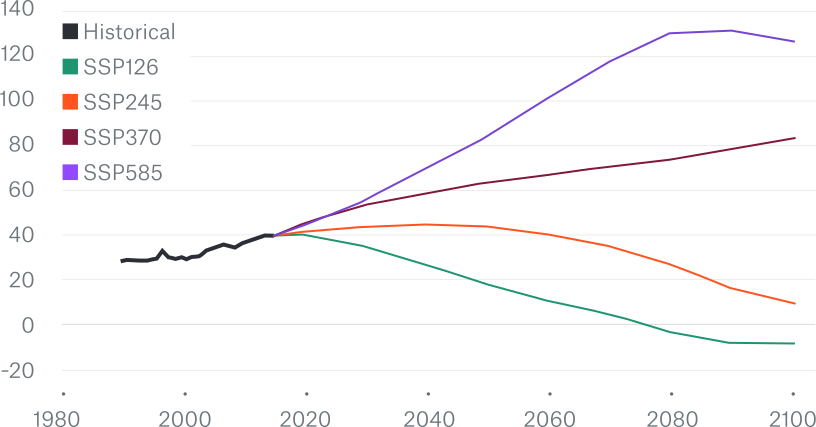
Source: DKRZ

What risk scores does Climate Change Edition provide?
Climate Change Edition supports you not only with information regarding the exposure of your assets to current physical risks, but above all in analysing and assessing the physical risks associated with climate change in various future scenarios and it does so worldwide. After all, only globally consistent data allows for a reliable global assessment.
In terms of both acute and chronic climate risks, this edition includes not only 15 Natural Hazard Scores and four NATHAN Risk Scores, but also 13 additional Climate Hazard Scores which consider the effects of climate change.
How is Climate Change Edition different from Natural Hazards Edition? Natural Hazards Edition scores current exposure to 15 natural hazards based on historical event data and present-day risk models. Climate Change Edition extends this with the projected changes in hazard intensity and frequency at specific locations under various climate scenarios to 2100.
Climate Hazard Scores
The 13 Climate Hazard Scores cover both acute and chronic risks across wind, water, land, and temperature categories:
River Flood, Storm Surge, Sea-Level Rise, Tropical Cyclone, Subsidence, Heat Stress, Heat-Humidity Stress, Cold Stress, Fire Weather Stress, Precipitation Stress, Drought Stress, Water Scarcity, Permafrost Event
The Climate Hazard Scores cover either RCP scenarios¹ (RCP2.6, RCP4.5, and RCP8.5) or SSP scenarios² (SSP1-2.6, SSP2-4.5, SSP3-7.0 and SSP5-8.5) as well as the current, 2030, 2040, 2050 and 2100 projection years.*
* For some Climate Hazard Scores only a part of the scenarios or projection years is available. ¹ Representative Concentration Pathway ² Shared Socioeconomic PathwayNATHAN Risk Scores
Four composite NATHAN Risk Scores: Overall, Earthquake, Storm, and Flood provide single-value indicators for rapid portfolio triage and red-flag identification.
Natural Hazard Scores
Also available On-Demand
Pay as you go: In the On-Demand version, users without a contractual commitment can use credits that can be purchased directly on the website to determine basic risk assessments for single locations (not entire portfolios) and download them in meaningful reports.
Climate Change Expert Module – 64 Climate Change Variables, or 64 ways to assess risks in more detail

Many business decisions depend on how accurately you can understand, measure, and manage the risk of climate change, and the decision-making process therefore requires the latest and most relevant data.
The Climate Change Expert Module provides you with a total of 64 underlying detailed scores, the so-called Climate Change Variables, for various wind-, water- and temperature-related Climate Hazard Scores such as Fire Weather Stress, Heat Stress, Heat-Humidity Stress, Cold Stress, Precipitation Stress, Drought Stress and more for an in-depth assessment of your assets. If you need to base your business decisions on extremely detailed data assessments, our REST API enables seamless integration of the entire underlying statistical uncertainty measures data. Each Climate Change Variable value is backed by six Climate Change Statistics to ensure highest data accuracy and provide transparency.
For more information on climate change variables, download the appropriate brochure: