Munich Re’s
Biodiversity and Nature Risk Edition
Transform climate and nature risks into strategic opportunity
Biodiversity and Nature Risk Edition gives you decision-ready climate and nature risk data in a single platform. It provides world-class biodiversity datasets, delivered within Munich Re’s Location Risk Intelligence. The SaaS solution is powered by Munich Re’s 140+ years of natural hazard expertise, allowing banks, investors, developers, and corporates to understand, measure, and manage climate and nature risks across assets and portfolios worldwide. Location-specific data and insights are aligned to frameworks such as TNFD, CSRD, EU Taxonomy.
Biodiversity loss and ecosystem collapse rank as the second biggest risk after extreme weather events in the coming decade, according to the World Economic Forum's Global Risks Report 2026. Business leaders are concerned about the long-term severity and impact of climate and nature risks.
Ecosystem damage lowers resilience and narrows options for addressing climate change. Leading organisations understand that managing climate and nature risks together drives long-term success.

How climate and nature risks affect organisations
For organisations, nature risk is potentially a financial risk. Without credible data, decision-makers can’t identify where they need to take action. Their operations or investments remain exposed to nature risks including water scarcity or ecosystem collapse. At the same time, healthy ecosystems act as a buffer against rising climate-related costs.
Climate change and nature loss are intertwined, so solutions must consider both. As climate change threatens financial and business foundations, regulators and investors are expecting companies to disclose their nature related vulnerabilities and impacts. Failing to do so can lead to financial penalties, reputational damage, and loss of stakeholder trust.
Yet biodiversity loss and nature risks are more than a reporting obligation. Without precise data, decisions remain guesswork. Organisations that can accurately locate and evaluate where climate and nature risks exist are able to mitigate the risks, build resilience, and tap into emerging market opportunities.
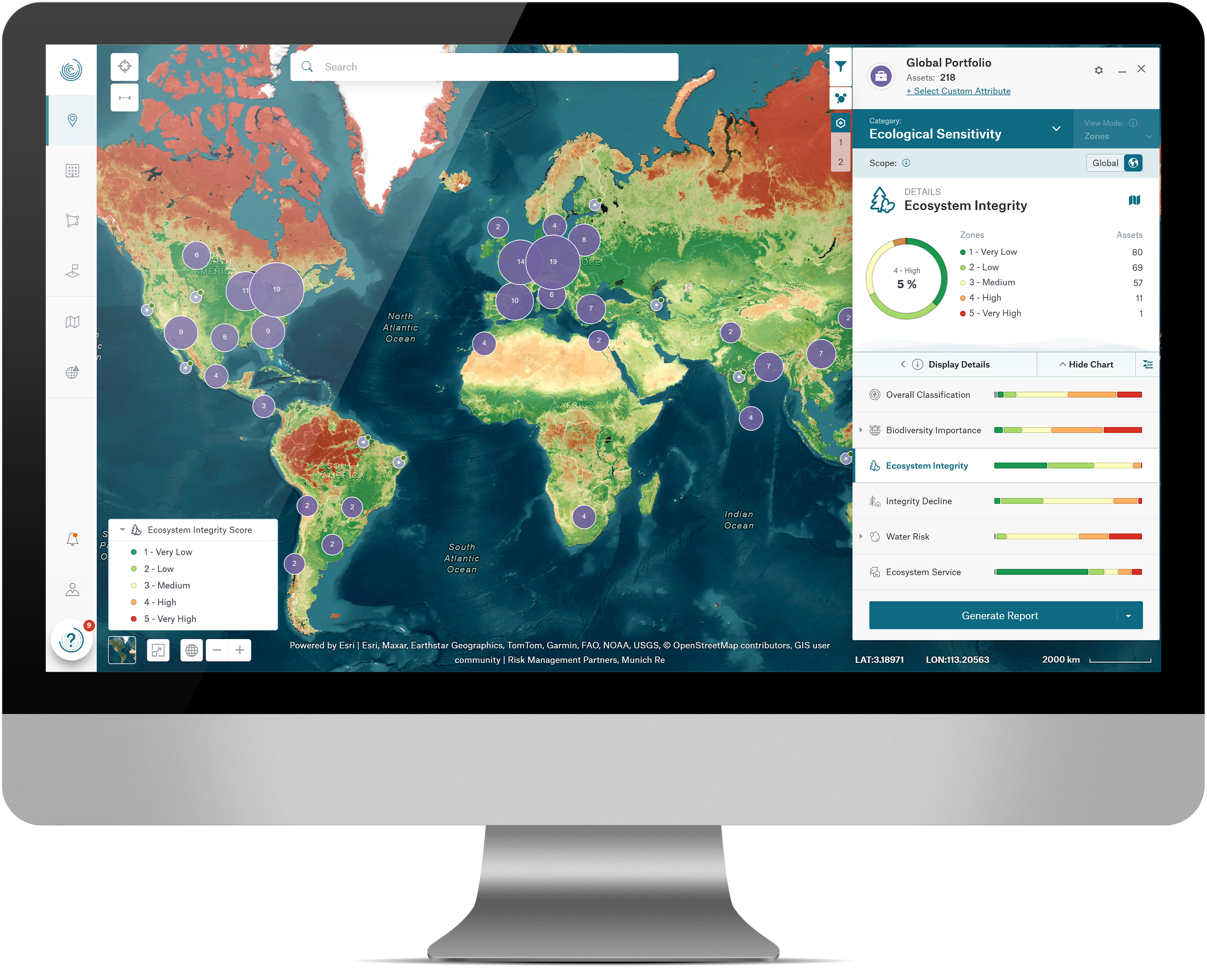
Go beyond compliance to support nature-positive growth with Biodiversity and Nature Risk Edition
- Report with confidence: Identify which of your sites are in “ecologically sensitive locations” as defined by the TNFD. Fulfil the nature-related data requirements of the EU Taxonomy and CSRD.
- Streamline disclosures: Easily generate location-specific assessments that satisfy regulatory requirements. Align with global frameworks and turn compliance into a strategic advantage.
- Invest safely: Assess sites for distance to protected areas. Safeguard your reputation and steer clear of hot spots for endangered species. Prevent poor location selection and devaluation.
- Enhance stakeholder confidence: Science-backed, trusted data sources give investors, clients, and regulators confidence in your nature risk management. Establish your business as a leader.
- Avoid revenue losses: Identify potential nature risks to your assets and portfolios, avoid ecological disruption while steering investments toward secure returns.
- Build resilient systems: Understand biodiversity and nature risks, manage dependencies on natural systems, anticipate ecological disruptions, and make operations more robust.
Key benefits at a glance
TNFD alignment
Built to make your LEAP effortless. Fully aligned to TNFD’s Locate and Evaluate steps so you can operationalise the LEAP process efficiently and at scale.
Spatial precision
See exactly where your business meets nature. Pinpoint nature-related interfaces across assets, suppliers, and value chains. Understand biodiversity impacts and dependencies.
Structured platform
Benefit from biodiversity and nature risk coverage without having to consolidate or harmonise the data. The information from all sources is delivered in an identical format.
Global coverage
Examine single locations, entire portfolios, or infrastructures for ecological sensitivity. Uncover dependencies and impacts worldwide.
Scientific credibility
Science you can trust, insights you can act on. Built on world-class biodiversity and ecosystem datasets (Munich Re, IBAT, Natural History Museum).
Integration-ready
Plug biodiversity data into your business systems via API. Automate disclosure, reporting, and nature risk management.

Benefits across sectors and industries
Reporting
Risk management
Real estate investment
Credit risk assessment
Third-party risk management
Strategic planning
Fulfil disclosure requirements and simplify reporting
With proprietary Munich Re intelligence, integration of mandatory IBAT data, and enriched scientific datasets from the Natural History Museum in one platform, you achieve unmatched clarity and credibility. Transform fragmented data into strategic insight, support compliance, reduce uncertainty, and lead nature-positive action with confidence.
| Regulation / Framework | How Biodiversity and Nature Risk Edition supports compliance |
|---|---|
| TNFD | Operationalise the Locate and Evaluate steps of TNFD’s LEAP process efficiently and at scale. |
| CSRD | ESRS E4 Biodiversity & Ecosystems - Mapping of sites, ecosystems, threatened species, protected areas, dependencies/impact. ESRS E3 Water - Screen portfolios for sites in water-stressed and water scarcity areas using 10 water quality indicators ESRS E1 Climate Risk – Location Risk Intelligence’s Reporting Edition covers all 28 physical climate risks |
| EU Taxonomy | Biodiversity & Ecosystems (Objective 6) - Geospatial checks for activities “in or near biodiversity sensitive areas”; distance to protected or Key Biodiversity Areas. Asset-level screening for Do No Significant Harm verifications. |
| CSDDD | Site-specific mapping and data to identify, prevent, and mitigate adverse environmental impacts and biodiversity loss in operations and value chains. |
| EU Nature Restoration Law | Location-based data and insights to align with EU-wide restoration targets of 20% of land/sea by 2030. |
| EIA Directive | Site-specific data to assess environmental impacts on species, habitats, and cumulative effects; Appropriate Assessment under Natura 2000 Habitats Directive |

Sector requirements for finance and insurance
Location-specific data and insights align with sector-specific nature-risk assessment expectations from the European Banking Authority (EBA), European Central Bank (ECB), Network for Greening the Financial System (NGFS), Sustainable Finance Disclosure Regulation (SFDR), European Insurance and Occupational Pensions Authority (EIOPA), among others.
European Banking Authority (EBA)
European Central Bank (ECB)
Network for Greening the Financial System (NGFS)
Sustainable Finance Disclosure Regulation (SFDR)
European Insurance and Occupational Pensions Authority (EIOPA)
For further information, download our Biodiversity and Nature Risk Edition brochure!
More than 730 organisations and US$ 22.4 trillion in assets under management have committed to TNFD-aligned reporting. This includes 179 financial institutions and 480 corporates.
Data foundation for Biodiversity and Nature Risk Edition
| Munich Re | Munich Re data is based on decades of natural hazard risk assessment expertise and risk modelling. This supports and contributes primarily the Ecosystem Services Score, water-related risk scores, and nature risk scores. |
| IBAT | Integrated Biodiversity Assessment Tool (IBAT) hosts three key global biodiversity datasets: the International Union for Conservation of Nature’s (IUCN) Red List of Threatened Species, Key Biodiversity Areas (KBA), and the World Database on Protected and Conserved Areas (WDPCA). |
| BII | Biodiversity Intactness Index (BII) is based on research led by the Natural History Museum in London. The BII shows the estimated percentage of the original number of species that remain and their abundance in any given area. |

Locate, evaluate, and rank biodiversity and nature risks with intuitive analytics
Easy-to-use scores for every type of ecological sensitivity enable fast prioritisation. Leverage our extensive offering of supporting data to effectively translate insights into action.
Overall Ecological Sensitivity (OESS)
The OESS incorporates the Biodiversity Importance Score, Ecosystem Integrity Score, Integrity Decline Score, Water Risk Score, and Ecosystem Service Score to support priorisation of sites that potentially have biodiversity and nature risks worthy of closer examination.
Biodiversity Importance
Combines scores for Threated Species, Proximity to Protected Areas, and Key Biodiversity Areas. Indicates the area’s importance for biodiversity.
- Threatened Species Prevalence: Based on IBAT's STAR metric.
- Proximity to Protected and Conserved Area: Distance to WDPCA-listed area.
- Proximity to Key Biodiversity Area: Distance to Key Biodiversity Area (KBA).
- Proximity to Biodiversity-sensitive Areas: CSRD and EU Taxonomy aligned, distance to UNESCO World Heritage Sites, Key Biodiversity Areas, Protected and Conserved Areas, Natura 2000 areas.

Ecosystem Integrity
Reflects the current level of ecosystem integrity in the area, after taking human impacts into account. Supporting data includes Natural History Museum’s Biodiversity Intactness Index (BII).

Integrity Decline
Categorises the average yearly decrease in Natural History Museum’s Biodiversity Intactness Index (BII) from 2000 to 2020. Data includes past levels of Biodiversity Intactness for multiple time horizons dating back to 2000.

Water Risk
Exposure to physical water risks, with water scarcity and water quality indicators.
- Physical Water Risk: Exposure to river flood, flash flood, storm surge, or drought.
- Water Scarcity: Freshwater deficit potentially challenging to people or ecosystem.
- Water Quality: Condition of local waterways based on 10 quality indicators.

Ecosystem Services
Shows how essential an area is for nature’s benefits to people such as flood protection, pollination, fisheries, and fodder production. Higher scores mean the area delivers many strong benefits that support well-being and sustainable development. Supporting data includes distance to indigenous communities.

Ready to transform climate and nature risks into strategic opportunity?
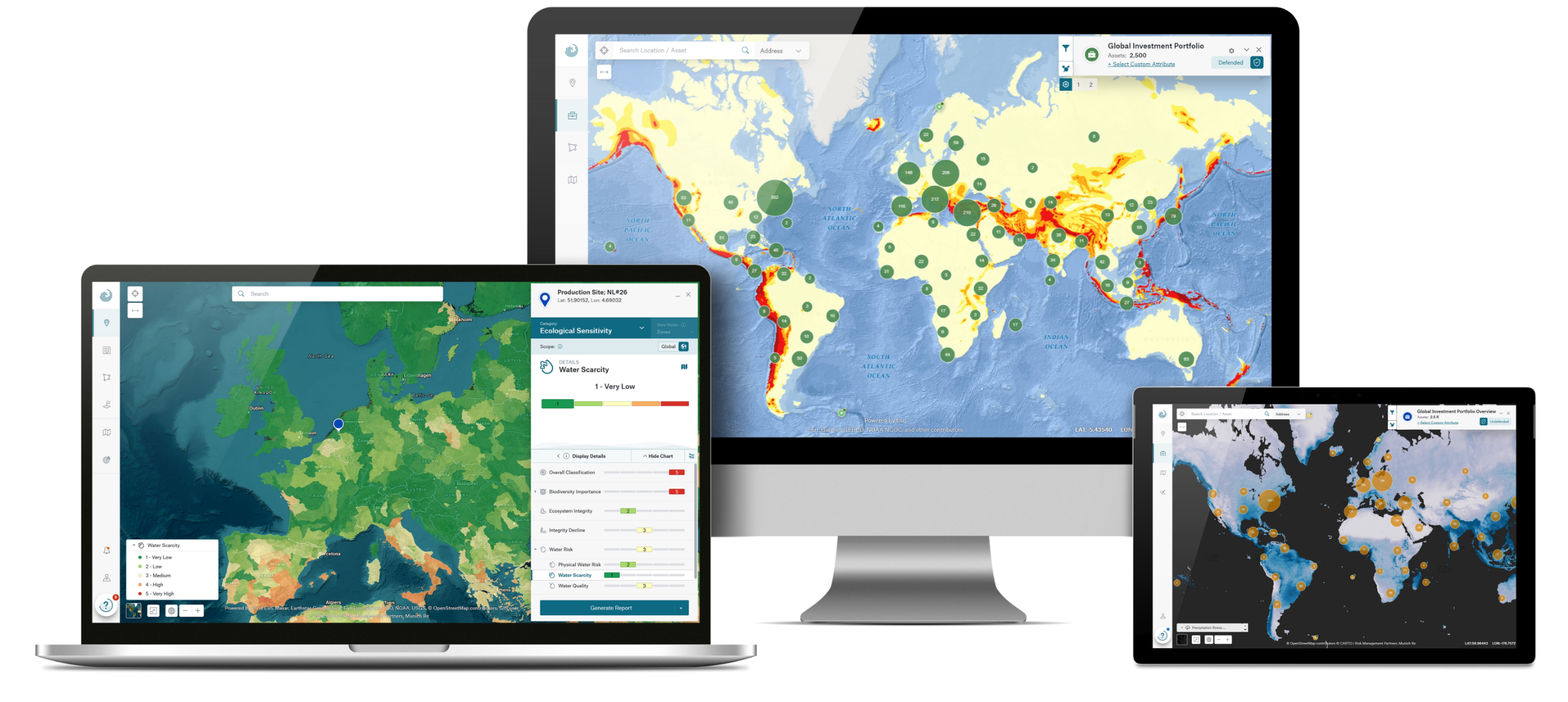
Biodiversity and Nature Risk Edition belongs to Location Risk Intelligence
Biodiversity and Nature Risk Edition gives you access to Munich Re’s more than 140 years of risk expertise, enabling you to perform efficient analyses for entire portfolios or individual assets. Reduce time spent gathering data from various sources. Get the full risk picture faster with climate and nature risk management in one solution. Understand, measure, and manage location-based impacts of biodiversity loss and ecosystem damage based on rigorous scientific datasets. Meet reporting requirements with confidence, achieve better outcomes, and protect what matters.