AI Data Centers, Power-Purchase Guarantees, and the Nuclear Energy Reawakening
Paul Coco
Senior Engineer, HSB Codes & Standards
Pressure Points Newsletter - March 2026
AI data centers, power-purchase guarantees, and the nuclear energy reawakening
Artificial intelligence (AI) is driving an unprecedented surge in electricity demand on a scale the power sector has not faced in decades. Modern AI data centers, particularly those supporting large-scale model training and real-time inference, require continuous, high-density power with extremely tight reliability requirements. These facilities increasingly operate like industrial baseload plants, running at very high capacity factors while scaling in increments that can exceed hundreds of megawatts at a single campus. In many parts of the United States, the pace and magnitude of this growth now exceed what existing transmission networks and traditional generation development cycles can deliver [(Reuters, 2026)].
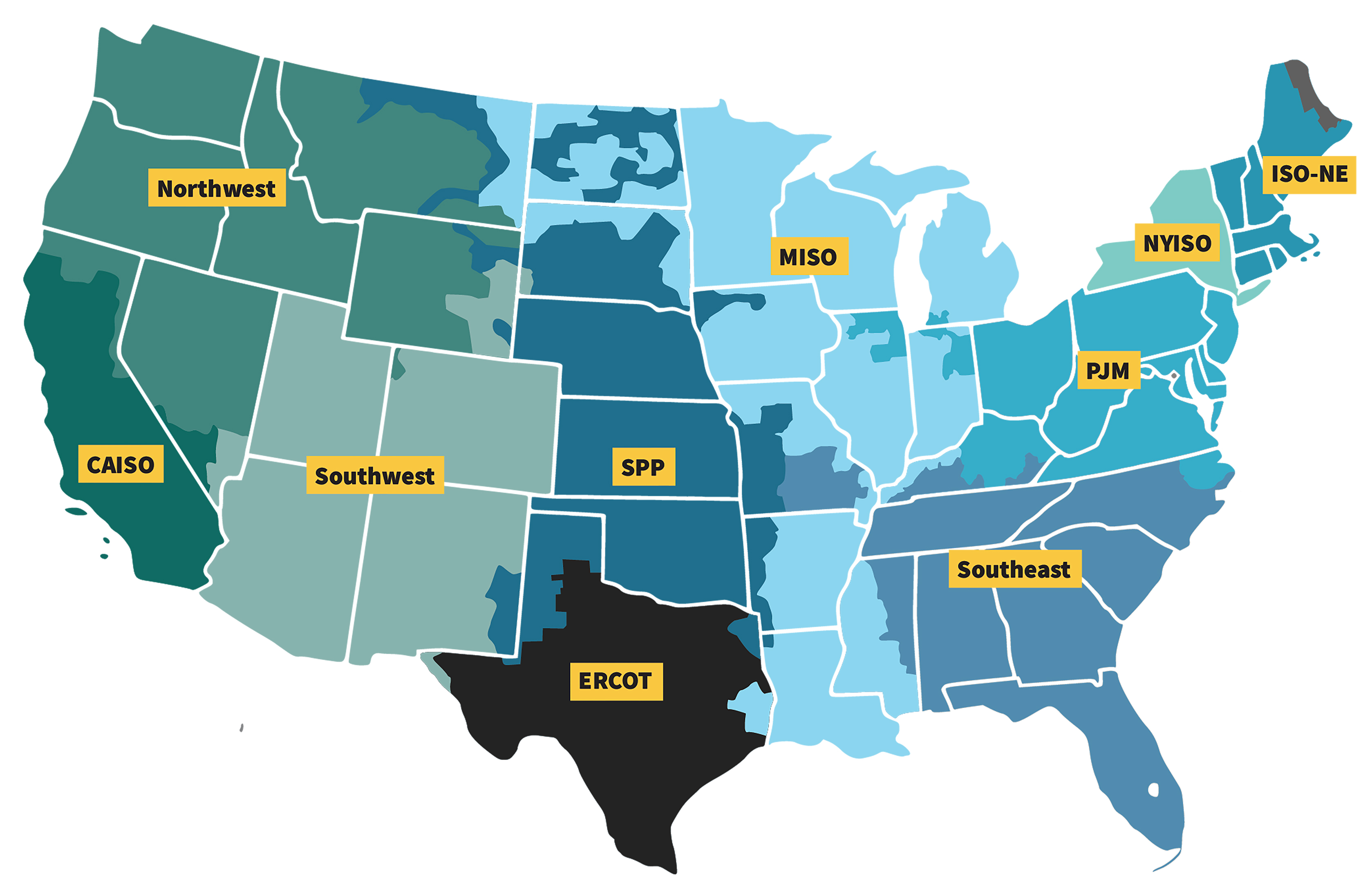
Access to power has become one of the primary constraints on AI deployment. In much of the country, large AI data centers must connect through organized wholesale markets operated by regional transmission organizations that manage both the high-voltage grid and the interconnection process for new loads. A key player in this landscape is PJM Interconnection, the largest regional transmission organization in the United States by electricity load (Figure 1). It manages the grid and wholesale electricity markets across much of the Mid-Atlantic and Midwest, including Northern Virginia, which hosts the world’s largest concentration of AI data centers.
New AI data center projects must enter formal interconnection queues to secure transmission capacity and associated system upgrades. Those queues have expanded rapidly and now often extend several years into the future, delaying access to firm power. Even when generation capacity is available, transmission upgrades frequently cannot be completed on the aggressive schedules demanded by hyperscale development. Currently, corporate decarbonization commitments increasingly constrain the use of fossil-fueled generation as a long-term supply option.
In response to these challenges, some developers are exploring behind-the-meter energy procurement strategies that bypass traditional grid interconnection. This approach allows for direct, on-site generation, often from low-carbon or zero-carbon sources, to meet high-reliability loads without being subject to the delays and constraints of regional transmission planning. This emerging market is of particular interest to developers of small modular reactors (SMRs) and microreactors, which are being designed for flexible, distributed deployment and could offer a compelling solution for power-intensive facilities seeking firm, clean, and independent energy supplies.
Rapid load growth, interconnection delays, reliability requirements, and carbon constraints are reshaping energy procurement. For many firms, nuclear power has emerged not as a policy preference but as a practical response to an engineering problem: how to secure large volumes of firm, carbon-free power on timelines compatible with AI infrastructure deployment [(TechFlowPost, 2026)].
Nuclear power’s renewed relevance lies in its technical attributes. Operating reactors provide continuous, dispatch-independent output with minimal fuel price volatility and no operational carbon emissions. Unlike intermittent renewable resources, nuclear generation naturally aligns with the always-on character of AI workloads. What has changed in recent years is not only the commercial framework for nuclear deployment, such as new market structures, procurement models, and private-sector investment, but also the technology itself, with significant advancements in advanced non-light water reactors that enable safer, more flexible, and more scalable deployment options [(WNA, 2025)].
A growing share of electricity demand is now driven by hyperscalers, large technology companies that operate expansive data center networks to support cloud computing and AI services. Long-term power purchase agreements have become the primary link between these firms, nuclear operators, and advanced reactor designers. These contracts often extend 15 to 20 years, longer than typical wholesale market commitments, and are increasingly structured to provide the revenue certainty needed to support capital investment at nuclear power plants. Large producers of carbon-free energy illustrate the willingness of hyperscale companies to contract for substantial blocks of nuclear capacity over extended time horizons [(AP News, 2026)]. In practice, these agreements serve as more than simple energy purchases. They function as power-purchase guarantees that stabilize cash flow and reduce exposure to commercial market risk. That stability has direct consequences for the existing nuclear fleet. Subsequent license renewal, which extends reactor operating lives from 60 to 80 years under U.S. Nuclear Regulatory Commission rules, becomes more attractive when future revenues are contractually secured. Similarly, power uprates, whether through measurement uncertainty recapture, stretch uprates, or extended uprates, can be justified when incremental output is backed by long-term offtake. AI demand is not simply consuming nuclear generation; it is helping to finance the continued operation and expansion of the current fleet [(ANS, 2026)].
Transmission congestion and long interconnection timelines have prompted AI data center developers to explore direct energy procurement through colocation and behind-the-meter supply models. Siting large loads adjacent to generation assets offers a potential way to reduce reliance on constrained transmission systems and improve delivery certainty. Nuclear-adjacent colocation is particularly attractive because it pairs continuous generation with continuous demand. Recent legislation, such as the proposed Decentralized Access to Technology Alternatives (DATA) Act of 2026, signals a significant shift in federal policy by establishing a new category of “consumer-regulated electric utilities” and explicitly exempting fully islanded behind-the-meter systems from FERC and DOE oversight [(Utility Dive, 2026)]. While such models are already being implemented, industry stakeholders continue to raise concerns about tariff treatment, cost allocation, reliability obligations, and the complexities of residual grid dependence.
These same pressures are shaping growing interest in small modular reactors and microreactors. Advanced nuclear designs have historically struggled to attract financing because of first-of-a-kind risk and reliance on commercial markets. Long-term, credit-worthy Power Purchase Agreements (PPA)s from technology companies materially change that risk profile. Many hyperscale companies now appear to be pursuing a phased strategy: securing near-term supply from existing plants, enabling up-rates and license renewals to add incremental capacity, and positioning SMRs or microreactors for deployment in the early to mid-2030s [(Reuters, 2025)].
Microreactors, in particular, are being evaluated for campus-scale applications where modularity, transportability, and simplified siting could offer practical advantages. While regulatory and licensing challenges remain substantial, the presence of committed off-takers with predictable load profiles represents one of the strongest commercial signals the advanced nuclear sector has yet received.
Emerging nuclear deployments are characterized by a diverse range of partnerships that include traditional utilities, independent developers, advanced reactor startups, and large energy consumers. While some projects involve collaboration with existing license holders, others are led by new entrants bringing private capital and alternative business models to the table. Financing strategies vary widely, reflecting different risk profiles, customer needs, and project structures. This diversity highlights the flexibility of advanced reactor technologies and the growing range of pathways to market.
The growing alignment between AI data center infrastructure and nuclear energy is therefore not driven by policy alone. It reflects industrial necessity. As AI becomes increasingly central to economic growth and national competitiveness, the demand for firm, scalable, low-carbon power will continue to rise. Power-purchase guarantees have emerged as the key enabling mechanism, supporting life extensions, uprates, and new reactor development while delivering the reliability that advanced digital infrastructure requires.
In this context, nuclear energy is evolving beyond its traditional role in long-term decarbonization or energy independence strategies. It is becoming foundational infrastructure, essential to the scalability, reliability, and continuity of the AI-driven economy.
References
- Reuters (2026): PJM unveils plan to tackle AI-driven power demand surge
- Utility dive: Senate bill exempts fully isolated large loads from FERC, DOE regulation
- AP News (2026): Meta lines up massive supply of nuclear power …
- WNA (2025) Economics of Nuclear Power (World Nuclear Association)
- ANS (2026): Meta’s data centers and nuclear power
- TechFlowPost (2026): AI demands strain grids, companies invest in power plants
- Reuters (2025): Big Tech contracts inject life into new nuclear