Climate Ambition & Reporting
The implementation plan for our Climate Ambition can be found here:
As one of the pioneers in the analysis of climate-related risks, Munich Re has been intensively studying the effects of climate change on the insurance and financial industries for over 50 years. As early as the 1970s, our Geo-Risk research units were investigating the causes of increasingly costly losses from weather-related natural catastrophes.
As part of the Munich Re Group Ambition 2030, the Climate Ambition 2030 was adopted, covering
- Investments,
- (Re)insurance, and
- our Own Operations.
We are continuing to follow the path of Climate Ambition 2025 under the Munich Re Group Ambition 2025, which applied until the end of financial year 2025 and has now been successfully implemented.
Climate Ambition 2030 for Munich Re Group
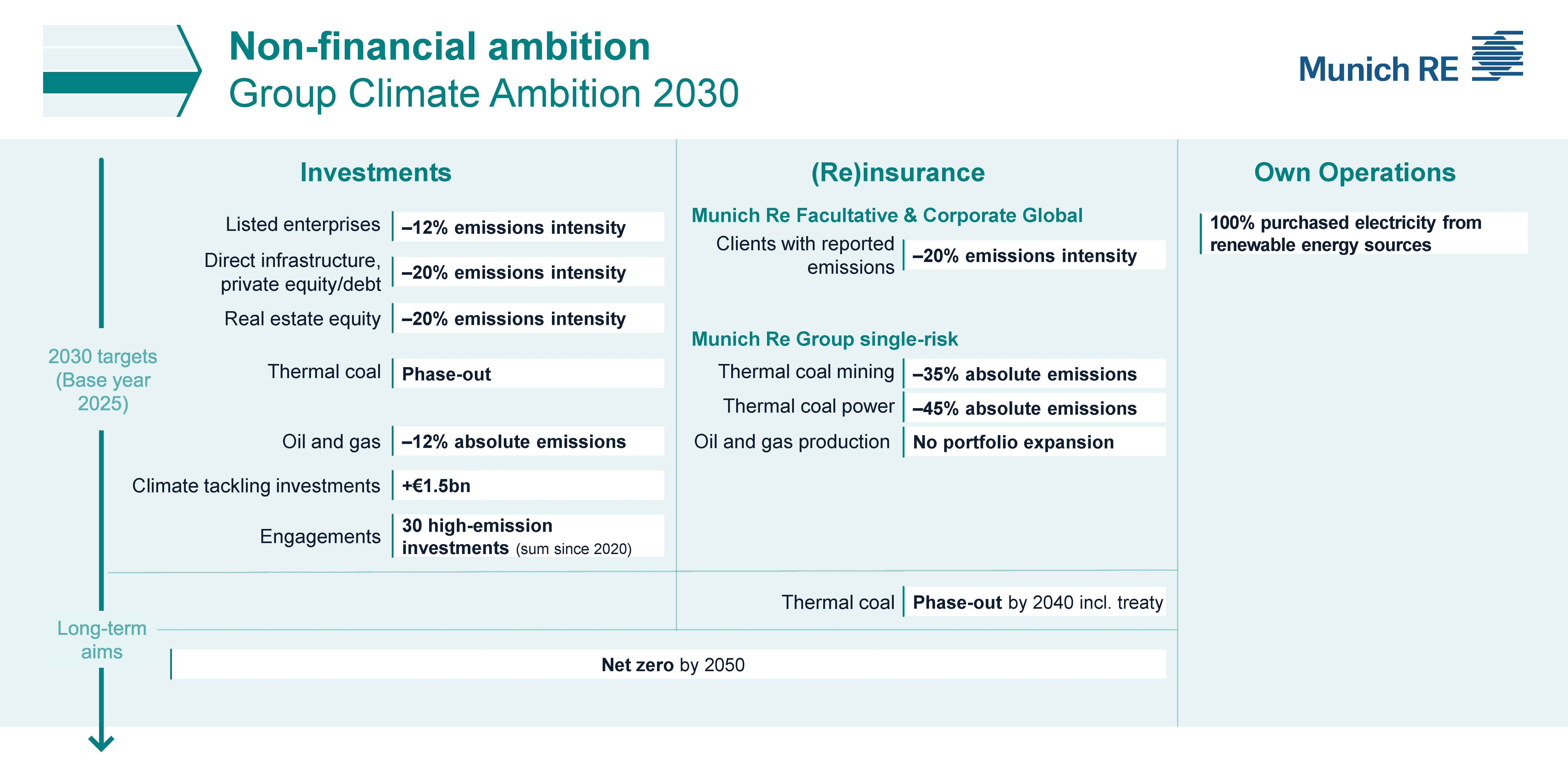
As part of Climate Ambition 2030, we strengthened our climate targets for the period up to the end of financial year 2030, continuing to work towards our long-term aims in (Re)insurance and Investments. With regard to Investments, for example, the original plan to phase out thermal coal by 2040 is to be significantly brought forward and accomplished by 2030. On the (Re)insurance side, a new target for reducing emissions intensity in the Facultative & Corporate Global divisional unit is being introduced, among other things. The targets for Investments and (Re)insurance were adopted based on the latest methodological developments and the most recent climate science.
Munich Re’s overarching, long-term aim is to reduce greenhouse gas emissions in our (re)insurance business and investment portfolio to net zero by 2050, thereby contributing to achieving the goals of the Paris Agreement.
Munich Re expresses the 2030 targets, as well as its long-term aims for 2040 and 2050, in the expectation that governments meet their own pledges to achieve the goals of the Paris Agreement.
Unless otherwise noted, 2025 is the base year for 2030 targets, the achievement of which will be measured at the end of each year.
Climate Ambition 2030 in Investments
As a global investor, Munich Re is aware of its responsibility to conduct its activities sustainably and integrates sustainability criteria into its investment policy.
Therefore, we have set ourselves climate targets until end of financial year 2030 as part of our new Climate Ambition 2030:
- The decarbonisation target for listed enterprises comprises equities and corporate bonds (excluding green bonds). Based on the reductions achieved to date, this results in a remaining reduction of 12% in emissions intensity.
- For the asset classes “direct investment infrastructure” and “direct private equity/debt”, we have set ourselves the target of achieving an overarching reduction in emissions intensity of 20%.
- For real estate equity, we have set ourselves the target of reducing emissions intensity by 20%.
- With our target to phase out thermal coal (according to defined criteria), we are committing to divest all thermal coal investments held in listed equities and corporate bonds (excluding green bonds) and to cease to conduct new direct alternative investments in thermal coal by the end of 2030.
- The oil and gas decarbonisation target refers to equities and bonds (excluding green bonds). Based on the reductions achieved to date, we have set ourselves the target of a further 12% reduction in emissions.
- We have set ourselves the target of increasing our climate tackling investments by €1.5bn by the end of 2030 compared to 2025. This target encompasses investments in certified forestry, certified real estate and energy-related levers.
- Our engagement activities seek to establish dialogue with the companies represented in our investment portfolio regarding their climate impact and strategies. By the end of 2030, our target is to have reached 30 active or completed engagements, calculated cumulatively since 2020. The engagement may apply to both liquid and illiquid investments.
► The achievement of our targets and aims is influenced by portfolio management as well as developments regarding the carbon emissions of the companies and assets we are invested in. Nevertheless, progress towards our Climate Ambition 2030 and related targets is subject to influencing factors beyond our direct control, such as regulatory and market developments, investee company actions and disclosures, the availability and quality of relevant data, and evolving methodologies and standards.
- Decarbonisation targets by 2030 (base year 2025):
- Listed enterprises: –12% emissions intensity
- Direct infrastructure, private equity/debt: –20% emissions intensity
- Real estate equity: –20% emissions intensity
- Thermal coal: Phase-out
- Oil and gas: –12% absolute emissions
- Climate tackling investments by 2030 (base year 2025): +€1.5bn
- Engagement target by 2030: 30 high-emission investments (total since 2020)
- Long-term aim: Net zero by 2050
Climate Ambition 2030 in (Re)insurance
Our business conduct is driven by appropriate risk management and a holistic approach to achieving economic success and added value for the Group. We do this in our (re)insurance business by having strong customer focus, by offering responsible solutions and by integrating sustainability aspects into our (re)insurance products and services.
Through our Climate Ambition 2030, we are continuing this pursuit, focusing our decarbonisation targets on the following three key areas:
- We have introduced a new decarbonisation target based on insurance-associated emissions (IAE) in accordance with the Partnership for Carbon Accounting Financials (PCAF) methodology.
- We are committing to reduce the intensity of greenhouse gas emissions related to clients with reported emissions in our Facultative & Corporate Global portfolio (−20% emissions intensity).
- Our Facultative & Corporate Global divisional unit is part of Munich Re’s property-casualty reinsurance segment; accordingly, we are focusing this target on a segment that covers global large-risk direct and facultative (re)insurance business.
- With our coal-related decarbonisation target, which is based on reductions already achieved as part of the Climate Ambition 2025, we are pursuing a planned further reduction in portfolio emissions for insured thermal coal mining (−35% absolute emissions) and from thermal coal power (−45% absolute emissions).
- The scope of this coal-related target (primary insurance as well as direct and facultative (re)insurance) remains unchanged from the Climate Ambition 2025.
- We continue to pursue a target for insured oil and gas production. Due to the substantial overachievement of the Climate Ambition 2025 (>95% emissions by the end of FY 2025), we are adjusting this target to commit to no expansion of the remaining portfolio.
- The target refers to the insurance of operational property business covering the oil and gas production activity by any entity of the Munich Re Group.With our decarbonisation target we are pursuing a planned further reduction in portfolio emissions for insured thermal coal mining (–35% absolute emissions) and from thermal coal power (–45% absolute emissions).
► The achievement of our targets and aims is influenced by portfolio management as well as client effects.
- Decarbonisation targets by 2030 (base year 2025):
- Thermal coal mining: –35% absolute emissions
- Thermal coal power: –45% absolute emissions
- Oil and gas production: No portfolio expansion
- Munich Re Facultative & Corporate Global: –20% emissions intensity
- Long-term aims:
- Thermal coal: Phase-out by 2040, including treaty business
- Net zero by 2050
Climate Ambition 2030 in Own Operations
Own Operations comprise Munich Re’s operational business activities, including the operation of office buildings, energy consumption, business travel and other activities required to run the Group’s day-to-day business.
Munich Re has set the target for its own operations to procure 100% purchased electricity from renewable energy sources by the end of financial year 2030. This applies to “scope 2” electricity (i.e. electricity that is purchased, rather than generated on site) and follows the 2015 GHG Protocol Scope 2 Guidance.
- The target covers own operations, as defined under the European Sustainability Reporting Standards (ESRS), representing a broader scope than under Climate Ambition 2025. As before, it considers Munich Re’s fully consolidated companies with staff, but under Climate Ambition 2030, the target scope additionally includes consumption from majority-interest non-consolidated companies with staff and relevant Munich Re buildings that are used both for internal purposes and by third parties, as well as partially vacant buildings, irrespective of whether consumption data is available.
- For staff with reported consumption data, the switch is taking place via renewable electricity supply contracts or renewable energy attributes; for all others, via the purchase of renewable energy attributes. The target for our Own Operations was defined on the basis of an estimate of the potential and relates to buildings’ indirect energy consumption from electricity (scope 2). Scope 2 also includes district heating and cooling. Therefore, a small share of the GHG emissions from scope 2 will remain even after implementing Climate Ambition 2030.
- In cases where no primary data is available, we use secondary data sources. In financial year 2025, we collected consumption data for companies whose staff constitute 86.6% of the overall number of employees in the scope of ESRS reporting. This data was then used as a basis to extrapolate the number of staff as at 31 December 2025 to 100% of all staff in the ESRS reporting scope. In the 2025 financial year, we also refined the extrapolation method to take account of the different emissions profiles in the company portfolio in line with the respective building uses.
Setting the context for Own Operations:
► Under the Climate Ambition 2030, which takes into account the entire scope of ESRS reporting, 78.9% of the total consumption of purchased electricity came from renewable sources in the 2025 financial year, including extrapolations. Considering 78.9% as the baseline, this leaves us with a remaining 21% to fulfil the target in 2030.
Climate Ambition 2025 for Munich Re Group
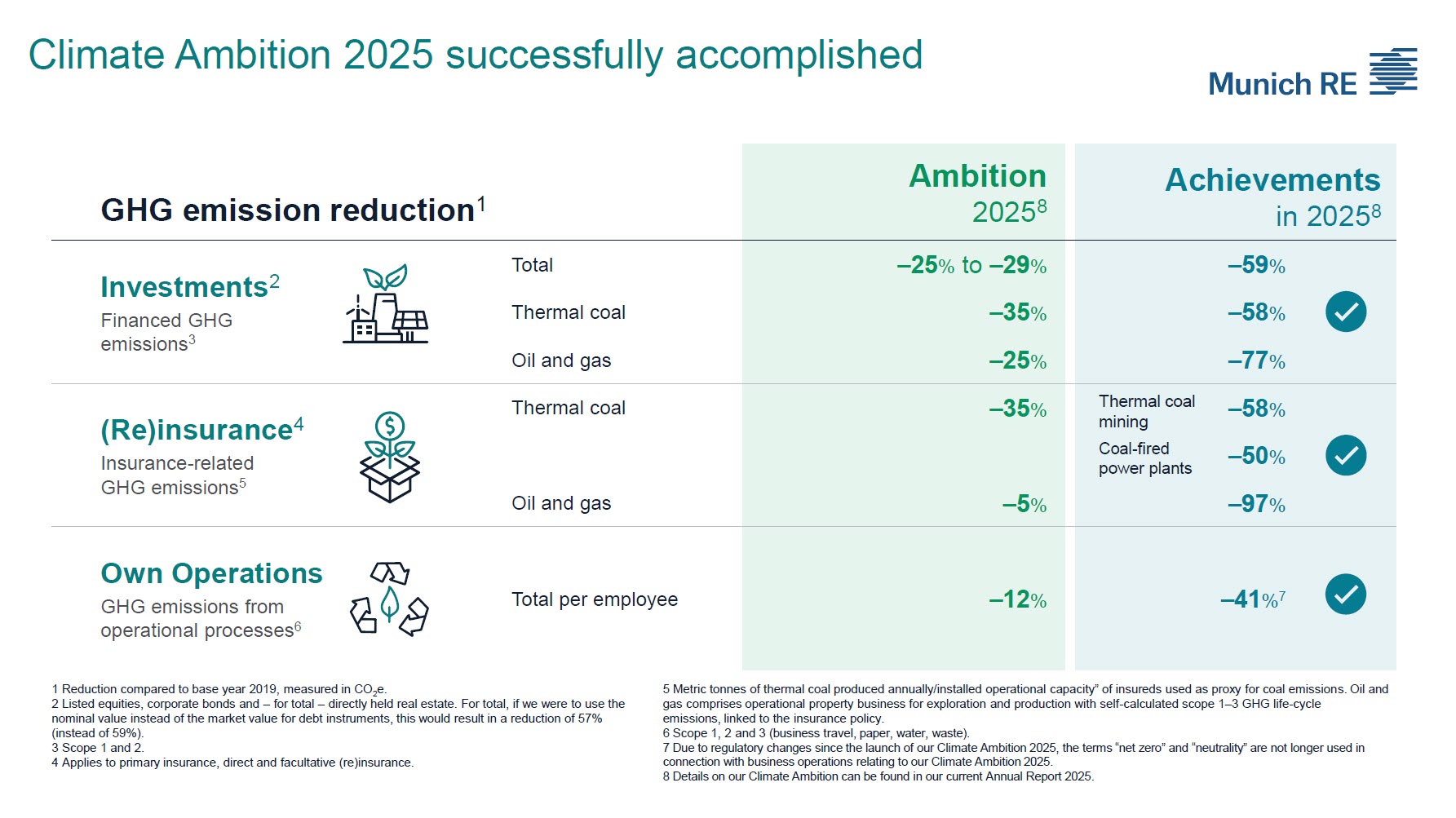
Our Climate Ambition 2025 – guided by the principles of “Scale, Shape, Succeed” – was launched in 2020, using 2019 as its base year. The Climate Ambition 2025 had three pillars: our Investments, our (Re)insurance business and our Own Operations.
In the first quarter of 2026, we disclosed the successful accomplishment of our Climate Ambition 2025.
Climate-related disclosures
As part of our Group Annual Report 2025, Munich Re has prepared a combined non-financial statement under full application of the first set of the European Sustainability Reporting Standards (ESRS).
We also recognise the importance of information in accordance with the Task Force on Climate-related Financial Disclosures (TCFD) and the International Sustainability Standards Board (ISSB):
Data sharing for analytical research focusing on enhancing adaptation to climate change
The EU Taxonomy underpins the key role the financial sector plays in the climate transformation, both as an investor and a risk carrier. In this context, the insurance industry is recognised as being in a leading position to contribute to climate change adaptation with its historic climate catastrophe loss data. For years, Munich Re has been supporting the German Insurance Association (GDV) data service with its natural catastrophe report. The report provides insights into natural catastrophe losses based on German insurers’ data and makes the information available to all interested parties (see gdv.de). Munich Re is also committed to supporting analytical research aimed at enhancing society’s adaptation to climate change at a regional, national and international level. To this end, we share relevant loss data with public authorities free of charge when requested, in line with applicable laws and regulations.
For requests covered by the Commission Delegated Regulation (EU) 2021/2139 supplementing Regulation (EU) 2020/852, Annex II, 10.1. Non-life insurance: underwriting of climate-related perils, 4. Data sharing; 10.2. Reinsurance, 4. Data sharing, please contact EUTaxonomy-DataSharing-(Pool).