Letter to Shareholders
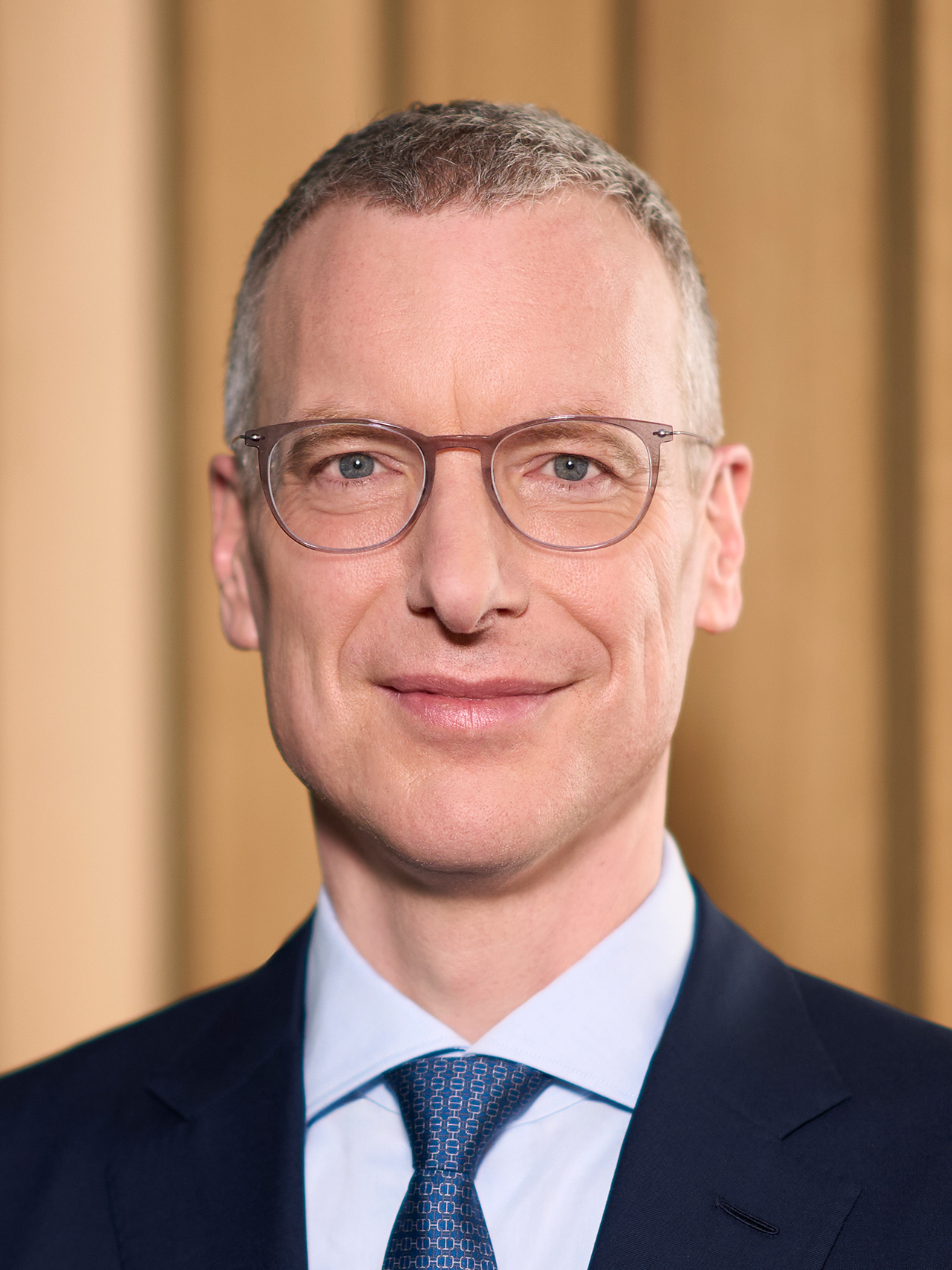
Christoph Jurecka
Chair of Munich Reinsurance Company’s Board of Management
Dear Shareholders,
The transition from last year to this year was special for Munich Re in several regards. First, our 2025 net result of €6.1bn set a new record. Second, our five-year Ambition 2025 strategy programme was brought to a successful close. And third, Joachim Wenning retired as CEO of the Munich Re Group, initiating a transition to me.
It is a great privilege for me to lead our Group into a promising future. Please rest assured that the interests of our shareholders will remain pivotal going forward. Details on that in the context of our new Ambition 2030 strategy are provided below.
But let me first look back on this past financial year and Ambition 2025. Thanks to the net result of €6.1bn in 2025, we outperformed our annual target for a fifth consecutive year. Since achieving a net result of €1.2bn in 2020, our annual profit has quintupled.¹
In parallel with our financial success, we have further strengthened our long-standing and trusting relationships with clients – as indicated by continually increasing satisfaction ratings in client surveys. I do wish to emphasise that we have grown and prospered in tandem with our clients in recent years.
Rising profits make higher dividends possible. Indeed, we will propose a dividend increase of 20% to €24.00 at the Annual General Meeting. In addition, we have already approved a share buy-back totalling €2.25bn.
You as a shareholder benefit from dividend payments, from share buybacks and from rising share prices. Already high when 2025 began, our share price rose some 16% last year. What’s more, Munich Re shares more than doubled in value during Ambition 2025, from January 2021 to December 2025. Our shares significantly outperformed both the German stock market index and the European insurance sector as a whole.
Dividends and share price performance are reflected in total shareholder return (TSR), which factors in all of a stock’s income components. This makes TSR the most important metric for measuring the appreciation of your investment. Munich Re’s total shareholder return during Ambition 2025 was 180% – an outstanding figure both in absolute terms and in a peer comparison.
TSR mirrors our commercial success. We met or surpassed every single Ambition 2025 target that we had defined five years ago. And now for some details.
Our return on equity increased from 11.9%² to 18.3%; we had aimed for 14–16%.
We were aiming to increase the earnings per share and our dividend per share by an average of at least 5% per year. And we achieved that in each and every of the five years of Ambition 2025. During the Ambition 2025 period, the increases amounted to 18.8% and 19.6%, respectively. For the solvency ratio, we had envisaged a target corridor of 175% to 220%. At the end of 2025, it was considerably higher: 298%.
We also achieved all our non-financial objectives. The percentage of women in management positions across the Group has risen to over 40%. Diversity, equity and inclusion are firmly embedded values in our organisational culture. The decarbonisation of our investment portfolio and (re)insurance business is well ahead of schedule. In this way we have made our initial contribution to achieving goals of the Paris Agreement – and we will continue doing so in the coming years. This annual report provides a detailed breakdown of the progress we have made.
We have managed to achieve all of this despite numerous challenges: initial expenditures arising from the COVID-19 pandemic and financial headwinds due to low interest rates; the war in Ukraine and the associated turbulence on capital markets, along with surging inflation and macroeconomic fluctuations; annual insured losses from natural disasters exceeding US$ 100bn a year – and the list goes on. Against a backdrop of various political and economic crises, our business model has proven to be robust, growth-driven and profitable. We also leveraged opportunities arising from a hardening reinsurance market more consistently than our competitors.
A cornerstone of our success lies in diversification, or the broad set-up of Munich Re. Our earnings power has become much less dependent on cyclical property-casualty reinsurance. More specifically, we have expanded our less volatile lines of business – life reinsurance, specialty insurance and primary insurance – and entrenched them as pivotal Munich Re Group profit pillars. Our strategic focus has paid off. And that won’t change; more about that below.
Now let’s take a closer look at the operating performance of each field of business in the year under review.
ERGO grew both its result and insurance revenue in 2025. Its segment result amounted to around €920m, some €100m higher year on year. ERGO clearly met its annual target.
There was a substantial rise in insurance revenue, particularly in international business, attributable primarily to property-casualty business in Poland, Austria and Thailand as well as health business in Belgium. Moreover, two international companies are fully included in the figures for the first time: Norwegian health insurer ERGO Forsikring AS (wholly owned by ERGO since 2024)³ and the US digital insurer Next Insurance Inc.⁴, which Munich Re successfully acquired in full in 2025. Thanks to the latter acquisition, ERGO’s presence in the US market has facilitated positioning in the attractive customer segment for small and medium-sized businesses (SMBs). These developments, along with other factors, create the ideal conditions for further profitable growth in the years to come.
Insurance revenue likewise grew in Germany, primarily attributable to life and travel insurance as well as health business. Property-casualty revenue rose slightly year on year thanks to growth in fire, property, and motor insurance.
Reinsurance profitability remains excellent. The segment’s result increased to €5.2bn in 2025, with slightly declining insurance revenue of €38.7bn – which reflects both the outstanding quality of our portfolio and our underwriting discipline.
For the 2025 financial year, we are reporting on our specialty insurance business – Global Specialty Insurance (GSI) – as a separate segment within the reinsurance field of business for the first time. This change reflects the increased – and still growing – significance of this line of business for our Group. GSI’s growth momentum remains robust, even though 2025 insurance revenue was slightly lower than in the previous year due to unfavourable currency developments. With a combined ratio of 86%, GSI’s profitability last year outperformed high expectations.
The same is true of the property-casualty reinsurance segment. The combined ratio for 2025 was an excellent 74%, a full five percentage points better than initially anticipated. The principal reason for this was, as with GSI, low major-loss expenditure. Although wildfires, flooding and severe thunderstorms once again led to insured losses in excess of US$ 100bn, no severe hurricanes struck the US mainland. As such, (re)insurers were spared the repercussions of this peak risk materialising. Our insurance revenue was lower year on year. This simply reflects our uncompromising commitment to profitability over growth in a market environment subject to intensifying competition.
The life and health reinsurance segment continued to develop very favourably this past year, in line with expectations. The total technical result of €1.7bn perfectly matched our ambitious forecast. In particular, major transactions involving life portfolios in North America and longevity business in the UK helped to fuel growth. The contractual service margin, which reflects expected future profits, continued to increase despite currency headwinds. This demonstrates just how strong new business in this segment is and, consequently, our prospects as well.
As for our investments, we once again benefited in 2025 from the reinvestment yield on fixed-interest securities being higher than the running yield. In other words, our investment income rose without us having to take any additional risks. We deliberately accelerated this advantageous process by selling fixed-interest investments before maturity and reinvesting in instruments with higher fixed interest rates. We also increased the contribution of active investment measures to returns by, for example, expanding alternative investments. All in all, we achieved a return on investment of 3.2% in 2025.
Simply put, we can look back on not just one good year, but five extremely successful years. This will be an excellent launch pad for the next five years. Our new Ambition 2030 strategy programme will indeed take off from a position of strength. And our new targets set the bar very high.
What exactly do we intend to accomplish? Munich Re is aiming for one of the highest returns on equity in the market: more than 18% by 2030. We will also strive for average earnings per share growth of more than 8% per year. And the Solvency II ratio is to remain above 200%. Of particular interest to shareholders: for the first time, we are making an explicit pledge to return capital. We aim to increase our total payout ratio⁵ from an average of 75% over the past five years to over 80% per year.
We also remain committed to our existing climate targets and will introduce new ones. For instance, we will phase out all capital investments involving thermal coal by the end of 2030 instead of 2040. Munich Re will also continue to advance diversity, equity and inclusion, with a focus on local requirements and circumstances.
How do we plan to meet our targets? The answer lies in our business mix. Although many people still regard Munich Re as a property-casualty reinsurer only, we are much more than that. In the coming years, we will evolve even more assertively as a diversified insurance group that offers reinsurance, specialty insurance, and primary insurance at scale. That is the core of our strategy. It will make us even less susceptible to market fluctuations going forward.
But what will that mean in practice? At present, life and health reinsurance, GSI and ERGO account for approximately 50% of the Group’s net result. Guided by Ambition 2030, we will grow that contribution by around ten percentage points to about 60% in 2030. Property-casualty reinsurance will remain the strong backbone of our Group.
Ambitious growth plans will make that possible. In life and health reinsurance, we will begin offering cover against longevity risks for customers in North America and Japan. We will also collaborate with asset managers to execute more major transactions involving life portfolios. In specialty insurance, we will launch new products and offer cover to customers in Asia and continental Europe. A key growth initiative at ERGO involves the integration and scaling of ERGO Next in the promising growth market for small businesses.
Doing so will enable us to enhance both the absolute size and the relative stability of our Group’s net result.
But this is predicated on us sustaining our strong operating performance in all segments. That is the foundation of our success. In terms of Ambition 2030 this will mean, first of all, tapping into opportunities for profitable growth. Second, we will streamline our processes and boost cost efficiency by systematically deploying artificial intelligence, among other things. And third, Munich Re will grow its investment result by gradually assuming greater investment risk – for instance, by steadily expanding our alternative investments.
All these concerted commitments allow us to set our targets for the current financial year, including a net result of €6.3bn and insurance revenue of around €64bn. We also plan to realise cost savings of €200m across the Group and increase the return on investment to above 3.5%.
As you can see, Munich Re will clearly remain an exceptionally attractive long-term investment. Together with my fellow Board of Management members and 44,000 staff members throughout the Group, I as CEO will do all I can to make sure that Munich Re remains among the very best worldwide.
With Ambition 2030 as our road map, we will drive the Group further forward in 2026. Thank you for joining us on this journey.
Sincerely,
Christoph Jurecka
² 2020, normalised value.
³ In 2025, the Norwegian company ERGO Forsikring AS was merged with the Danish travel insurance company Europæiske Rejseforsikring A/S to form a single company: ERGO Forsikring A/S.
⁴ The company has been operating on the market as ERGO Next since January 2026.
⁵ Total payout ratio is defined as the sum of the announced dividend payment and share buy-back, divided by the IFRS net result.