
It’s better to treat the cause than the symptoms. But then, you knew that already!
With Location Risk Intelligence, you spot climate risks long before they turn into serious problems.
Climate-related risks are among the most pressing challenges facing the healthcare sector in the 21st century – ranging from flooded hospitals to medicine shortages.
For organisations in the healthcare and life sciences sector, the focus is no longer just on long-term resilience. It’s about maintaining operational capability now: how can you ensure infrastructure reliability, product quality, supply security and regulatory compliance under changing climate conditions?
According to a recent Deloitte survey, 88% of life sciences CEOs named production and logistics issues as their top challenges1 – a trend that will only intensify as extreme weather events like floods, heatwaves and storms become more frequent.
At the same time, medical institutions are – quite literally – fighting to save lives. Between 2000 and 2019, heat-related mortality among people aged over 65 increased by 53% – a dramatic rise that clearly illustrates the direct impact of the climate crisis.²
With Munich Re’s Location Risk Intelligence, you can assess risks at the level of the individual location and make robust decisions – whether in relation to hospitals, manufacturing facilities, supply chains or investment projects. With Location Risk Intelligence by Munich Re, you can assess your organisation’s exposure to climate risks at individual locations – and build a solid foundation for resilient decisions in the energy sector.
Sources: 1Deloitte 2023 Global Life Sciences Outlook | 2Lancet Countdown Report 2020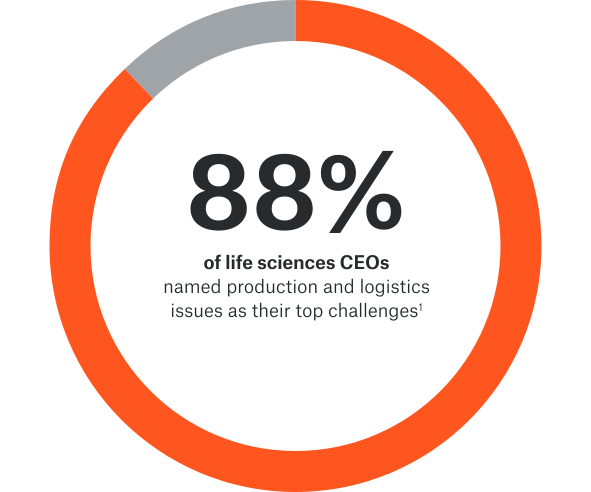
Turn the five biggest challenges in healthcare & life sciences into five strategic advantages
From operational failures to global supply disruption: climate-related risks now rank among the top business risks for the healthcare sector. Extreme weather, rising regulatory pressure and long-term planning challenges demand a new kind of management: data-driven, forward-looking and resilient.
With Location Risk Intelligence from Munich Re, you transform these challenges into strategic assets – scientifically sound, scalable and location-specific.
1. Protect your infrastructure – and secure long-term operational continuity and product quality
Many hospitals, labs and production facilities were originally built under climatic assumptions that no longer hold true. Floods, storms and heatwaves are increasing in frequency and intensity – along with the risks they pose to patients, infrastructure and operations. Knowing your risk exposure enables you to prevent damage, protect staff and patients, and invest in the right places.
How to protect your infrastructure with precision:
- For infrastructure managers: Detect location-specific vulnerabilities based on 80+ scientifically validated hazard indicators – including mapping, probability scores and scenario modelling.
- For technical managers: Use climate scenarios up to 2100 (SSP/IPCC) to assess existing buildings – and derive concrete requirements for retrofits, new construction and protective upgrades.
- For healthcare investors: Analyse climate risk exposure with detailed risk scores and investment decision tools – location by location.
2. Minimise climate-related supply chain risks – and ensure reliable access to medicines
Supply chains in the pharma and medtech sectors span multiple continents – they’re complex, efficient, but highly vulnerable. When an earthquake shuts down transport routes or a hurricane strikes a production facility, the availability of active ingredients or critical medical components can be severely impacted. Temperature-sensitive products like insulin or blood plasma rely on stable cold chains – and extreme weather can cause product degradation or outright loss.
Just one weather-related event can trigger disruptions, delays or quality issues throughout the entire supply chain – with direct consequences for production, supply reliability and ultimately patient care.
How to build supply chain resilience – step by step:
- For procurement teams in pharma & medtech: Analyse supplier exposure using location-specific risk assessments backed by global data coverage.
- For logistics teams: Identify climate-sensitive weak points across your transport infrastructure and simulate disruption scenarios using interactive map tools.
- For third-party risk managers: Evaluate external sites using standardised risk scores – including the expected severity of damage.
3. Plan ahead for changing healthcare challenges – and safeguard your care delivery and research strategy
Climate change affects not only infrastructure but entire healthcare systems themselves: heatwaves are driving up case numbers, new disease patterns are emerging, and existing treatments are losing effectiveness. Diseases like dengue fever and West Nile virus are spreading into regions previously unaffected – including parts of Europe. To prepare for these shifts, you need reliable data to plan preventive measures, allocate resources and respond strategically to new health challenges.
How to future-proof your healthcare delivery and research:
- For public health departments: Use regional climate scenarios to forecast heat- or disease-related strain on healthcare systems over the coming decades.
- For strategic planning teams: Combine historical damage data with future models to identify risk-prone regions and potential capacity bottlenecks early.
- For pharma R&D: Link climate scenarios with epidemiological data – to guide your drug development pipeline and market entry strategies.
4. Meet ESG and reporting requirements – and build trust with regulators, investors and the public
Reporting requirements for physical climate risks are increasing – both nationally and internationally. From CSRD and ISSB to TCFD and the EU taxonomy, expectations around transparency and traceability are rising fast.
In the healthcare sector – where critical infrastructure, supply chains and investment projects are at stake – organisations need a solid, auditable data foundation. Those working with consistent risk analyses today will save time and money tomorrow – and avoid reputational damage.
How to meet reporting requirements efficiently and in an audit-compliant way:
- For ESG managers: Create complete, auditable climate risk reports (CSRD, ISSB, TCFD, EU Taxonomy) directly from the software – with scenario context, risk scores and export options.
- For compliance officers: Use validated risk metrics and loss estimates to demonstrate compliance and fulfil your regulatory duties.
- For sustainability and finance teams: Link physical climate risks to KPIs such as asset value, downtimes or recovery costs.
5. Keep your operations running – even during extreme weather events
Whether it’s hospital operations, pharmaceutical production or logistics hubs – without resilient infrastructure and functioning supply chains, fast response is impossible. But climate-related disruptions are on the rise: flooded utility rooms, overheating of cooling systems, power outages.
With precise, location-based risk assessments, you can prevent service interruptions, improve emergency planning and safeguard vulnerable operations before damage occurs.
How to safeguard critical processes – even in extreme weather:
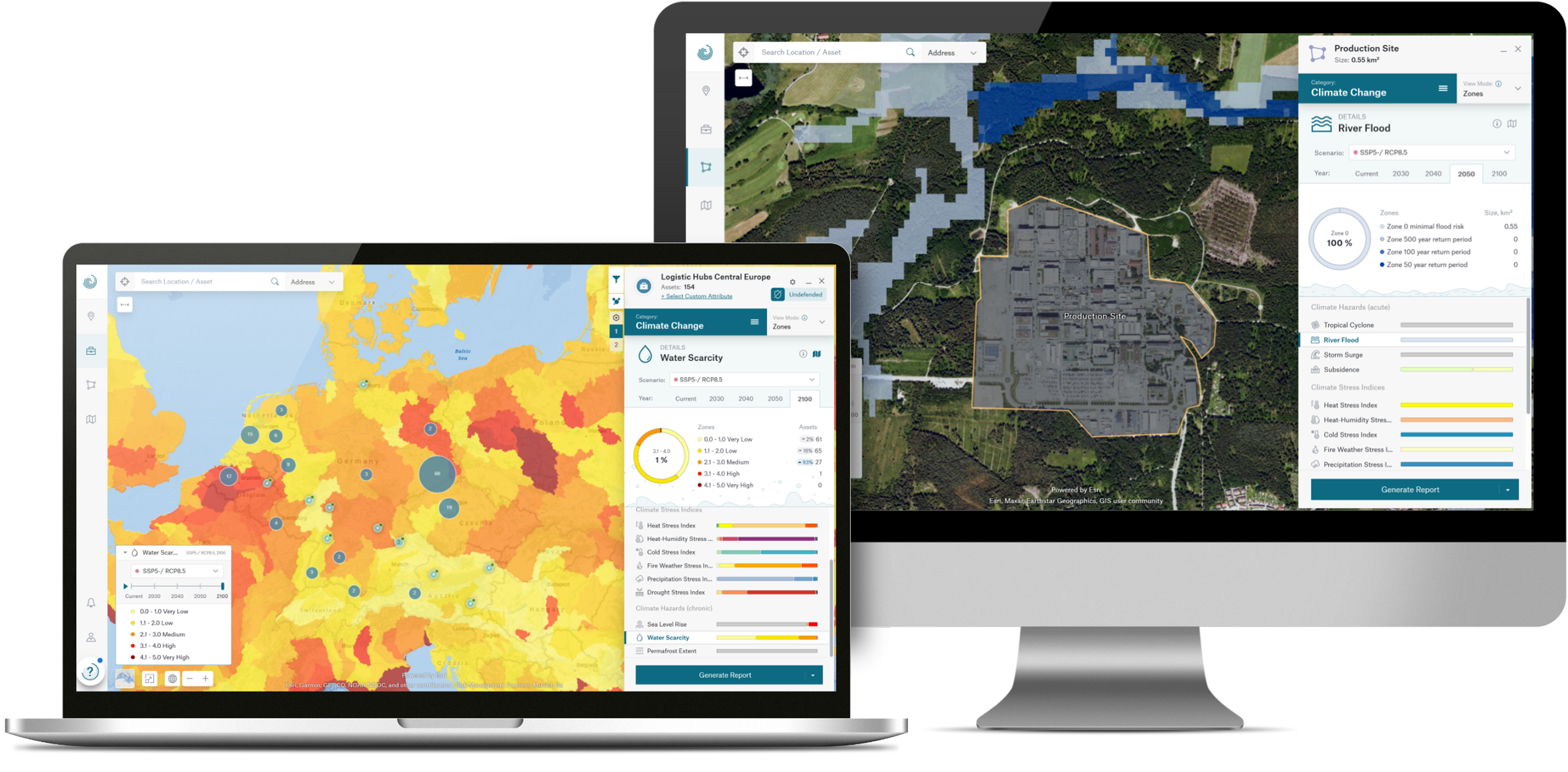
- For operations and facility managers: Visualise weather-related risks at individual locations using risk maps – and develop protective measures directly on the basis of the results.
- For business continuity teams: Simulate climate scenarios and incorporate restart strategies for critical infrastructure into your continuity planning.
- For control centres and supply units: Monitor the risk exposure of your key assets. With traffic-light style indicators, you can easily track portfolio risk levels and act accordingly.
Your benefits from Location Risk Intelligence
Identify vulnerabilities early – across hospitals, labs and supply chains
Whether it’s a hospital, laboratory or global logistics hub – the platform shows you exactly where climate risks may affect your operations, and what action to take.
Make decisions based on robust scientific data
Location Risk Intelligence is powered by over 140 years of natural-hazard expertise – including 80+ validated indicators, climate scenarios projected up to the year 2100 and global data coverage.
Invest smartly – with a clear view of risk and resilience
Simulate the impacts of heatwaves, storms or flooding, and design future-proof investment strategies for new or existing locations.
Fulfil ESG and reporting requirements reliably and efficiently
Create CSRD-, ISSB-, and TCFD-compliant reports with just a few clicks – complete with transparent sourcing and audit-ready metrics.
Stay operational – even during extreme weather events
Embed climate risk into your daily operations: from emergency plans to strategic maintenance – all based on precise location-level assessments.
Earn trust from auditors, investors and partners
Demonstrate to customers, partners, regulators and the public that your climate strategy is data-driven and credible.
Strengthen your supply security and climate resilience – with forward-looking, data-based insights. Talk to our experts today.
The strength of Munich Re’s solution for locational intelligence was a key reason for its top 3 placing in our inaugural ClimateRisk50 ranking. Also important was its ability to provide applications and solutions to suit a variety of industry sectors, including insurance, banking, real estate and manufacturing.


How Location Risk Intelligence supports you in day-to-day operations across healthcare and life sciences
The modular software solution supports you with its dedicated data editions in integrating climate-related impacts into your strategic, operational and regulatory decision-making. Whether you manage a hospital network, laboratory operations, a production facility or a global supply chain – you gain access to precise analyses, climate scenarios and reports to assess and manage the impact of natural hazards and climate change.
By entering individual locations or entire asset portfolios into Location Risk Intelligence, you can analyse and compare climate and natural hazard risks – and generate meaningful, ready-to-use reports. This enables you to identify both current and future risks, as well as their financial implications – providing a solid basis for resilience strategies, investment decisions and regulatory reporting.
Climate Change Edition
With Climate Change Edition you can assess how strongly your hospital locations, laboratories or production facilities are exposed to climate risks – now and in the future.
The Edition analyses each location’s exposure to acute events such as heavy rainfall, heatwaves or storms – as well as to chronic stressors like water scarcity or rising temperatures.
Based on 13 climate indicators and four IPCC-aligned scenarios up to the year 2100, you can create robust risk assessments, identify regional differences and derive targeted measures for site selection, retrofitting or securing service continuity. Unlike traditional models, this Edition incorporates not only historical data but also projected changes in frequency and intensity – making it ideal for resilience planning and investment certainty.
Climate Financial Impact Edition
Climate Financial Impact Edition helps you to make a better assessment of the potential financial consequences of extreme climate-related events – such as production downtime, infrastructure damage or asset loss at critical locations.
It combines high-resolution risk data with one of the world’s most comprehensive natural catastrophe models – built on over 140 years of reinsurance expertise. This gives you a solid estimate of the Climate Expected Loss (CEL) per location – providing a reliable basis for resilience investments, insurability assessments and emergency planning.
Reporting Edition
With Reporting Edition you can fulfil your ESG and climate disclosure obligations quickly, accurately and in an audit-compliant way. Generate fully compliant reports on physical climate risks – for the CSRD, ISSB, TCFD and the EU Taxonomy.
All risk analyses are based on transparent methodologies and auditable scores, and can be conveniently exported as PDF or CSV files, or via API to your existing reporting systems. This helps you save time and reduce errors – whether it’s for your annual report, your sustainability disclosures or responses to auditors, investors or regulators. Especially valuable for ESG teams, compliance officers and sustainability managers.
Take action now to protect not just your entire infrastructure, but also lives.
With Location Risk Intelligence from Munich Re, you can prepare for climate-related challenges in good time, strengthen healthcare delivery, and turn risk data into informed decisions.